
Over the last few months, I’ve been spending a lot more time researching AI-related crypto projects.
Not because AI is trending.
Not because influencers keep posting about it every day.
And definitely not because every chart with “AI” in the name suddenly pumps during market hype.
I started researching deeper because I honestly think we are entering a period where AI will slowly become part of almost everything people do online.
Trading.
Content creation.
Gaming.
Automation.
Business workflows.
Data analysis.
Digital identity.
Even the way people interact with applications themselves.
And once you start thinking from that perspective, you realize something important:
The biggest long-term winners may not simply be AI applications.
The real value could come from the infrastructure layer powering the entire AI economy.
That’s exactly why @OpenLedger started catching my attention recently.
At first glance, I honestly assumed it was another project trying to combine AI and blockchain because the narrative is hot right now. We’ve seen countless projects do that already.
Most sound exciting at the beginning.
But once you dig deeper, many of them feel very surface level.
Some are just attaching AI branding to existing products.
Some depend entirely on centralized systems behind the scenes.
Others focus more on short-term token speculation than solving actual infrastructure problems.
But after researching OpenLedger more carefully, I started realizing the project seems to be approaching the sector differently.
And personally, I think that difference matters more than most people realize right now.
The current AI industry has a serious structural problem.
The people contributing data often don’t own anything.
The communities helping models improve rarely capture long-term value.
Developers build on closed systems they don’t control.
Most monetization flows toward centralized platforms controlling the infrastructure.
Meanwhile, users continue generating enormous amounts of valuable information every single day without meaningful ownership over how that value is distributed.
That model may work temporarily.
But I don’t think it scales well long term once AI becomes deeply integrated into global digital economies.
This is where OpenLedger becomes genuinely interesting to me.
Instead of treating blockchain as a marketing layer, OpenLedger appears focused on building an actual AI-native blockchain infrastructure where models, datasets, and autonomous agents can interact directly on-chain.
And I think that changes the conversation completely.
Because once AI systems become capable of operating autonomously, infrastructure suddenly becomes extremely important.
You need transparency.
You need ownership verification.
You need coordination between agents.
You need monetization systems.
You need trusted execution environments.
You need economic alignment between contributors and networks.
Without proper infrastructure, AI ecosystems eventually become fragmented, opaque, and heavily centralized.
And honestly, I think this becomes even more important when you look at trading itself.
Most AI trading discussions today still revolve around prediction.
People obsess over signals, market direction, trend forecasting, and which AI model supposedly predicts price movements better than everyone else.
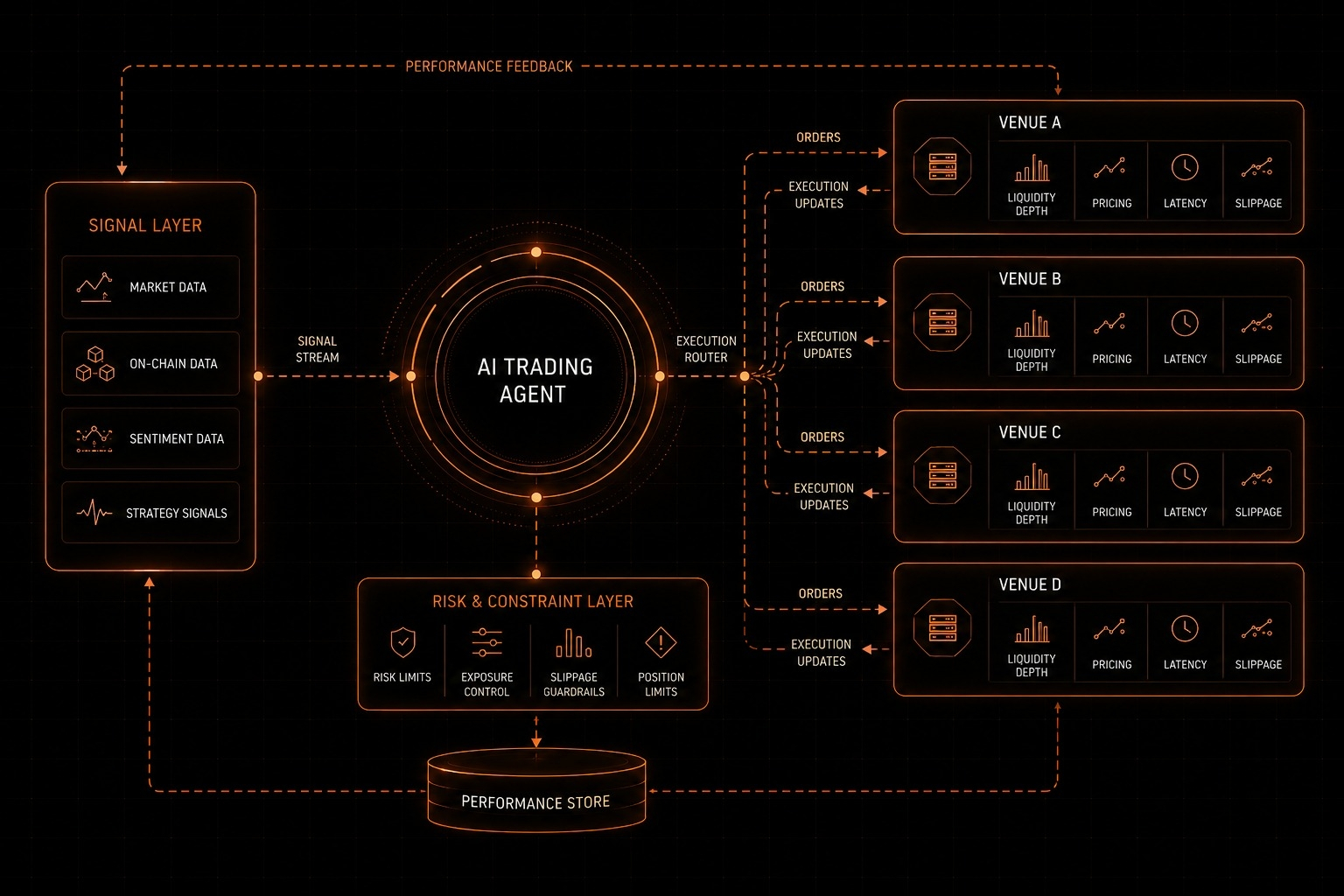
But in fragmented on-chain markets, I think the real differentiator is increasingly becoming execution.
Because prediction alone is no longer enough.
As autonomous systems mature, the entire stack starts shifting toward execution quality itself:
Signal ingestion.
Risk management.
Routing logic.
Cross-venue coordination.
Liquidity access.
Continuous feedback systems.
That’s where things start becoming much more interesting.
In on-chain trading environments, execution is no longer just a backend process people ignore.
Execution itself becomes part of the edge.
And personally, I think that’s one of the biggest long-term opportunities around AI infrastructure most people still underestimate.
As autonomous agents become more active across decentralized systems, infrastructure capable of coordinating decisions, transactions, and data flows efficiently could become incredibly valuable.
That’s one of the reasons I think the infrastructure narrative around AI could become significantly bigger over the next few years.
Most people still focus only on applications because applications are easier to understand quickly.
But infrastructure quietly captures long-term value underneath entire industries.
Crypto itself already proved that.
People once ignored blockchain infrastructure projects because they seemed “boring” compared to hype narratives. Later those same infrastructure layers became some of the most important parts of the entire ecosystem.
I honestly think AI could follow a similar path.
And OpenLedger feels positioned closer to the infrastructure side of the market than the temporary narrative side.
Another thing I personally find interesting is the way OpenLedger approaches on-chain ownership and monetization around AI participation itself.
That concept matters a lot more than people currently realize.
Right now AI systems are becoming smarter extremely fast, but economic ownership around AI still feels very concentrated.
A small number of centralized entities control most large-scale models, compute resources, and monetization layers.
Open systems eventually become important because contributors want economic exposure to the value they help create.
We already saw similar dynamics happen in crypto, social media, creator economies, and open-source software communities.
People increasingly want participation, transparency, and ownership instead of simply feeding value into closed ecosystems forever.
That shift could become one of the defining trends of decentralized AI over time.
And from my perspective, OpenLedger seems to understand that direction early.
I also think the Ethereum compatibility side is extremely underrated here.
A lot of projects underestimate how important developer accessibility becomes during adoption phases.
Developers already understand Ethereum tooling.
Wallet infrastructure already exists.
Liquidity infrastructure already exists.
Smart contract standards already exist.
Integration pathways already exist.
Reducing friction for developers matters massively.
Because no matter how strong a vision sounds, adoption becomes difficult if builders need to relearn entirely new systems from scratch.
OpenLedger integrating with familiar ecosystems could make expansion much smoother later if developer activity continues growing.
Another thing I personally appreciate is that the project feels more focused on building foundational systems instead of relying entirely on hype cycles.
And honestly, that’s becoming rare in crypto.
A lot of projects today optimize for short-term attention.
Temporary engagement.
Fast speculation.
Narrative momentum.
But infrastructure projects usually operate differently.
They often move slower initially because infrastructure takes time to build properly.
The market usually ignores them in early stages because infrastructure is harder to market emotionally compared to fast-moving narratives.
But over time, infrastructure becomes the layer everything else depends on.
That’s why I’ve personally become much more interested in projects building long-term coordination systems instead of simply chasing temporary excitement.
Of course, none of this guarantees success.
The AI sector is still early.
Competition will become extremely aggressive.
Execution matters more than narratives.
And every emerging market carries risk.
But if decentralized AI continues expanding, I strongly believe infrastructure projects will eventually become some of the most important pieces of the ecosystem.
And from everything I’ve researched recently, OpenLedger genuinely feels like one of the projects trying to build that foundation instead of simply marketing around it.
That’s my personal takeaway after digging into the project.
Still early.
Still developing.
Still speculative.
But definitely one of the more interesting AI infrastructure plays I’ve been watching lately.