
A few days ago, I watched a man at a local office trying to sort out a simple issue with his documents. He had all the papers, waited patiently, and followed every instruction. Still, every counter seemed to tell him something different. Someone who arrived later somehow finished first, while others kept standing there, confused about what rule they had missed. What stayed with me was not just the delay, but the feeling that effort and reward were somehow disconnected. People were participating in the system, yet many did not seem to benefit from it fairly.
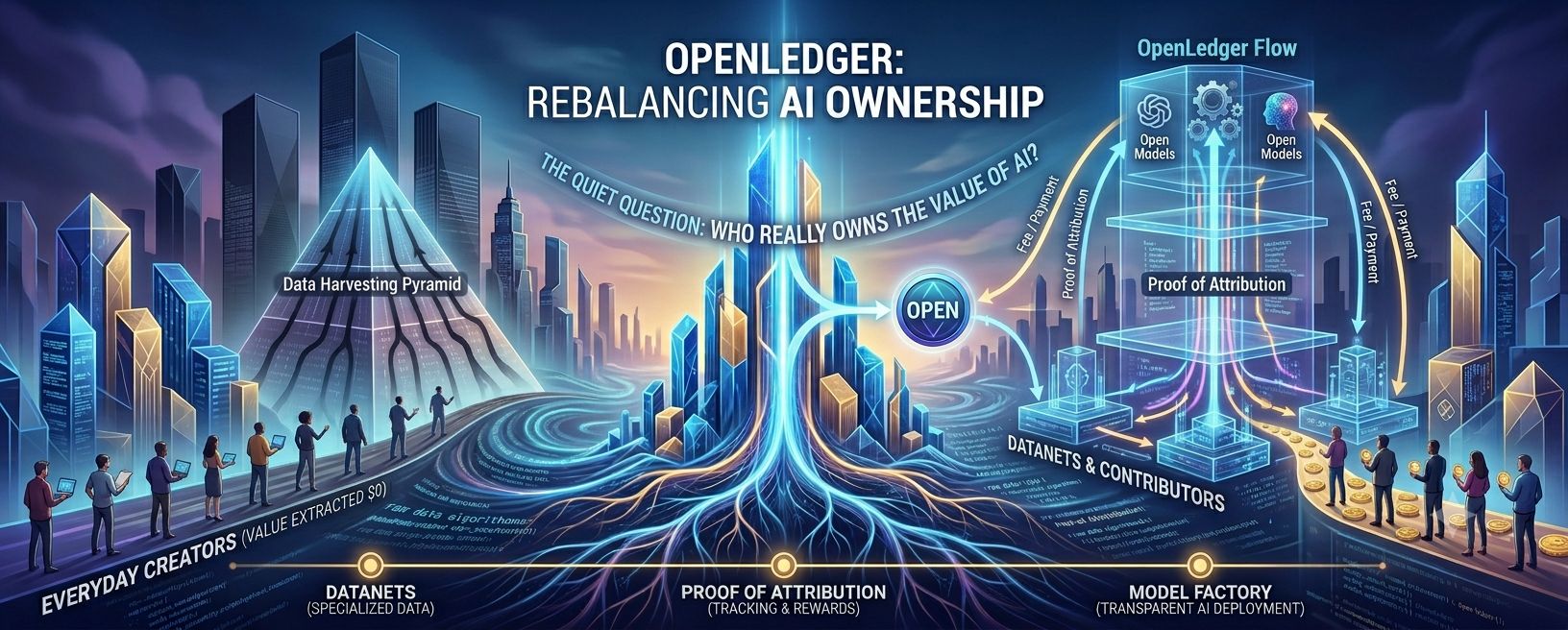
The more I look at OpenLedger (OPEN), the more that memory comes back to me. At first, an AI blockchain designed to unlock liquidity for data, models, and agents sounds highly technical. But underneath the terminology sits a surprisingly human question: when many people contribute to creating something valuable, who should actually benefit from it?
AI today often feels like a system built on invisible contributions. Millions of people generate data, developers improve systems, researchers push boundaries, and users constantly interact with intelligent tools. Yet when value is created, it often feels concentrated in a few places. Most people help shape the machine, but only a small number seem to control the outcome.
I keep noticing how many projects in this space focus on attention rather than structure. Big promises are easier to sell than difficult questions. Everyone talks about smarter AI, faster systems, or industry disruption, but fewer people stop to ask how value should move through these systems in the first place. If AI becomes increasingly powerful, does it make sense for ownership to stay so narrow? And if contribution matters, how should it even be measured?
This is where OpenLedger starts to feel different. Not necessarily better in every way, but different in what it seems to care about. Instead of only focusing on building intelligence, it appears interested in the economic layer around intelligence — creating ways for data, models, and agents to hold value and potentially be monetized.
That idea feels important because it shifts the conversation. Instead of asking only, “What can AI do?” it quietly asks, “Who benefits from what AI creates?”
But meaningful ideas often come with uncomfortable trade-offs.
The reality is that fairness is hard to design. Systems that try to reward contributions fairly can become slow, complicated, or vulnerable to manipulation. If OpenLedger creates financial incentives around participation, what happens when people focus more on rewards than quality? Can openness remain useful if everyone is optimizing for profit? And how do you truly measure the worth of someone’s contribution in something as complicated as artificial intelligence?
There is also a deeper tension that feels impossible to ignore. In the real world, efficiency and fairness rarely walk together comfortably. Efficient systems often become centralized because decisions move faster that way. Fair systems usually require patience, transparency, and extra complexity. So where should the balance sit? Can OpenLedger stay open without becoming messy? Or could it slowly become another system where power quietly gathers in fewer hands over time?
These are not criticisms as much as they are honest questions. Because history has shown us that even good ideas can drift away from their original purpose. Systems built around inclusion sometimes become exclusive. Projects designed for communities can eventually favor insiders. Human behavior has a way of reshaping technology in unexpected ways.
Still, I think there is something meaningful in what OpenLedger is trying to explore. Not because it promises certainty, but because it seems willing to challenge assumptions that many others ignore. The future of AI may not only depend on smarter machines, but on whether the systems around those machines feel fair, sustainable, and genuinely participatory.
And maybe that is the part people are quietly underestimating. The real story may not be about another blockchain or another AI narrative. It may be about a much larger question hiding underneath: in a world increasingly shaped by intelligence, who gets to share in the value it creates?
That question feels bigger than any trend, and far more exciting than short-term noise. Because if projects like OpenLedger can even partially rethink how value moves in AI, they may help shape something much more important than attention — they may influence the rules of tomorrow’s digital economy in ways we are only beginning to understand.@OpenLedger $OPEN #OpenLedger