
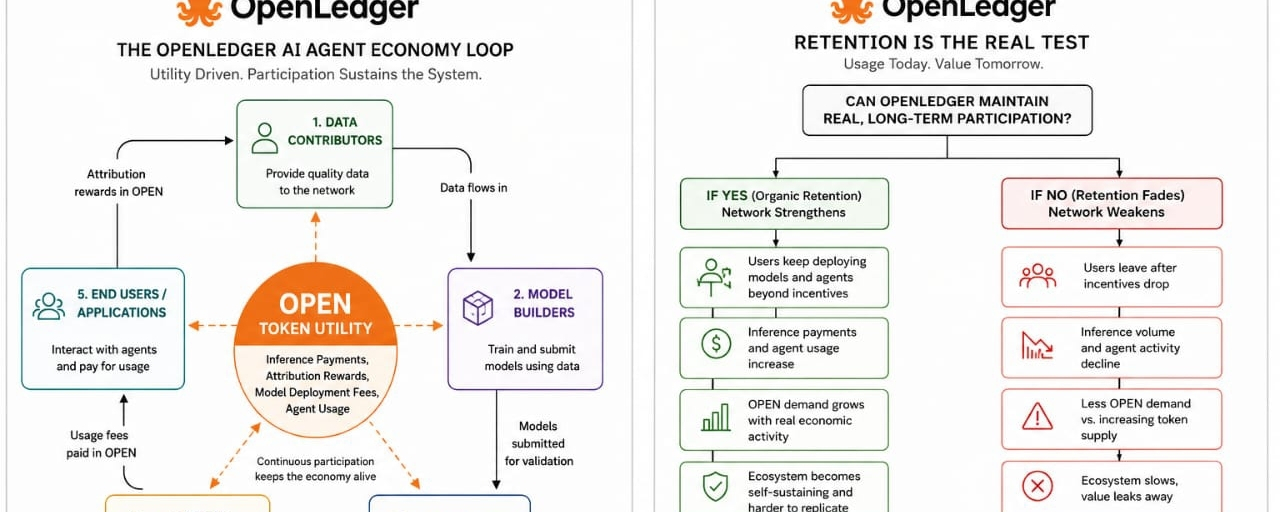
@OpenLedger I remember staring at the OPEN chart at around 2 a.m. a few weeks after the mainnet launch and realizing I had spent more time tracking wallet activity than price candles. That’s usually a weird sign for me. When I stop caring about short term pumps and start watching whether people are actually coming back to use something, it means the project probably has more depth than the average AI narrative token.
That’s honestly my first real impression of openledgerand its AI agent push right now. Not excitement. Not disbelief. More like cautious curiosity.
Because here’s the thing nobody wants to admit during AI runs. Most AI agent projects don’t really have a retention model. They have a launch model. There’s a difference. You can attract users with a flashy demo and a token incentive campaign. Keeping them active six months later is the hard part. That’s where projects quietly die while CT keeps pretending they’re alive.
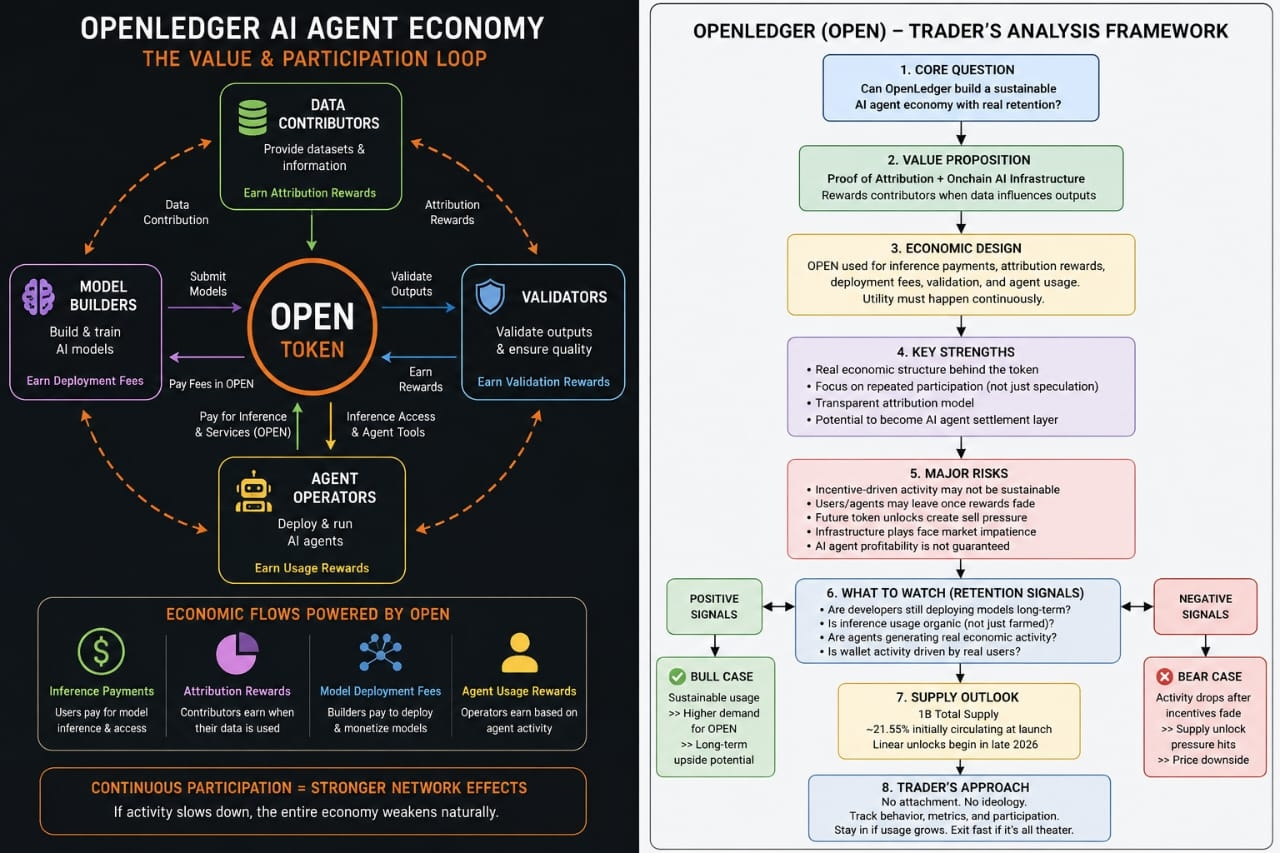
What surprised me about OpenLedger is that they at least seem aware of this problem. Their whole structure is built around repeated participation. Data contributors, model builders, validators, agent operators. The system only works if people continue feeding it activity over time. OPEN isn’t just supposed to sit in wallets waiting for price appreciation. It’s tied to inference payments, attribution rewards, model deployment fees, and agent usage across the network.
That sounds abstract until you think about it like this. Most crypto ecosystems reward speculation first and utility second. OpenLedger is trying to force utility to happen continuously or the token economy weakens naturally. As a trader, I actually respect that design choice even if it creates short term friction.
But I’m still conflicted. I’ve traded enough AI related tokens to know that “usage” metrics can become theater very quickly. Wallet activity gets farmed. Incentives distort behavior. People run agents because rewards exist, not because the product matters. OpenLedger’s biggest challenge is proving that its agent economy can survive after the incentive sugar rush fades.
That’s the retention problem again. And honestly, this matters more than TPS numbers or partnership announcements.
OpenLedger currently has a 1 billion total token supply with only about 21.55% initially circulating at launch. That’s manageable right now, but traders ignoring future unlock pressure are making a mistake. Starting later in 2026, investor and team allocations begin unlocking on a linear schedule. If network activity doesn’t grow fast enough to absorb that supply, price action could get ugly fast.
And this is where my frustration starts. I actually like the core idea behind Proof of Attribution. Contributors getting paid when their data influences model outputs makes intuitive sense. It’s one of the few AI token concepts where I can explain the value loop to another trader without sounding delusional. But OpenLedger still feels very infrastructure heavy. There’s a real risk the market gets bored before the ecosystem becomes sticky enough.
Infrastructure plays are slow. Traders are impatient. That tension matters. The bull case is pretty straightforward though. If OpenLedger becomes a genuine settlement layer for AI agents and onchain inference, OPEN could justify much larger transactional demand than people currently model. The project is already pushing the idea of agents operating economically onchain with attribution and auditability baked in. If even a fraction of AI driven automation in trading, analytics, or enterprise tooling moves toward transparent settlement systems, this category could expand hard over the next two years.
And unlike meme driven AI coins, OpenLedger at least has a visible economic structure behind it.
Still, I’m cautious because AI agents themselves are not guaranteed to become profitable users. That’s the hidden assumption behind this whole sector. People talk about autonomous agents like adoption is inevitable, but a lot of these systems are still expensive, inefficient, and unreliable under real conditions. Even recent research on live trading agents showed that reliability problems only improved after heavy operational controls and constant iteration.
That’s why I’m watching retention metrics more than announcements now. Are developers still deploying models three months later? Are users paying for inference without farming incentives? Are agents actually generating economic activity or just simulated activity?
Those answers matter more than another roadmap graphic. I’m not buying the fantasy that OpenLedger suddenly dominates AI infrastructure overnight. But I also don’t think this is another empty AI ticker with nothing underneath it. There’s at least a serious attempt here to solve a real coordination problem between data, models, and economic incentives.
For me, that’s enough to keep tracking it closely. But if participation drops once rewards cool off, or if usage starts looking artificial instead of organic, I’ll probably exit fast. No attachment. No ideology. Just numbers and behavior.