
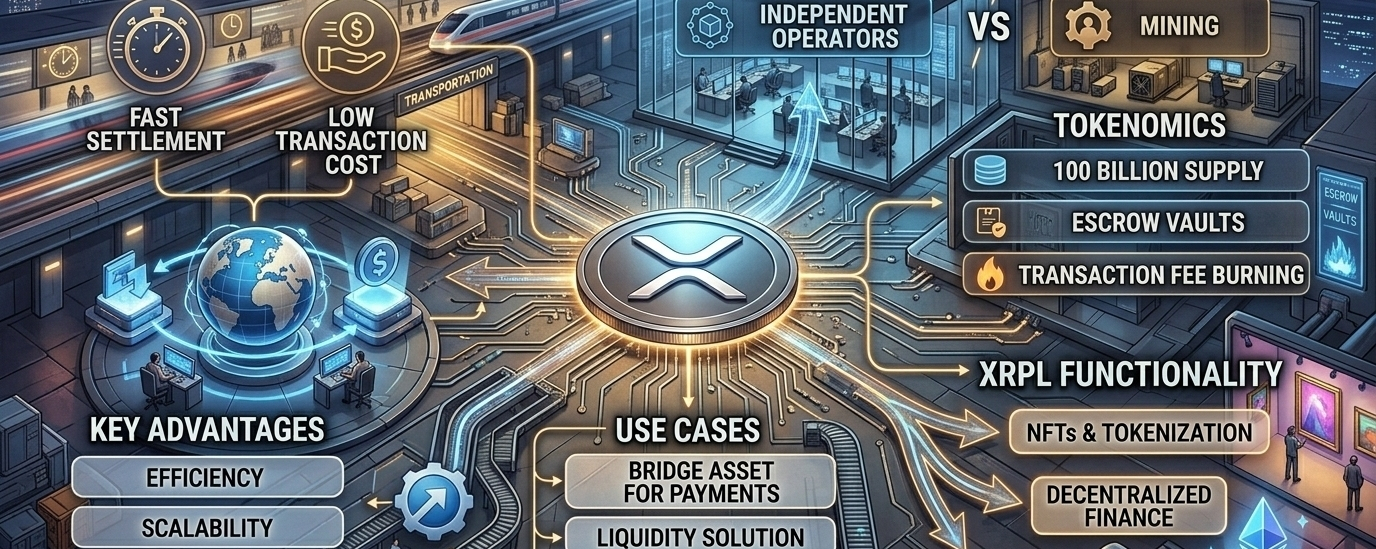
XRP has always felt different from most cryptocurrencies in the market. While many blockchain projects chase hype, trends, or speculation, XRP was built around one primary goal: making global payments faster, cheaper, and more efficient.
When I first discovered XRP years ago, I honestly didn’t understand why it had such a massive following. Back then, the crypto space was dominated by mining discussions, meme coins, and endless price predictions. XRP didn’t fit that culture. Instead of focusing on internet excitement, it seemed far more connected to real financial infrastructure.
The deeper I looked into international payment systems, the more XRP started to make sense. Traditional cross-border transfers are often slow, expensive, and filled with intermediaries. Transactions can take days to settle while users deal with conversion fees, banking delays, and processing costs. XRP was designed to reduce those inefficiencies by allowing value to move almost instantly across borders.
In many ways, that practical use case is one of the main reasons XRP has remained relevant for so long.
The Beginning of XRP
The XRP Ledger officially launched in 2012, created by developers including David Schwartz, Jed McCaleb, and Arthur Britto. Around the same time, Ripple was formed to build financial products around the ecosystem.
The crypto industry looked completely different back then. Bitcoin was still establishing itself, and Ethereum had not yet transformed the market with smart contracts.
What made XRP stand out early was its strategy. Rather than attempting to replace the financial system overnight, the project focused on improving how money moves between banks, payment providers, and institutions.
That approach created debate inside the crypto community. Some people appreciated the enterprise-focused vision, while others believed cryptocurrency should remain entirely separate from traditional finance. But regardless of opinions, XRP built a unique identity because of that direction.
Technology Behind XRP
The technology powering XRP is also very different from older cryptocurrencies.
Unlike Bitcoin, the XRP Ledger does not rely on mining. Instead, it uses a consensus mechanism where independent validators confirm transactions across the network. This system is known as the XRP Ledger Consensus Protocol.
For everyday users, the biggest advantage is speed.
The first time I transferred XRP between exchanges, I genuinely thought something had gone wrong because the transaction arrived almost instantly. Compared to waiting on slower networks, XRP felt practical and efficient. The transaction fee was also extremely small.
That experience completely changed how I viewed blockchain payments. It showed that cryptocurrency could actually function like modern financial technology instead of feeling slow or overly complicated.
The network was designed from the start to support large transaction volumes efficiently. Since there is no mining competition, XRP also consumes far less energy than traditional Proof-of-Work blockchains.
Scalability has always been central to the project’s design. Payments were never treated as a secondary feature — they were the foundation of the ecosystem from day one.
Over time, the validator network expanded to include independent operators, exchanges, universities, and infrastructure providers. Discussions about decentralization still exist, but the XRP Ledger has continued evolving steadily over the years.
XRP Tokenomics
XRP has a maximum supply of 100 billion tokens, and all of them were created at launch. Unlike Bitcoin, XRP is not mined gradually over time.
When I first learned this, it felt unusual because most crypto discussions revolved around mining rewards or staking systems. XRP follows a very different structure.
A large portion of the supply was allocated to Ripple for ecosystem development and operational growth. Later, Ripple introduced escrow systems designed to release XRP gradually in order to improve transparency and reduce concerns about supply management.
Another interesting aspect of XRP is that every transaction burns a tiny amount of tokens as network fees. The amount is extremely small, but over time it slowly reduces the overall supply.
Within the ecosystem, XRP mainly functions as:
A bridge asset for international payments
A liquidity solution for transfers
A settlement asset between currencies
A transaction fee token on the XRP Ledger
Personally, XRP makes more sense when viewed as financial infrastructure rather than just another speculative cryptocurrency.
Ecosystem and Real-World Utility
Over the years, the XRP ecosystem expanded beyond simple payments.
Today, the XRP Ledger supports NFTs, tokenization, decentralized finance applications, and digital asset transfers. Even so, payments remain at the center of the project’s identity.
That consistency stands out in an industry where narratives constantly change. Many crypto projects shift focus every market cycle — from gaming to AI to the metaverse and beyond. XRP, however, has largely stayed committed to improving payment efficiency and financial movement.
Ripple has also worked with financial institutions and payment providers across multiple regions. Some partnerships gained significant attention, while others developed more quietly, but the long-term direction remained focused on transaction infrastructure.
Consistency may not always generate headlines, but in blockchain, it often matters more than short-term hype.
Security and Infrastructure
The XRP Ledger was designed for reliability and continuous performance. Transactions are validated through consensus rather than mining, allowing the network to process transfers quickly while maintaining security.
Because mining is unnecessary, XRP’s infrastructure also operates with significantly lower energy consumption compared to Proof-of-Work systems.
One thing the crypto industry has repeatedly shown is that survival matters. Many projects appear during bull markets with massive promises, only to disappear during difficult periods.
XRP has survived market crashes, regulatory pressure, criticism, and changing industry narratives — yet the ecosystem continues developing.
That longevity says a lot about the strength of the infrastructure behind the project.
The network is also exploring future improvements through interoperability features, scalability upgrades, and sidechain development aimed at expanding functionality even further.
The Future of XRP
No one can predict the future of cryptocurrency with certainty, and that’s important to acknowledge.
But when I look at XRP, I see a project that has consistently focused on solving a real-world problem rather than chasing temporary trends.
As global digital payments continue evolving, networks capable of offering fast settlement, low costs, and scalable infrastructure could become increasingly important. XRP already operates in that space, giving it years of experience many newer projects still lack.
At the same time, competition continues growing. Stablecoins, fintech platforms, and central bank digital currencies are all entering the digital payments sector. Regulation will also remain a major factor in XRP’s long-term adoption.
Still, XRP’s biggest strength may simply be clarity.
For years, the project has maintained a relatively consistent purpose while much of the crypto industry constantly reinvented itself.
And in crypto, that level of consistency is actually far rarer than most people realize.#xprppriceprediction