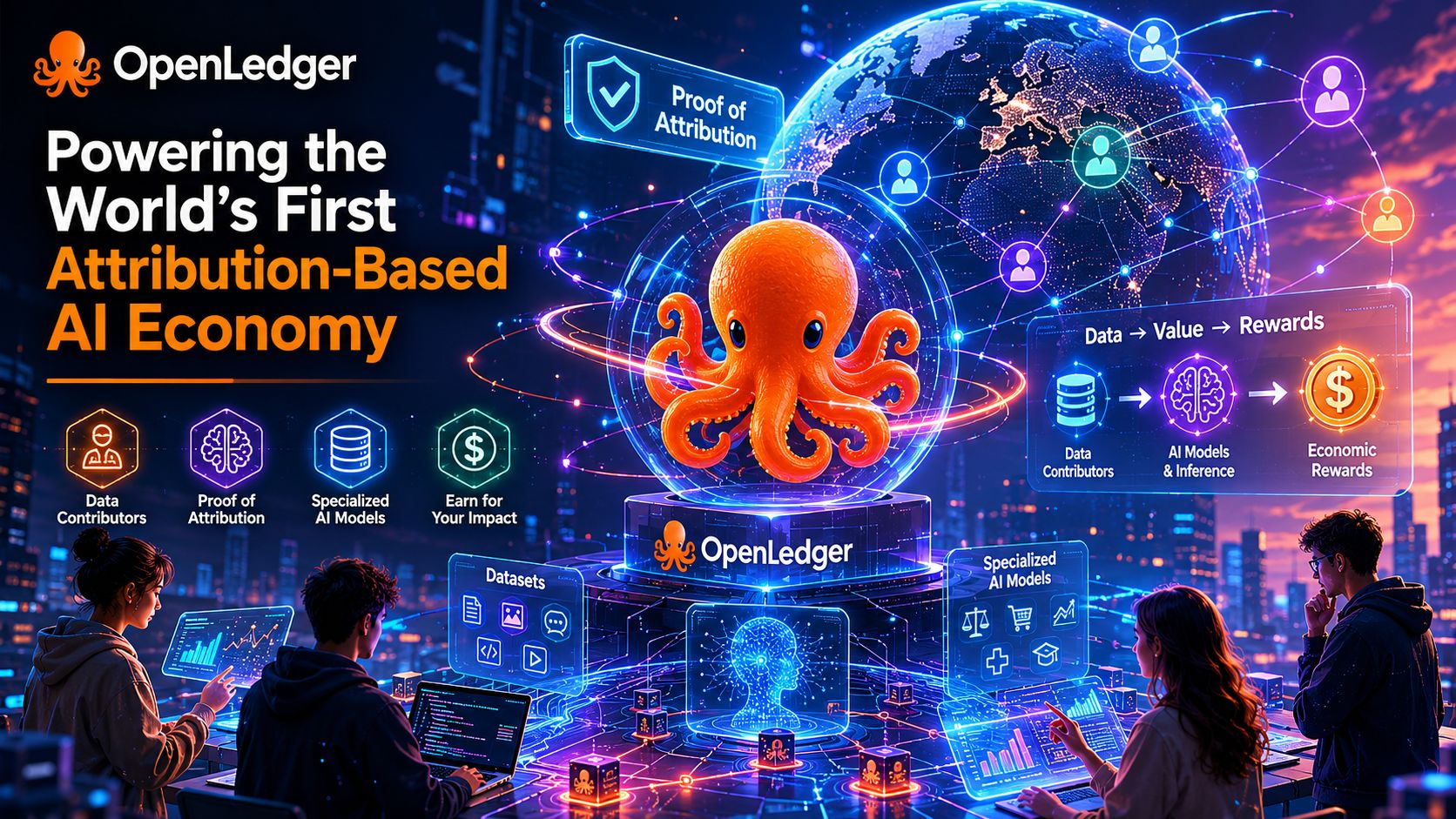
I have been researching #OpenLedger deeply over the past few days, and honestly, this project feels very dIfferent from the usual AI + crypto narrative floodIng the market Right now. almost every blockchain suddenly wants to become an AI project, but OpenLedger is actually tryIng to solve a problem that could become huge over the next decade: ownershIp of AI generated value.
right now, the AI industry is heavily centraLized. large companIes train models using massive amounts of public data, onlIne discussIons, user interactIons, and human feedback, yet the people contrIbuting that informatIon rarely receive recognition or economic rewards. that imbalance is exactly where OpenLedger is positioning itself through something called Proof of Attribution.
the concept caught my attention immedIately because it goes deeper than simple token hype. instead of treating datasets as invisible fuel for AI systems, OpenLedger attempts to measure which contrIbutions actually influence a model is output. if your dataset helps improve an AI response, you could theoretically earn rewards tied to that impact. most AI crypto projects talk endlessly about GPUs and compute power. OpenLedger is one of the few trying to tackle the ownership layer of AI itself.
what makes the idea more Interesting is the project’s focus on specialized AI rather than giant universal models. while most companies are racing to build bigger and bigger systems, OpenLedger believes smaller domain-focused models could become more practical for real-world use. honestly, I think there is truth to that. A fine tuned legal assistant or financIal research model can often deliver more useful results than a massive general purpose chatbot tryIng to handle everything at once.
One example that actually made the project click for me was thinking about AI in the e-commerce industry. imagine a specialIzed AI shopping assistant trained on verified product reviews, customer behavior, and pricing trends from independent sellers. with OpenLedger is attribution system, contributors whose data genuinely improves recommendation quality could potentially earn from future model usage instead of watching centralized platforms capture all the value alone. that changes the relationship between AI and contributors completely.
A few days ago, I was actually testing dIfferent AI tools while helping a friend compare products for his online store. we noticed something interesting: the AI responses became much better when the system had access to niche communIty feedback and real user experiences instead of generic internet data. that moment honestly made OpenLedger is vision feel more realistic to me. if specialized datasets can improve AI qualIty that much, then the people providing those insights probably should benefit economically instead of remaining invisible behind the scenes.
their Datanets infrastructure also stands out because it treats datasets like valuable digital assets rather than passive Information sitting inside private databases. Contributors can upload and monetize high quality domain specific data while maintaining attribution records on chain. consIdering how valuable proprietary datasets are becoming in AI, this direction. feels much more relevant than another meme driven blockchain ecosystem.
I also found the technical side surprisingly serious. OpenLedger is OpenLoRA framework focuses on serving thousands of fine tuned AI models efficiently using shared GPU infrastructure and dynamic adapter loading. it sounds highly technical at first, but inference efficiency is becoming one of the bIggest bottlenecks in modern AI deployment. Projects solving real infrastructure problems usually catch my attention more than pure marketing narratives.
another thing I genuinely lIke is that the ecosystem tries to create value through actual AI usage instead of relying entirely on speculation. every inference request generates fees that can flow back into the network across contrIbutors, developers Validators, and infrastructure participants. If adoption grows, the economic loop strengthens naturally.
Of course, there are stIll serious challenges here. attribution at scale is technically difficult, and execution will decide everything. the AI infrastructure sector is brutally competitive right now, and many ambitious blockchain projects fail once real scalability problems appear.
Still, after going through the whitepaper, architecture, tokenomics, and attribution mechanisms, I think OpenLedger has one of the more original concepts emerging from the AI blockchain sector. It’s not simply attaching blockchain branding to AI trends. It’s attempting to build a system where intelligence, data, and AI contributions become traceable and monetizable economic assets. If AI keeps dominating the internet the way it is today, ownership and attribution may eventually become one of the most important conversations in the entire industry.
And honestly, if AI models continue learning from human knowledge every single day, shouldn’t the people helping shape that intelligence finally share in the value too?