

Most announcements in crypto follow a predictable arc. Ship a feature, frame it as a milestone, move on. OpenLedger's EVM bridge dropped into the feed the same way. Clean graphic, one-liner caption, community repost. Easy to scroll past. Harder to scroll past once you understand what cross-chain AI agent deployment actually changes about how these systems get built and used.
The framing everyone defaults to is liquidity. EVM compatibility means capital from Ethereum, Arbitrum, Base, the whole connected surface area, can interact with OpenLedger's infrastructure without wrapping gymnastics or manual bridging overhead. That part is real. But it is the smaller half of the story.
The more important half is execution environment. AI agents running on OpenLedger do not just need data access and model availability. They need the ability to settle outputs, trigger downstream logic, and interact with contracts living on other chains. Before a functioning EVM bridge, that required either centralised relay layers or custom middleware carrying trust assumptions most serious builders will not accept. The bridge collapses that gap. An agent trained and deployed within OpenLedger can now call EVM-compatible contract logic as a native step in its workflow, not as an afterthought patched through an API.
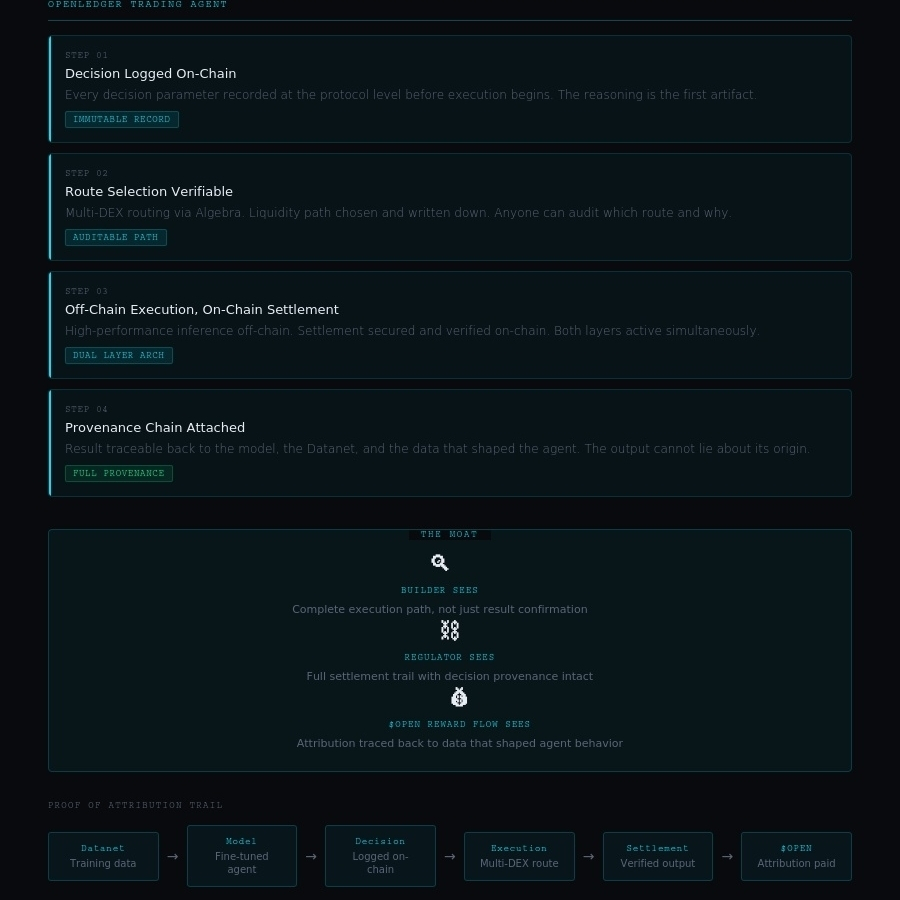
Consider what that means for agent economics specifically. Most on-chain AI agent deployments today are siloed. They operate within whatever chain they are native to, and cross-chain capability either does not exist or gets abstracted in ways that obscure the actual cost and settlement logic. OpenLedger's bridge makes those economics legible. An agent can verify its own execution environment, settle across chains, and log the activity against a verifiable record. That is not a marginal improvement. That is a different category of what agents can do.
There is also a developer acquisition angle the announcement undersold. EVM is where most serious smart contract talent already lives. The tooling, debugging environments, deployment patterns, all of it is built around EVM assumptions. By shipping a bridge rather than asking developers to abandon existing stack familiarity, OpenLedger removed the single largest friction point for teams that want to build AI-native applications on its infrastructure.
Distribution follows tooling compatibility, not the other way around.
None of this guarantees adoption. A bridge creates optionality. It does not force anyone through it. The question now is whether OpenLedger builds agent use cases compelling enough to make that optionality worth exercising. The infrastructure argument is sound. The product execution argument is still being written.
But the bridge being a bigger deal than the announcement suggested? That part is already settled.
