
I used to think the biggest AI problem was access.Access to better models.Access to better compute.Access to better tools.But the more I look at OpenLedger, the real issue seems different.$OPEN #OpenLedger @OpenLedger
AI has a contribution problem.In today’s AI economy, value is created by many people, but captured by very few platforms. Someone provides useful data. Someone improves a model. Someone validates an output. Someone adds domain knowledge that makes the system smarter.
But once that value enters the AI pipeline, it often disappears into the product.The platform grows.The model improves.The contributor gets almost no visibility.
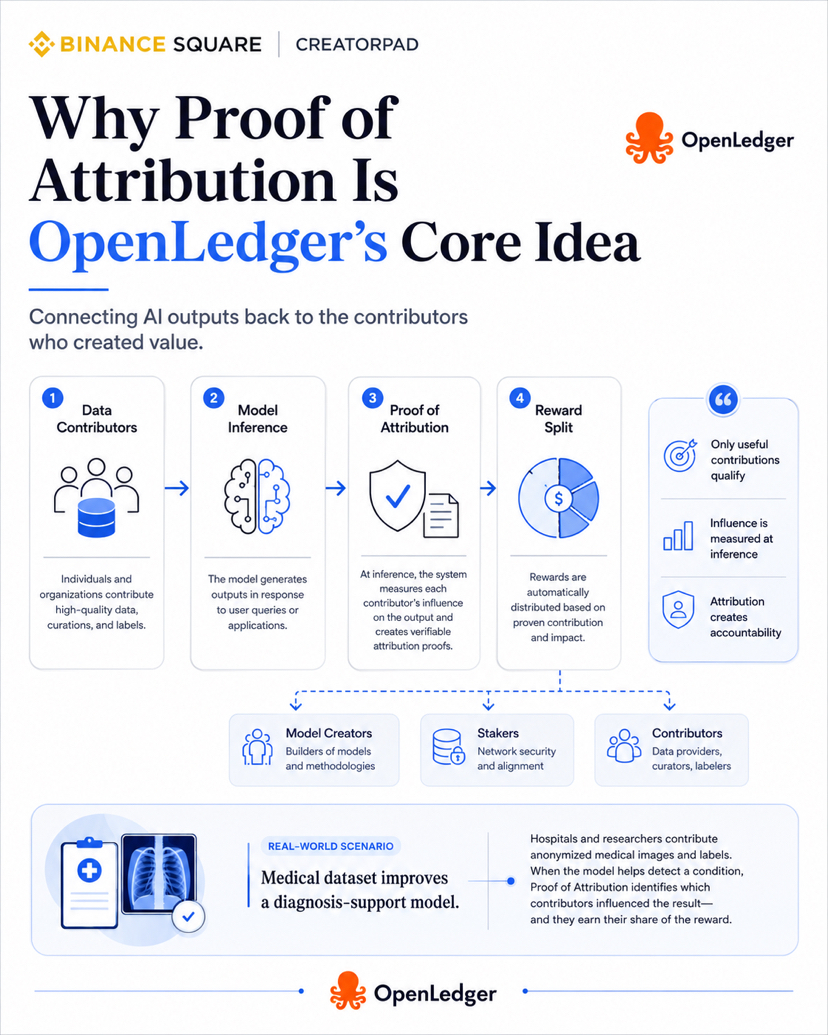
That is the practical friction OpenLedger is trying to address with Proof of Attribution.To me, this is the core idea of OpenLedger. Not just “AI on blockchain.” Not just another attempt to put buzzwords together. The more interesting angle is whether AI contribution can become traceable, measurable, and economically rewardable.Proof of Attribution is OpenLedger’s attempt to connect AI outputs back to the people and data that helped create them.
That sounds simple, but it is actually a difficult problem.In normal AI systems, data is usually treated like a hidden input. A dataset may help improve a model, but when the model later produces a useful answer, it is hard to know which contribution actually mattered. Was it one data source? A model update? A validator? A feedback loop? Or a combination of all of them?
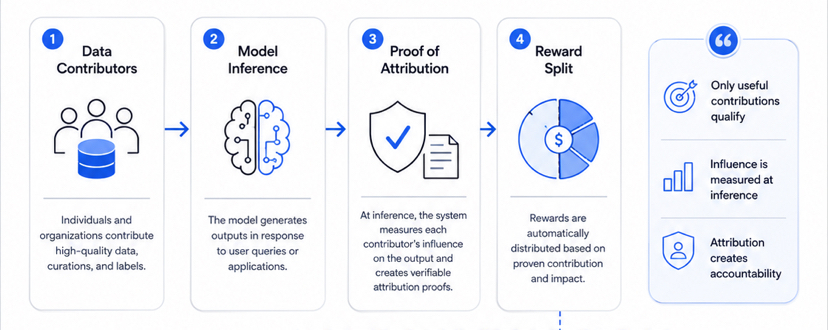
OpenLedger’s idea is to make that contribution trail more visible.If a model uses data during inference, the system can calculate influence and distribute rewards based on contribution value. In theory, this means contributors are not paid just because they uploaded something. They are rewarded when their contribution actually helps produce useful results.
That distinction matters.A reward system based only on participation can easily become noisy. People may submit low-quality data just to farm rewards. But a reward system based on influence tries to ask a better question:
Did this contribution actually improve the output?
This is where Proof of Attribution becomes more than a reward tool. It becomes a filtering mechanism.If data points can be linked to outputs, contributors get a clearer path to ownership. If only useful contributions qualify for rewards, the system has a reason to care about quality. If inference fees can be split between model creators, stakers, and contributors, then AI revenue becomes more connected to the people who helped build the intelligence behind it.
That is a very different model from today’s centralized AI platforms.In most AI businesses, the platform controls the user relationship, the model, the monetization, and the data advantage. Contributors may create value, but the economic loop is mostly closed. OpenLedger is trying to open that loop by making contribution part of the payment structure.
A simple example makes this easier to understand.Imagine a medical data contributor provides a highly specific dataset related to rare diagnosis patterns. The dataset is not huge. It is not glamorous. But it helps a diagnosis-support model become more accurate in a small but important area.
Later, a hospital or health application uses that AI model during inference. If the contributor’s dataset meaningfully influenced the output, Proof of Attribution could help determine that contribution’s reward share.That changes the role of data.Data is no longer just raw material collected once and forgotten. It becomes an economic asset that can continue to earn if it keeps proving useful.
This is important for crypto because it gives blockchain a more specific job inside AI.The value of blockchain here is not just storage. It is not just putting AI records on-chain for marketing. The useful part is transparency, traceability, and settlement. If AI contribution can be recorded, attributed, and rewarded through a crypto-native system, then ownership becomes easier to verify and harder to ignore.
That is the strongest argument for OpenLedger’s design.But I’m still cautious.Attribution is powerful only if it is accurate. If the system rewards the wrong contributors, it becomes a farming game.If the system starts rewarding low-quality data too much, serious contributors may stop trusting it. And if the rules become too complicated, people may not understand why they got paid or why they were left out.And if attribution slows down inference or makes AI more expensive, adoption may become difficult.
This is the real tradeoff.OpenLedger needs to prove that contribution value can be measured without turning the AI experience into something slow, costly, or confusing.Quality control will be one of the biggest tests. A system like this needs strong anti-gaming rules. It must detect duplicate data, low-value submissions, fake influence, and reward manipulation. Otherwise Proof of Attribution could become another points system where the loudest participants win instead of the most useful ones.
That would defeat the whole purpose.The more useful version of OpenLedger is not a system that rewards everyone equally. It is a system that rewards impact.That is why I think Proof of Attribution is the core idea.It tries to move AI from hidden contribution to visible contribution. It tries to make data ownership more measurable. It tries to give model builders, stakers, and contributors a shared economic structure. And it tries to make AI outputs accountable by showing where value came from.
Maybe this is one of the more serious crypto-AI experiments because it focuses on a real business problem: who gets paid when AI creates value?

I’m not sure yet if OpenLedger can execute it at scale.The idea is strong. The challenge is measurement.
If OpenLedger can prove attribution without rewarding noise, slowing inference, or making the system too expensive, then Proof of Attribution could become more than a technical feature. It could become the economic layer that specialized AI has been missing.
Can OpenLedger prove contribution value without making AI slower or more expensive?$OPEN #OpenLedger @OpenLedger