
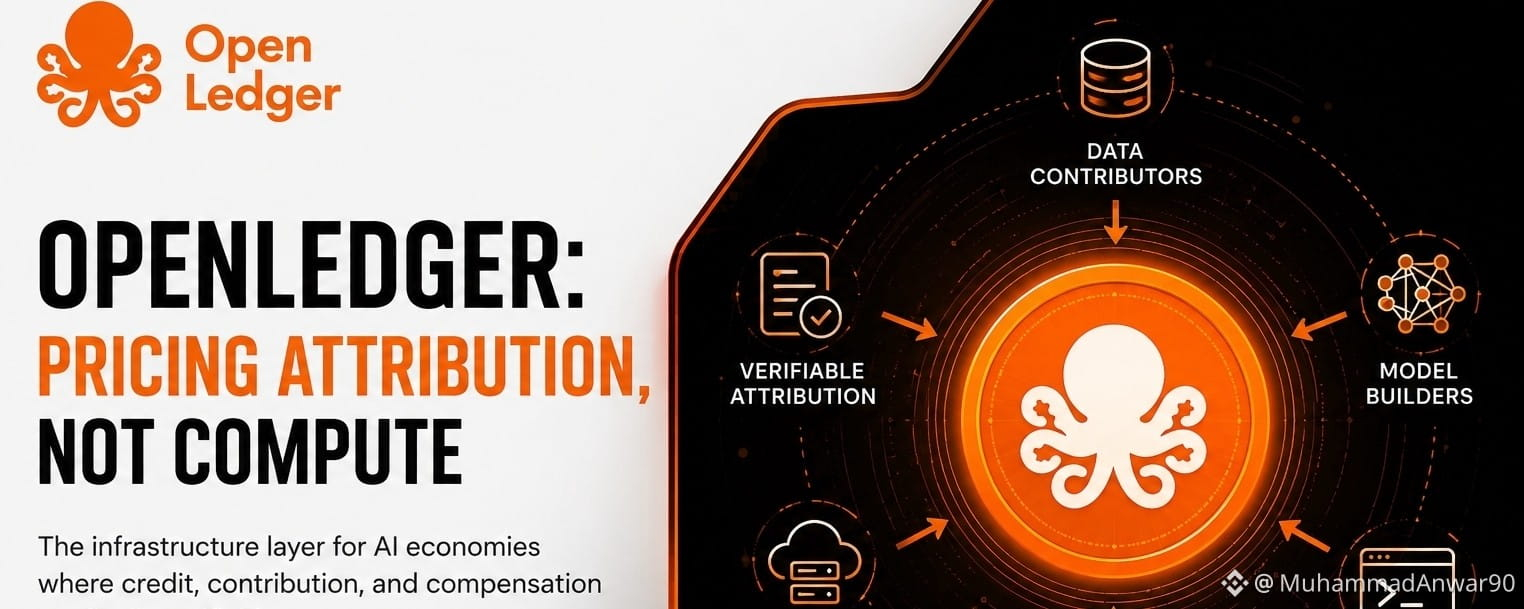
A few years ago, when people in crypto talked about infrastructure, the conversation was almost embarrassingly simple. Faster chains. Cheaper transactions. More throughput. Then AI arrived and somehow we copied the same mental shortcut. Bigger models. More GPUs. Lower inference costs. Same reflex, different sector.
I understood that instinct at first
If something computationally expensive becomes commercially important, naturally the market looks at compute as the bottleneck. That’s clean. Easy to price. Investors like clean stories.
But the longer I watch how AI systems are actually evolving, the less convinced I am that compute is the hardest economic problem.
I think attribution might be worse.
Not the vague “credit the creator” kind of attribution people casually mention online. I mean actual economic attribution. The uncomfortable question nobody really wants to unpack because it gets messy fast: when an AI-generated output creates value, who exactly deserves to be paid?
That question sounds theoretical until real money is involved.
Imagine a healthcare AI trained partly on licensed clinical datasets, partly on internal hospital records, then fine-tuned by a third party before being deployed through some enterprise interface. A doctor uses it. Productivity improves. Revenue exists somewhere in that chain.
Who earned what?
The hospital? The model provider? The inference layer? The data contributors? The deployment company?
People pretend this will sort itself out naturally. Markets usually do that when they don’t yet have infrastructure for something awkward.
I’ve seen this before in different forms.
Digital advertising spent years arguing over attribution because everyone wanted credit for conversion events. Finance built entire settlement systems because nobody trusts vague accounting once capital scales. Music streaming still gets attacked over royalty opacity. The technical product may be innovative, but eventually the economic plumbing becomes the real story.
AI feels like it’s drifting toward that same wall.
Which is why I think OpenLedger is more interesting than the typical “AI blockchain” label suggests.
Honestly, calling it just another AI chain misses the weird part.
Because if you look past the surface branding, OpenLedger doesn’t feel like a project obsessing over compute scarcity. It feels more like an attempt to build attribution infrastructure for AI economies.
That’s a very different thing.
Compute is easy to conceptualize. You consume machine resources, you pay for them. Cloud pricing already trained the market to understand this. Expensive? Yes. Complicated? Operationally, sure. Conceptually? Not really..
