
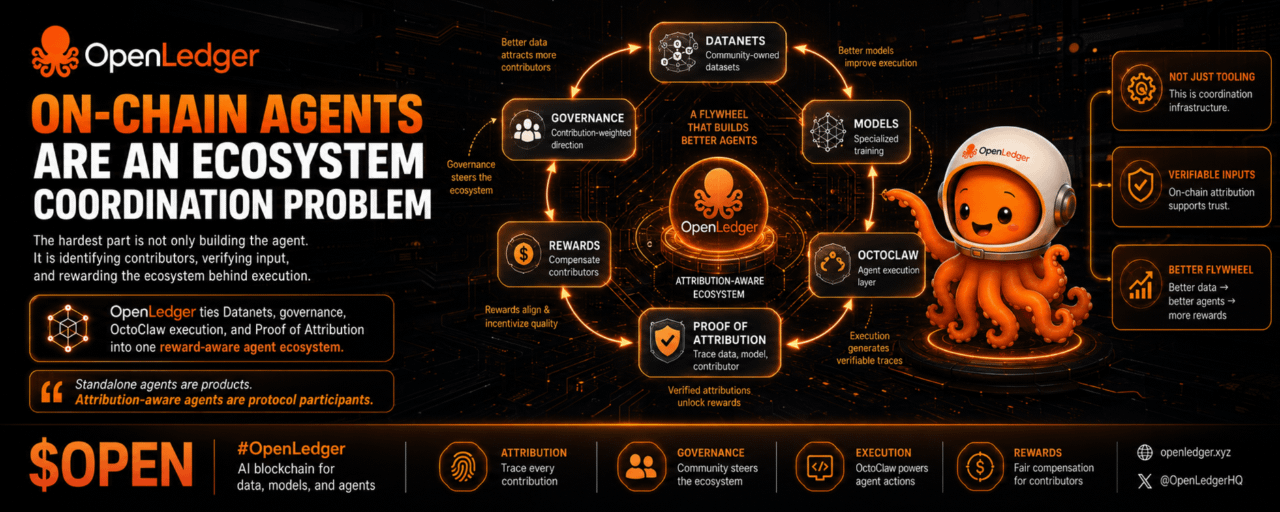

The developer question — can you build the agent, deploy it, and keep it running — is real but increasingly solvable. The tooling is maturing. Frameworks exist. The harder problem, the one that keeps coming up when I look at agent ecosystems in detail, is the ecosystem coordination problem. Who benefits when an agent runs? Who contributes to the system that makes it possible? How are those contributors identified, verified, and rewarded? These are not developer problems — they're economic and governance problems layered on top of technical infrastructure.
This is where @OpenLedger is doing something structurally different from most agent platforms I've looked at.
The foundation is what they call Datanets — community-owned datasets used to train specialized models. Contributors upload data, verify contributions on-chain, and receive attribution and rewards tied to how much their data influences model training and subsequent inference. Governance happens through a hybrid on-chain system using OpenZeppelin's modular Governor framework — not a token-weighted popularity contest, but a structure where participants who contribute meaningfully carry governance weight proportional to that contribution.
OctoClaw, the agent execution layer, sits on top of this foundation. Every time an agent built on OpenLedger runs a workflow, executes a trade, or generates an output, the system can trace exactly which model was used, what data trained it, and who provided that data. The Proof of Attribution mechanism isn't a reporting feature — it's what makes contributor compensation work.
I've spent time looking at other AI infrastructure protocols over the past year, and the pattern I see repeatedly is that the data layer and the execution layer are treated as separate concerns. Platforms focus on one or the other. OpenLedger's approach of tying them together through attribution creates a different kind of flywheel: better data attracts better model training, which enables more capable agents, which creates more execution events, which rewards more contributors, which attracts better data.
The ecosystem implications of this are worth thinking through. Developers deploying agents on OpenLedger aren't just consuming infrastructure — they're participating in a system where their usage creates rewards flowing back to the contributors who made their agents possible. That's a meaningful incentive alignment if it works as designed.
The governance structure matters here too. When contributors have meaningful say in protocol direction, you get a different development trajectory than when a small team or a set of large token holders makes all decisions. The OpenZeppelin Governor framework OpenLedger is using is battle-tested in DeFi contexts — the question is whether it translates well to AI infrastructure governance, where the decisions are more technical and the tradeoffs harder for non-specialists to evaluate.
I don't think these problems are fully solved yet. Governance in AI infrastructure is genuinely hard, and community-owned models are still an experiment at scale. But the structural design here is more carefully considered than most alternatives.
The fact that OctoClaw is positioned as the execution layer within this ecosystem — rather than as a standalone agent product — is the detail I keep returning to. Standalone agents are products. Agents embedded in attribution-aware infrastructure are something closer to protocol participants than tools.