
I’ve spent enough time around crypto and AI projects to become careful whenever both words show up beside each other. Maybe careful is not even the right word anymore. Tired might fit better. After a while, you start noticing the same cycle repeating itself over and over. AI gets attached because it sounds intelligent. Blockchain gets attached because it sounds decentralized. Then both are packaged together and presented as if the combination alone is supposed to mean something important.
I used to get curious every time I saw it. I would read the threads, open the documents, sit there trying to understand where the real substance was hiding underneath all the polished language. But after enough projects, that curiosity slowly turned into hesitation. Not because the ideas were bad, but because the execution almost always felt incomplete. There was always a missing layer somewhere. Something important happening outside the system while the visible part kept pretending everything was connected.
That gap keeps bothering me more than I expected.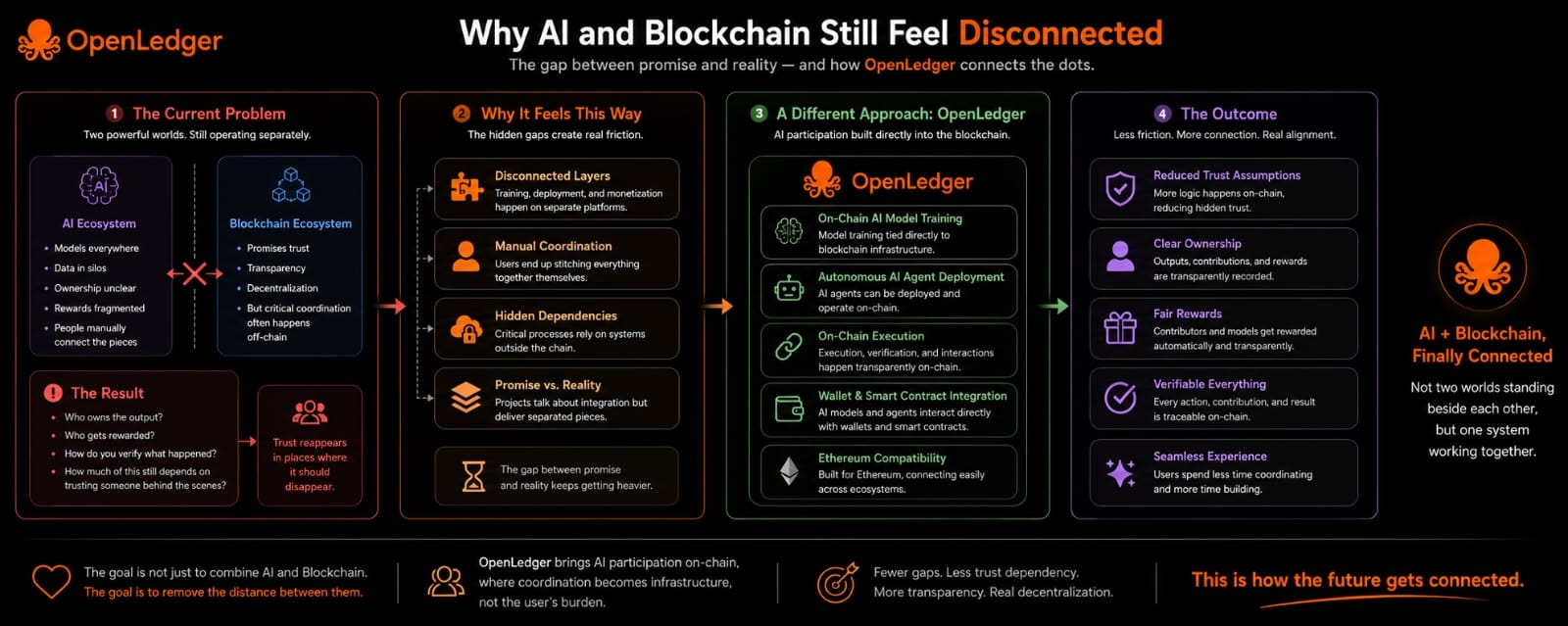
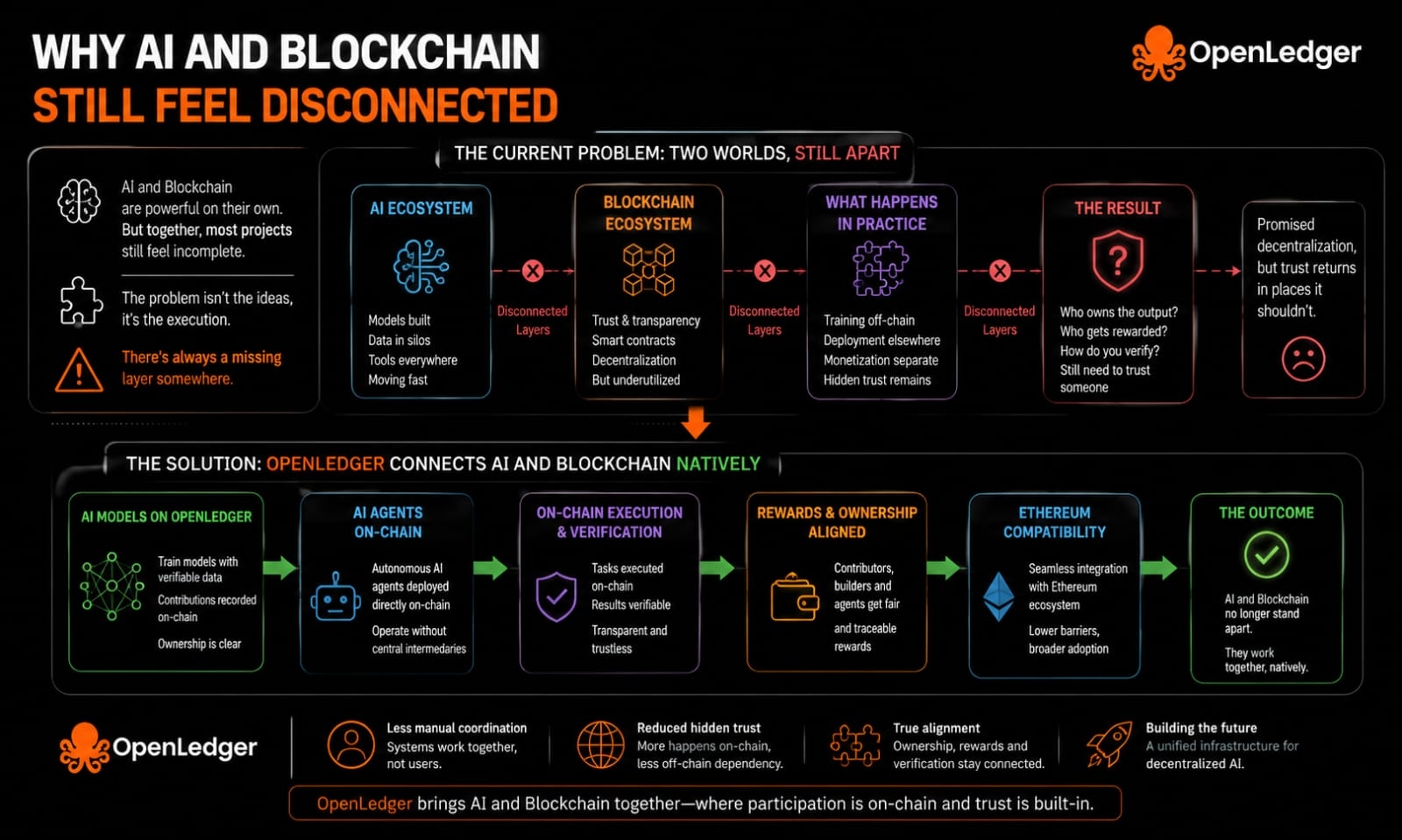
AI is moving fast, almost too fast sometimes. New models appear constantly, new tools appear constantly, and everyone talks about building intelligent systems. But when I look closely, the ecosystem still feels scattered. Data sits in one place. Models live somewhere else. Ownership becomes difficult to define. Rewards move through separate systems. People end up doing the work of coordination themselves, manually connecting pieces that were supposed to fit naturally together.
Then blockchain enters the conversation and promises trust, transparency, and decentralization. But strangely enough, many projects still leave most of the important coordination outside the chain itself. And that is where the frustration starts creeping in.
Because once an AI model is trained somewhere, deployed somewhere else, and monetized through an entirely different platform, things become messy very quickly. Suddenly simple questions stop feeling simple. Who actually owns the output? Who gets rewarded? How do you verify what happened? How much of this still depends on trusting someone behind the scenes?
For something built around reducing dependency on trust, I keep finding trust hidden in places where I thought it was supposed to disappear.
While looking more deeply into OpenLedger, one thing that caught my attention was that it seemed to approach the problem differently. Instead of treating AI like another feature attached around blockchain infrastructure, the design felt more centered around AI participation itself. Model training tied directly into blockchain infrastructure, autonomous AI agent deployment, and execution happening on chain all seemed like attempts to reduce the separation that keeps appearing between systems.
And honestly, the technical terms themselves were not what held my attention.
What stayed with me was the practical side of it. If AI agents can operate directly on-chain, if models can connect with wallets and smart contracts without relying on disconnected layers sitting somewhere in the background, and if Ethereum compatibility lowers the barriers between ecosystems, then maybe users spend less time trying to hold everything together manually.
Because I think that has been part of the problem all along.
Too many systems feel like they hand responsibility back to the user while claiming they removed complexity. Too many projects speak about coordination while quietly expecting people to coordinate everything themselves.
Maybe that is why AI and blockchain still feel disconnected to me. Not because they cannot work together, but because most attempts feel like two separate worlds standing beside each other, pretending they are already connected.
And after watching enough of it happen, the distance between promise and reality starts feeling heavier than the technology itself.