
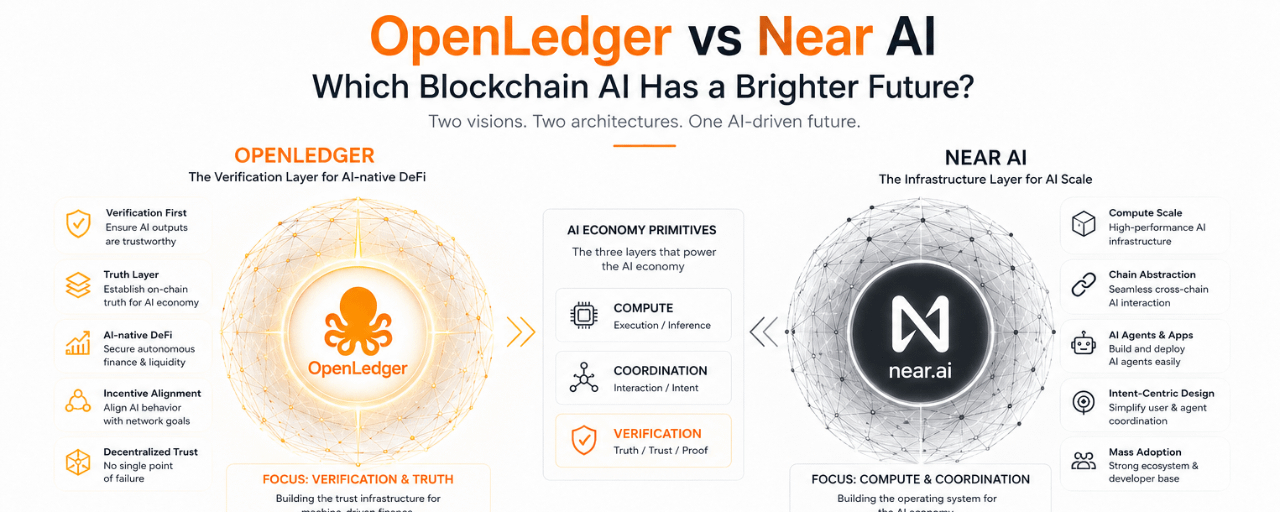
The more I look at OpenLedger and Near AI, the more I feel the market misunderstands the relationship between them. On the surface, both sit under the “AI blockchain” narrative, so people naturally frame them as competitors. But underneath, they’re actually solving very different problems inside the future AI economy.
Near AI, at least from my perspective, approaches AI as an infrastructure problem. Their vision is centered around making AI more accessible, composable, and usable on the internet through decentralized systems. A lot of their narrative revolves around user-owned AI, chain abstraction, intent layers, AI agents, and frictionless interaction between applications, users, and machines.
In many ways, it feels similar to building cloud infrastructure for the AI era, but with crypto-native coordination.
OpenLedger feels fundamentally different.
I don’t see OpenLedger as an AI execution layer. I see it more as a verification layer for AI-native finance. That distinction may sound subtle at first, but I think it changes the entire logic behind how these systems are designed.
If we reduce the AI economy to its core primitives, there are really only three things that matter: compute, coordination, and verification.
Near AI leans heavily toward compute and coordination. OpenLedger leans toward verification and truth.
And I think that difference becomes more important as autonomous systems start interacting with capital at scale.
Right now, most of the AI crypto market is still focused on execution. Autonomous trading agents, AI-managed vaults, intelligent liquidity routing, AI-powered yield optimization — everything revolves around machines making financial decisions more efficiently than humans.
But eventually the bottleneck stops being execution itself.
The real question becomes: How do networks verify the quality, reliability, and incentive alignment of machine-generated decisions?
That’s where OpenLedger becomes interesting to me.
Near AI clearly has advantages in ecosystem strength, developer reach, and distribution. They already have the infrastructure, community, and narrative scale necessary to attract builders quickly. In the short term, that probably allows them to scale much faster because they’re creating an operating environment where AI agents can actually function on-chain.
It’s almost like building an operating system for the AI economy.
But operating systems alone don’t create trust.
If AI agents eventually manage liquidity, rebalance portfolios, optimize vault strategies, or control autonomous capital flows, then markets will need systems capable of verifying machine intelligence itself — not just enabling it.
That’s the part I think many people overlook.
OpenLedger doesn’t necessarily need to build the best AI agent or the smoothest consumer interface. Instead, it seems focused on building trust infrastructure for machine-driven finance — a way for markets to identify reliable intelligence inside decentralized environments where autonomous systems increasingly interact with real capital.
And this becomes especially important in crypto.
In Web2 AI, trust comes from centralized ownership. People trust companies like OpenAI because those companies control the models, compute, and inference layers.
But crypto operates differently.
In decentralized systems, trust can’t rely purely on reputation. It eventually needs verification. Otherwise, decentralized AI risks becoming nothing more than tokenized API wrappers around centralized intelligence providers.
That’s the core philosophical split I see:
Near AI is trying to make AI more accessible on-chain. OpenLedger is trying to make AI more verifiable on-chain.
One optimizes the execution economy. The other optimizes the truth economy.
And honestly, both approaches make sense depending on how AI Web3 evolves.
If the market prioritizes consumer adoption first, Near AI could have a major advantage because accessibility and developer experience usually scale faster than deeper infrastructure primitives.
But if the market shifts toward AI-native DeFi, autonomous capital systems, and machine-driven liquidity management, then verification layers may become far more important than most people currently expect.
I also think the market is probably mispricing this dynamic right now.
Early-stage technologies usually reward visibility first. The easiest things to see — user growth, apps, interfaces, agents, dashboards — attract attention and capital faster.
But as ecosystems mature, reliability becomes the actual bottleneck.
DeFi followed a similar path.
At first, markets chased APY. Later, they realized liquidity infrastructure, settlement guarantees, and risk coordination mattered far more.
AI crypto may evolve the same way.
That’s why I think OpenLedger is worth watching closely, even if it isn’t the loudest or most attention-driven project today. They may be building infrastructure the market only fully appreciates later, especially if AI-native finance becomes a major category.
At the same time, I don’t think the outcome is obvious.
There’s still one uncomfortable question hanging over the entire AI crypto sector:
Do users actually care about decentralized verification as much as crypto believes they do?
Most users historically choose whatever is faster, easier, and “good enough.” If centralized AI systems continue outperforming decentralized alternatives in usability and efficiency, will the average market participant really prioritize transparent verification layers?
That may end up being the defining question for the future of AI crypto itself.