
When I first looked at OctoClaw, what caught my attention wasn’t the language around automation. Every project says that now. What stood out was the quieter layer underneath it. The idea that an intelligent agent is no longer being treated like a chatbot sitting beside your workflow, but as an active operational layer moving through the workflow itself. Researching, interpreting, deciding, executing, and then looping back to verify outcomes in real time. That changes the texture of what people now expect from software.
For years, automation mostly meant rigid sequences. If this happens, trigger that. If a wallet receives funds, send an alert. If a spreadsheet updates, push a notification. Useful, but narrow. The system only knew the path it had already been given. OctoClaw seems to be aiming at something different. An agent that can move across fragmented environments and maintain context while doing it. That distinction matters more than it sounds.
Right now the average crypto user touches at least five or six disconnected systems every day. A DEX for swaps. A dashboard for analytics. A bridge for liquidity movement. Telegram for coordination. Maybe another terminal for on-chain monitoring. Then a separate AI interface for summarizing information. The workflow itself becomes the friction. People are spending more time navigating tools than making decisions inside them.
That creates a strange imbalance in the market. On-chain infrastructure has become incredibly fast. Solana can theoretically process over 65,000 transactions per second under ideal conditions, while Ethereum Layer 2 ecosystems now settle transactions in seconds instead of minutes. Yet the human operating those systems is still manually copying addresses, switching tabs, reading dashboards, and interpreting raw data streams. Infrastructure accelerated. Human coordination didn’t.
Understanding that helps explain why intelligent agents are suddenly becoming one of the strongest narratives in crypto and AI simultaneously. The market is not only looking for faster execution anymore. It is looking for reduced operational drag.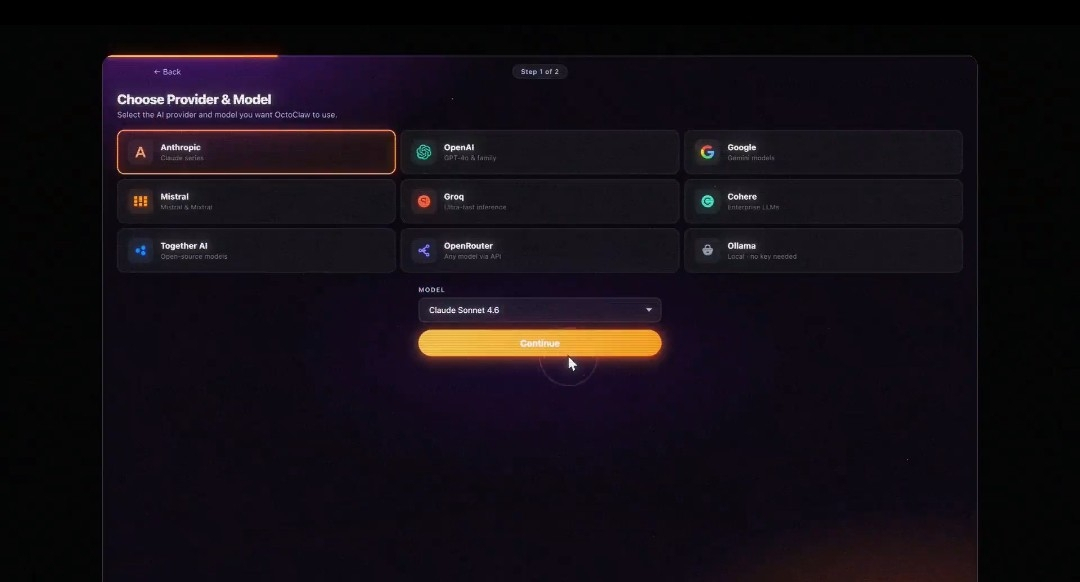
OctoClaw sits directly inside that conversation. On the surface, it looks like a unified assistant layer. Research information, generate outputs, automate actions, execute workflows. Straightforward enough. But underneath, the important part is orchestration. That word gets overused, but here it carries real weight because orchestration means the system is managing relationships between tasks rather than treating each task as isolated.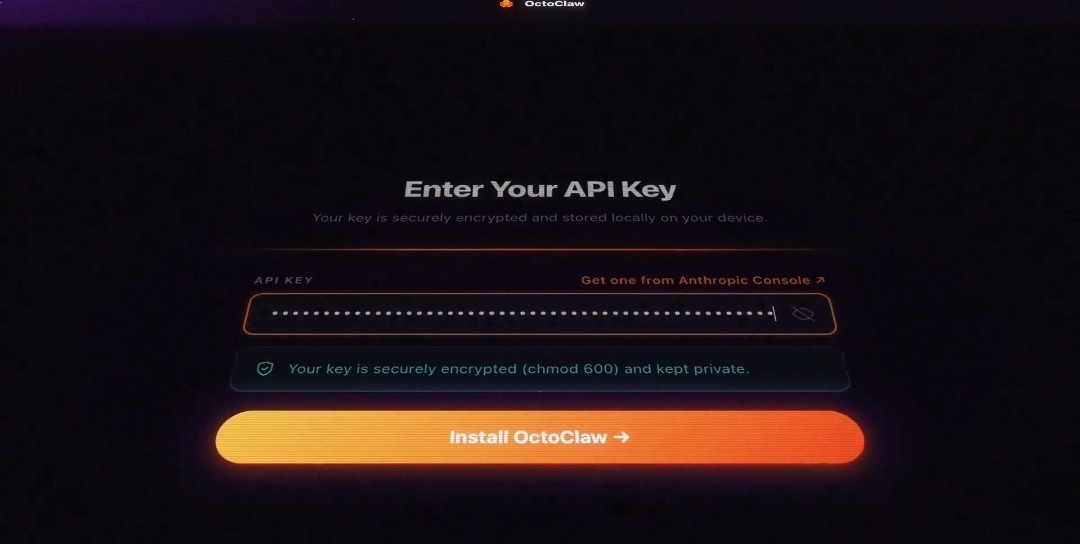
Imagine a trader tracking whale wallet movement before entering a position. Normally that process involves monitoring on-chain scanners, cross-checking social sentiment, reviewing liquidity conditions, and then executing manually once conviction forms. An intelligent agent compresses that cycle. It retrieves the wallet activity, filters noise, identifies repeated accumulation patterns, compares them against historical volatility, and prepares execution logic before the user even finishes interpreting the data. The human still decides. But the operational latency shrinks dramatically.
That matters because markets increasingly move faster than human reaction speed. In January alone, several AI-linked tokens saw double-digit percentage swings within hours following ecosystem announcements and agent framework integrations. Meanwhile, decentralized finance still processes billions in weekly trading volume, much of it driven by automated systems rather than discretionary human action. Early signs suggest the next competitive advantage may not come from access to information, but from coordination speed between information and execution.
There’s another layer underneath this that deserves attention. Real-time orchestration sounds attractive until you realize how fragile it can become. The more authority an agent receives, the more dangerous mistakes become. A retrieval error inside a research assistant is annoying. A retrieval error connected directly to on-chain execution can become expensive very quickly.
That’s why the phrase “simplify everything” carries hidden complexity behind it. Simplicity for the user usually means abstraction of complexity somewhere else. OctoClaw is essentially trying to hide infrastructure depth behind conversational interaction. The user asks. The agent interprets. The system executes. But underneath that clean surface sits continuous verification logic, permission handling, execution routing, and risk management.
And honestly, that is where projects like this either earn trust or lose it.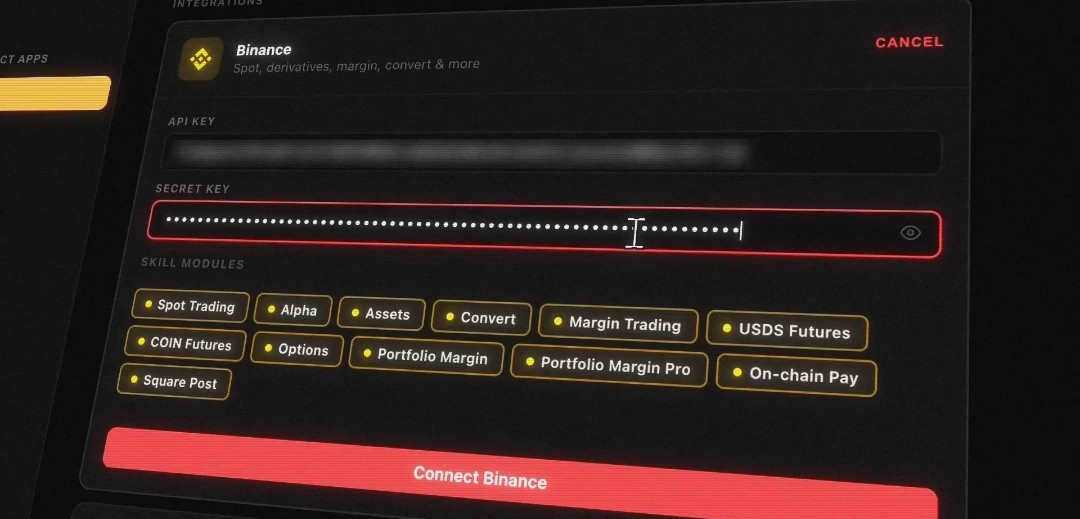
Because autonomous execution introduces a very specific psychological shift. People are comfortable receiving suggestions from AI. They are far less comfortable delegating action authority. Especially in crypto, where one wrong signature can permanently move assets. So the challenge is no longer just intelligence. It becomes controlled intelligence. How much autonomy should an agent have before human confirmation is required? Which actions deserve friction, and which should feel instant?
Those questions are becoming foundational across the industry. Quietly, almost every serious AI infrastructure project is now moving toward some version of layered agency. Observation first. Recommendation second. Limited execution third. Full orchestration only after trust is earned through repeated reliability.
What struck me about OctoClaw is that it seems positioned closer to that operational middle ground rather than pure autonomy theater. That is probably the smarter direction right now. The market has already learned that fully autonomous systems sound impressive in demos but become unpredictable under real market conditions. Coordination matters more than spectacle.
Meanwhile, broader market behavior supports this shift. AI-related crypto sectors collectively pushed back above multi-billion dollar valuations during recent market rotations, while venture funding into agent infrastructure continued climbing despite tighter liquidity conditions elsewhere. At the same time, enterprise automation outside crypto is accelerating at a similar pace. McKinsey estimated that generative AI could add between $2.6 trillion and $4.4 trillion annually across industries, largely through workflow compression rather than content generation alone. That distinction matters. The money is flowing toward systems that reduce operational time.
And workflow compression is exactly what projects like OctoClaw are attempting to monetize.
Still, there’s a counterargument worth taking seriously. As agents become intermediaries between users and systems, users may slowly lose direct understanding of the infrastructure they rely on. Convenience creates dependency. Dependency reduces visibility. If an agent handles research, execution, monitoring, and optimization, eventually the human operator stops learning the underlying mechanics. That tradeoff remains unresolved.
But maybe that’s also the natural direction of technological maturity. Most internet users today cannot explain TCP/IP routing, yet they comfortably operate global communication systems every day. Most drivers cannot explain combustion timing or battery chemistry either. Tools mature by hiding complexity beneath interfaces people trust.
If this holds, intelligent agents may become the new interface layer for crypto itself. Not wallets. Not exchanges. Agents.
Instead of navigating protocols directly, users may increasingly navigate intent. “Find yield.” “Monitor risk.” “Rebalance exposure.” “Track this wallet.” The system interprets the objective and coordinates infrastructure underneath. The interface stops being transactional and starts becoming operational.
That changes how people interact with digital systems entirely.
And maybe that’s the real signal underneath OctoClaw. Not that AI agents are becoming smarter, but that software itself is quietly shifting from passive tools into active participants in decision flow. The screen is no longer waiting for commands. It is beginning to move alongside the user.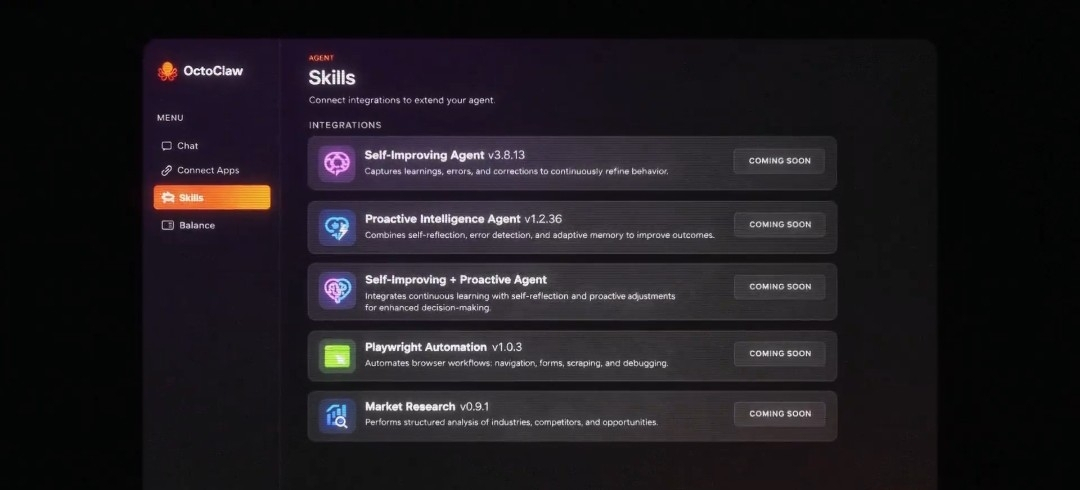
The projects that matter over the next few years probably won’t be the loudest ones promising intelligence everywhere. They’ll be the ones that make coordination feel so natural you barely notice the machinery underneath.