
Honestly… I didn’t expect to feel this level of attention when reading about how OctoClaw structures its execution agent system.
I spent the whole day researching OpenLedger. It doesn’t feel like skepticism. it doesn’t feel like something to be cautious about either. it’s closer to that moment when an “AI chatbot” that you thought was just for conversation turns out to be a real coordination layer for financial and on-chain workflows.
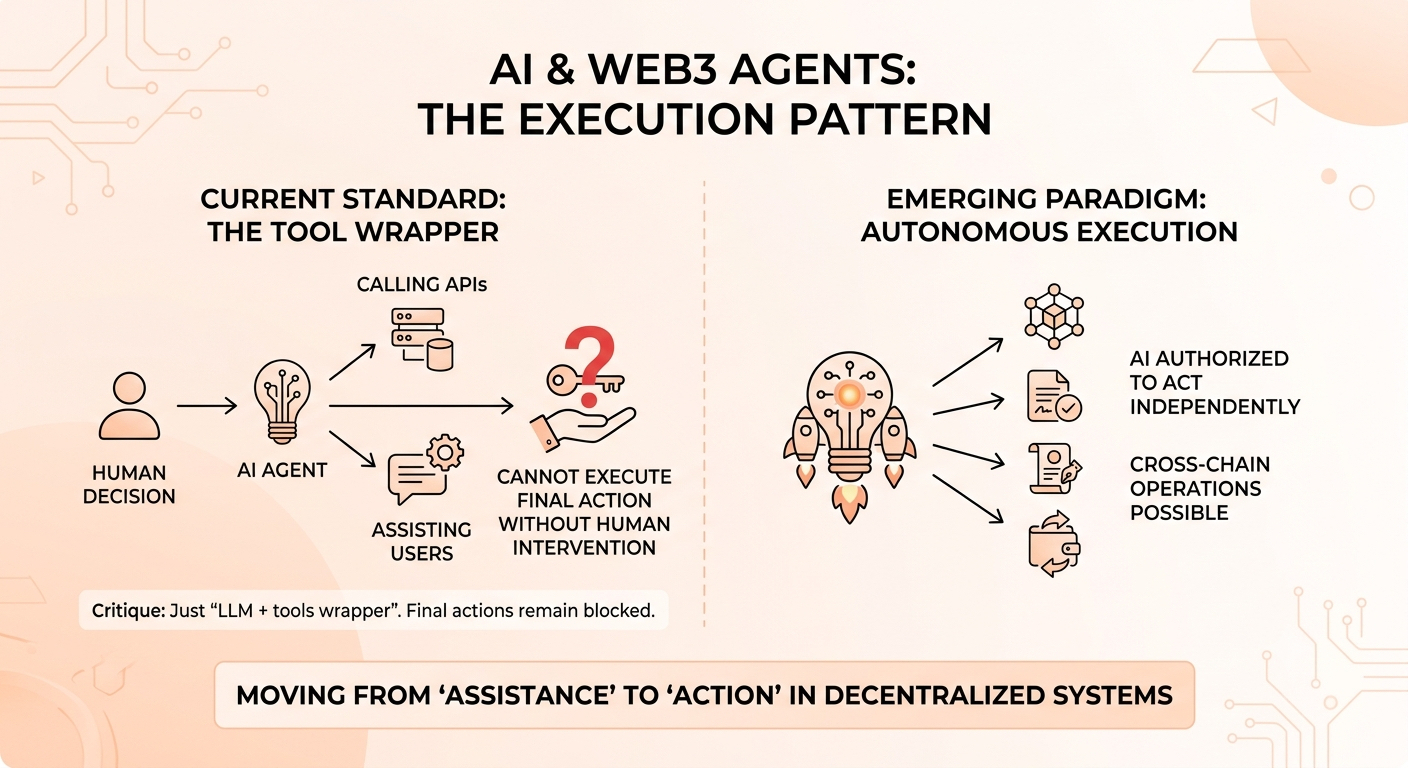
Because there’s a pattern in how AI + crypto / Web3 agent systems approach the problem of “AI only producing outputs” that the space tends t0 accept without really questioning whether AI should actually be allowed to act. The standard critique of AI agents is that they are just “LLM + tools wrappers”. That usually means: the system calls APIs, assists users and still requires humans for final execution. That alone changed the way I think about…this argument is convincing because it is true for most existing products.
but OctoClaw builds something inverted: a system where AI doesn’t just suggest actions - it directly executes them. At first glance, it sounded simple… wait, huh?
My observation is: AI agent layer, automation layer and execution layer are n0t the same thing. they are separate tiers and the boundary between them is actually implemented as an operational architecture.
because what they are describing is real.What I took away more deeply is. the AI agent layer handles intent understanding and planning. the automation layer connects applications like Telegram, Slack or market APIs. the execution layer signs transactions, sends orders and performs both on-chain and off-chain actions.
for example, a user might say “buy $10 BTC when RSI drops below 30” and the system automatically translates that into: fetching market data → setting conditions → executing a swap when conditions are met. or something simpler like “summarize all trading sessions today and send to Telegram”, where the system doesn’t just summarize but also pushes the message to the correct channel without any further user interaction.
When I look back, the project feels…
Well, wait a second
so… the idea of “AI being able to commit actions” becomes the real standout point.
That’s why I started paying attention. but interesting design has never been the hard part of building a sustainable system.
the hard part is whether the boundary between AI suggesting actions and AI being allowed to execute actions actually changes user behavior in a meaningful way, especially when real financial assets are involved.
Honestly, it changes the mindset….
because this is the part I keep coming back to. each layer in OctoClaw’s architecture solves a specific problem. the agent layer exists because complex intent needs to be understood beyond simple prompts. the automation layer exists because the crypto and app ecosystem is fragmented. the execution layer exists because the end goal is to move actions out of chat interfaces and into real systems.
three problems. three layers. the architecture is not decorative - it is the load-bearing structure of the entire system.
and then comes the question of “whether AI should be allowed to sign transactions at all”. because of course.
and this is where the design becomes genuinely interesting to examine. the mechanism that allows AI to execute directly on wallets creates a significant acceleration in user experience. this is not a minor convenience improvement. it is a direct amplifier on financial decision speed, meaning users are not just interacting with AI to ask questions - they are delegating actions to it, while simultaneously participating in an automated financial system.
for example: a user could say “rebalance my portfolio to 60% BTC, 30% ETH, 10% stablecoins” and the system would automatically allocate funds, swap through a DEX aggregator and display execution results in real time. or another case: “if ETH drops 5% in 24h, hedge my position”, where the entire risk response logic is handled by the agent without requiring a multi-step manual UI process.
the experience layer and the execution layer start reinforcing each other. a user is chatting, confirming and watching transactions happen within a single interaction loop. the layered system creates an architecture where these flows don’t interfere with each other.
Are we getting too excited?
there is another angle that has not been explored deeply enough.
the lower layer is what makes OctoClaw actually accessible to mainstream crypto users, most of whom are not actively involved in DeFi or complex trading strategies. mainstream users represent the majority of the market, in spaces where execution-level simplicity like “fast swaps”, “automated alerts”, or “decision delegation” provides real value. the lower layer is not a simplified version - it is the layer where most users actually live and designing it properly without breaking the execution layer above it is what enables scalability.
a system where only advanced on-chain users interact with core execution is a system with a very limited market. OctoClaw solves this by making the simple experience layer actually functional, which is what gives the advanced execution layer a foundation to exist.
That really bothers me.
but… there is one more point I want to make.
the decision to build a multi-layer agent architecture instead of collapsing everything into a single chatbot reflects a deeper understanding of how different users interact with assets and actions. complexity is not redundancy here. it allows OctoClaw to operate multiple levels of automation simultaneously without collapsing into inconsistency.
May be…
the question is whether users at any layer actually understand what they are allowing the AI to do and where their real control boundary lies, because in a system structured this carefully, understanding the line between “suggestion” and “execution” becomes the defining factor in how it is used in practice.
and in this world, the people who understand all layers are not just seeing an AI agent - they are seeing a financial automation system emerging from within.
Really, but still…🫣