
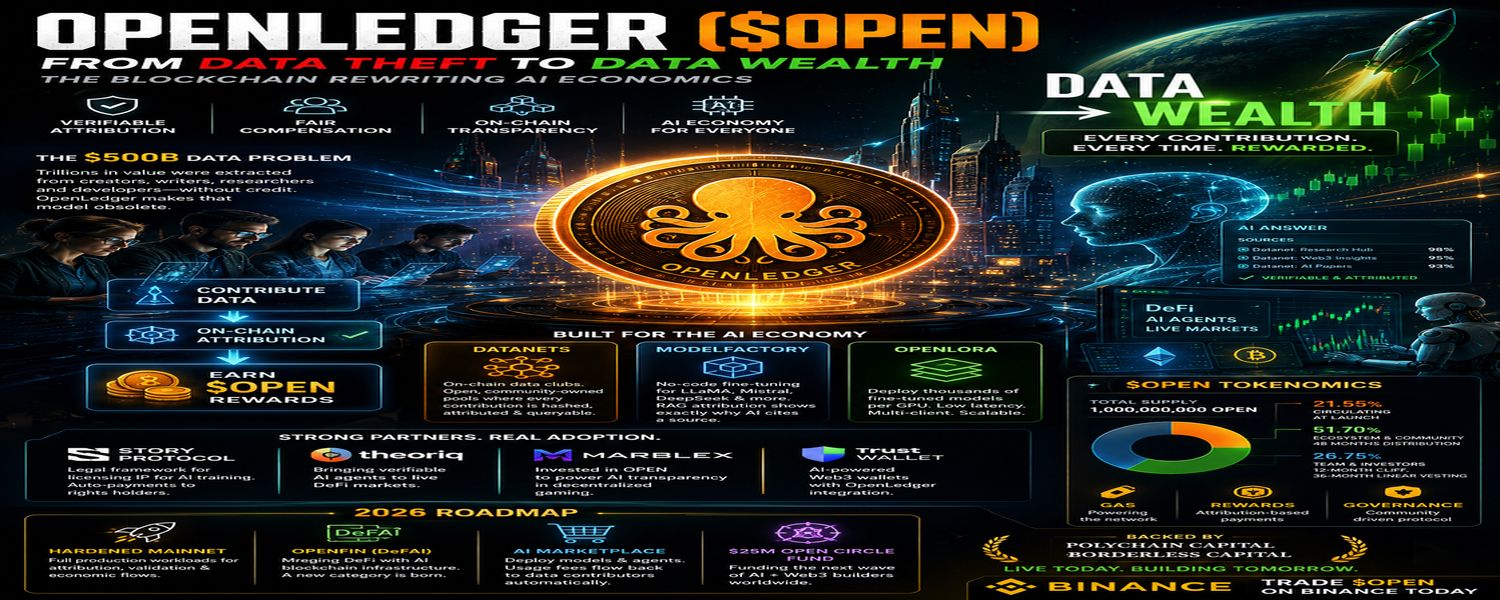
Every major AI company in the world was built on data it did not pay for. Trillions of dollars in value were extracted from writers, researchers, developers, and creators silently, without credit and without compensation. OpenLedger ($OPEN) is the infrastructure layer that makes this extraction model obsolete, replacing it with a programmable economy where every data contribution has a verifiable price tag.
An Ecosystem Built for Scale
OpenLedger is not a single product it is a full-stack AI economy running on its own EVM-compatible blockchain, built as an OP Stack rollup with AltLayer as its infrastructure partner. This means developers can use familiar Ethereum tooling, wallets, and bridges while benefiting from the speed and efficiency of a purpose-built Layer 2. At the application layer, three interconnected tools power the entire ecosystem. Datanets serve as on-chain data clubs open, community-owned pools organized by topic where every contribution is hashed, attributed, and queryable. ModelFactory gives anyone the ability to fine-tune powerful base models like LLaMA, Mistral, and DeepSeek through a no-code dashboard, with RAG attribution showing exactly why an AI answer cites certain sources. OpenLoRA then deploys these fine-tuned models efficiently, hosting thousands of models per GPU and keeping latency low across multiple clients and domains.
Partnerships That Signal Real Adoption
The strength of a blockchain project is measured not just by its technology but by the quality of companies building on top of it. OpenLedger partnered with Story Protocol to create a legal standard for licensing creative works for AI training with automatic payments flowing to rights holders every time their work trains a model. In January 2026, OpenLedger and Theoriq joined forces to bring verifiable AI agents into live DeFi markets. Gaming giant MARBLEX invested directly into OPEN to boost AI transparency in the decentralized gaming sector. Trust Wallet collaborated with OpenLedger to launch AI-powered Web3 wallets. These are not marketing announcements they are structural integrations that expand OPEN token utility across multiple industries simultaneously.
Tokenomics Designed for Long-Term Trust
Of the 1 billion total OPEN supply, 21.55% entered circulation at launch. Team and investor tokens are subject to a 12-month cliff followed by a 36-month linear release a disciplined vesting structure that signals long-term alignment rather than short-term extraction. The ecosystem and community allocation of 51.7% is distributed over 48 months, ensuring sustained incentives for builders and contributors. The OPEN token serves as gas on the network, powers attribution-based rewards, and governs the protocol creating genuine, multi-layered demand that goes far beyond speculative trading.
The Road Ahead in 2026
OpenLedger's 2026 roadmap targets a hardened mainnet where attribution, validation, and economic flows handle full production workloads. OpenFin teased in March 2026 is set to merge decentralized finance with AI blockchain infrastructure, creating an entirely new DeFAI category. The upcoming AI Marketplace will allow developers to deploy models and agents while usage fees are automatically routed back to data contributors through smart contracts. With $25 million committed through its OpenCircle launchpad to fund AI and Web3 startups, OpenLedger is not waiting for adoption to come to it. It is funding the next generation of builders directly.
The $500 billion data problem has a solution. It is live, it is backed by Polychain Capital and Borderless Capital, and it trades on Binance today.
#OpenLedger #open @OpenLedger $OPEN #creatorpad #Binance #TradingTales