


The more time I spend around AI projects in crypto, the more I notice the same contradiction repeating itself. Everyone talks about autonomous intelligence as if it already exists, but underneath the surface, the systems still depend on fragmented human coordination. Liquidity sits on different chains. Data comes from disconnected environments. Users move constantly between ecosystems chasing incentives. And somehow we expect AI agents to operate smoothly inside that mess. That thought stayed in my head while I was reading through @OpenLedger and its EVM Bridge architecture. What surprised me wasn’t the technology itself. It was the realization that the bridge might actually explain the project better than the AI branding does.
At first, I barely paid attention to it. Honestly, bridges in crypto have started feeling almost routine. Every protocol eventually adds one because interoperability has become part of the standard roadmap formula. So when I first saw #OpenLedger discussing EVM integration, I assumed it was mostly about expanding access and moving assets across ecosystems. Useful infrastructure, but nothing that fundamentally changes how you understand a network. Then somewhere in the middle of reading deeper into the whitepaper, the entire thing flipped in my mind. The bridge stopped looking like an extra feature and started looking like the mechanism holding the broader AI economy together.
What changed my perspective was understanding how dependent AI systems are on uninterrupted economic coordination. Humans tolerate fragmented infrastructure because we manually compensate for it every day. We switch wallets, bridge assets, manage slippage, move capital, adapt to delays. Machines cannot realistically function that way forever. The moment AI agents begin participating in decentralized economies autonomously, interoperability stops being a convenience and becomes part of the environment itself. An AI economy trapped on one chain eventually stops behaving like an economy. It becomes an isolated application pretending to be a network.
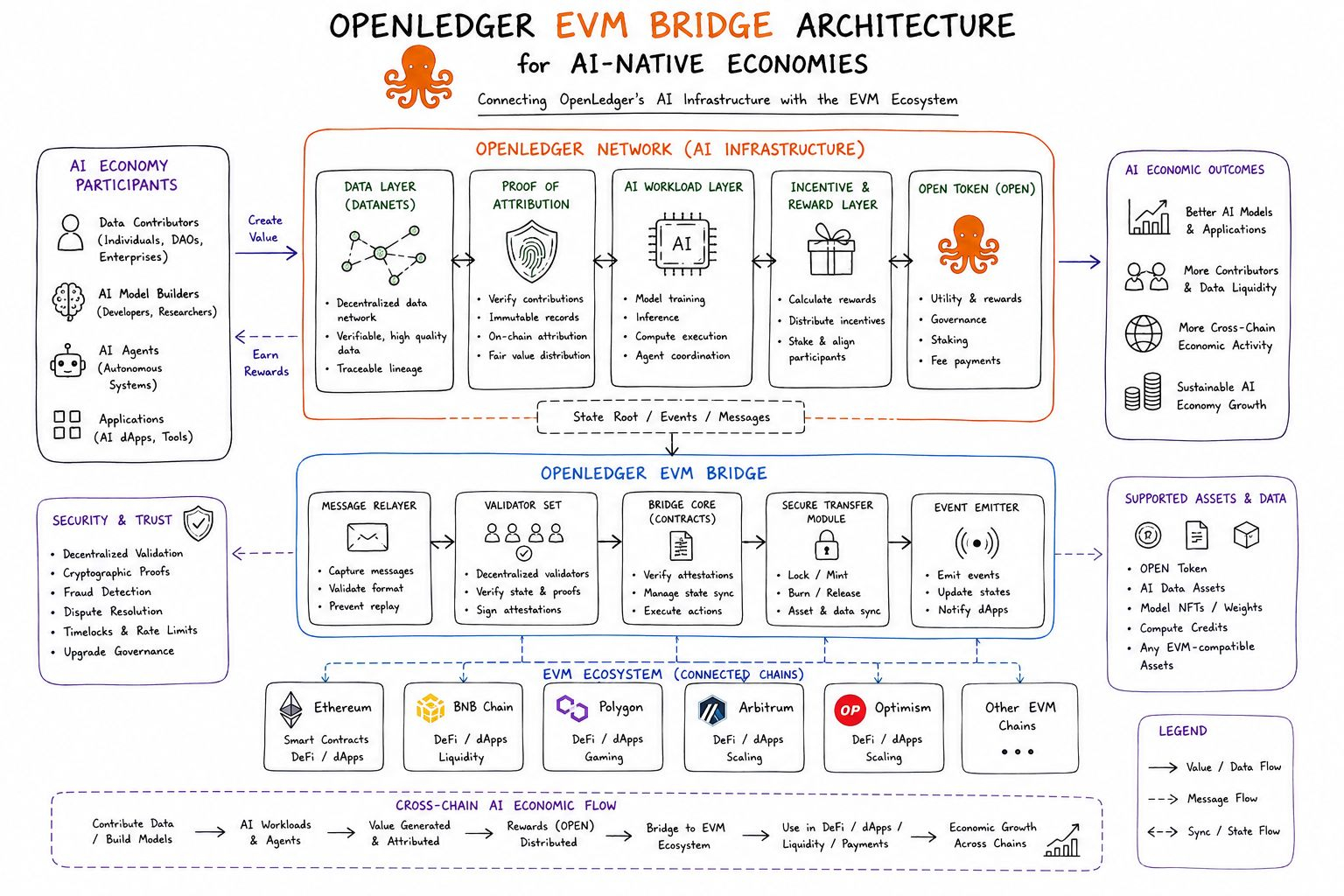
That’s probably why OpenLedger’s EVM Bridge feels structurally different from the usual cross chain narrative. Most blockchain bridges are built around asset portability. Move token A from chain X to chain Y and increase liquidity access. OpenLedger seems to frame interoperability more around continuity, continuity of attribution, incentives, data contribution, and machine driven economic activity. The more I thought about it, the more I realized this aligns directly with the project’s deeper architecture. If decentralized AI depends on contributors, models, compute layers, and economic rewards interacting continuously, then fragmentation itself becomes a threat to the intelligence system.
And honestly, this is where the project started feeling less theoretical to me. Most AI crypto discussions still focus on visible outputs because those are easier to market. Better agents. Smarter automation. More advanced models. But infrastructure problems usually decide which ecosystems survive long term. $OPEN appears unusually focused on the invisible coordination layer underneath decentralized AI. How contributors remain incentivized across chains. How attribution systems maintain integrity outside closed environments. How economic activity flows between ecosystems without breaking reward logic. These aren’t exciting marketing topics, but they feel much closer to the real bottlenecks AI economies will eventually face.
I also think the project quietly acknowledges something the broader market still avoids admitting. Blockchain dominance is temporary by nature. Every cycle creates new execution environments, new liquidity centers, new ecosystems competing for relevance. Yet many AI protocols still behave as if one chain will eventually contain the entire future economy. I’m not convinced that world exists anymore. Intelligence itself is fluid. Data originates everywhere. Compute moves everywhere. Capital migrates constantly. If AI systems are supposed to coordinate value autonomously, then restricting them to isolated ecosystems almost feels inefficient at a structural level.
That realization made the whitepaper feel more coherent the deeper I went into it. The EVM Bridge doesn’t feel disconnected from OpenLedger’s AI vision. It feels embedded inside it. The project’s ideas around attribution, decentralized data infrastructure, and AI native economic coordination only fully make sense if those systems can interact beyond closed blockchain environments. Without interoperability, decentralized intelligence risks becoming fragmented intelligence. And fragmented intelligence eventually weakens the economic network supporting it.
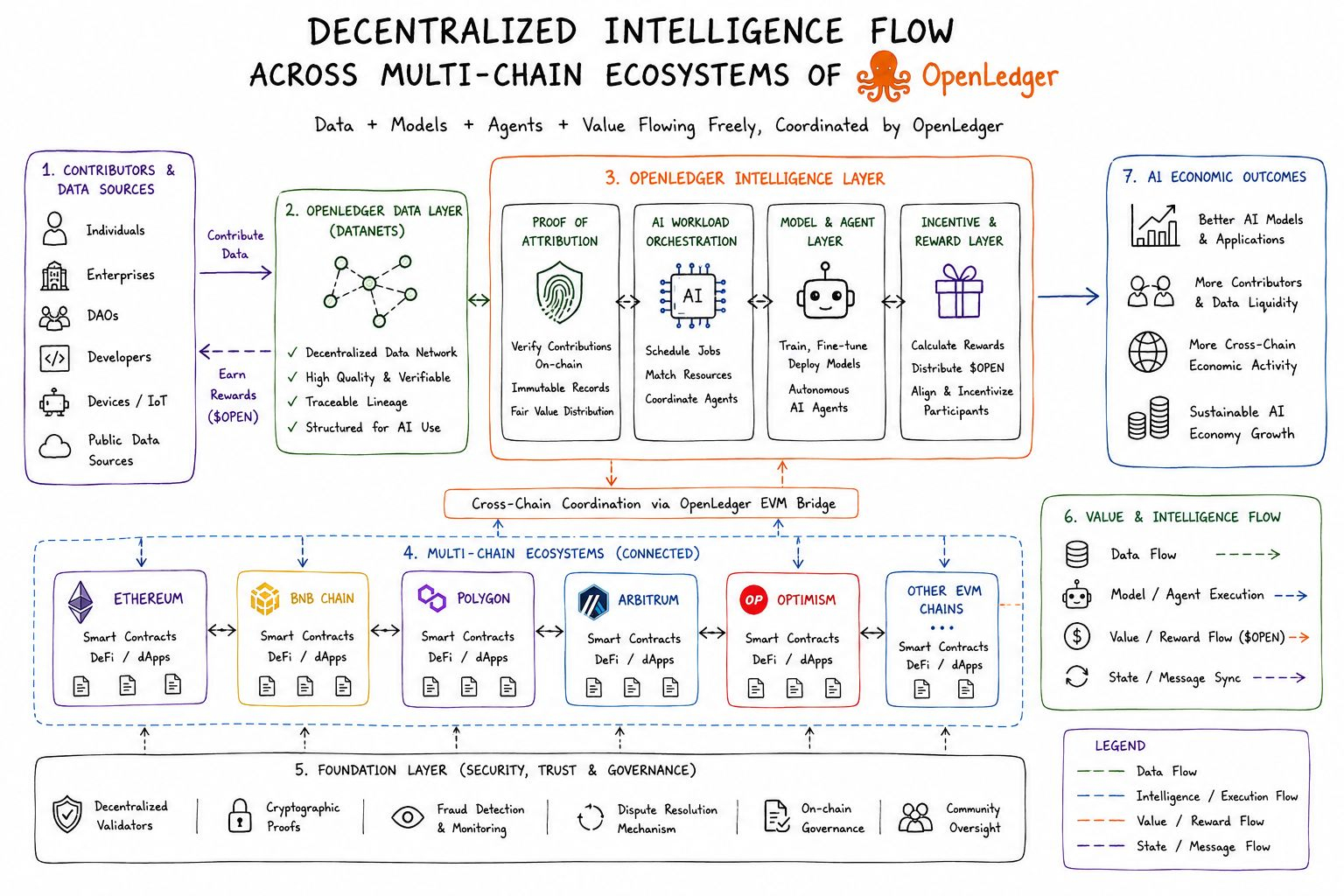
Crypto history hasn’t exactly been kind to bridges. The moment multiple ecosystems interact, security assumptions become harder to manage and failure points multiply quickly. So I don’t read OpenLedger’s architecture and assume execution is guaranteed. If anything, the ambition of the design makes the implementation challenge even larger. Maintaining attribution integrity and economic consistency across multiple environments is far harder in practice than it sounds in theory. That uncertainty matters. Ignoring it would make the analysis feel dishonest.
OpenLedger doesn’t feel like a project simply attaching AI terminology onto a normal blockchain framework. The EVM Bridge revealed something deeper about how the team understands decentralized intelligence itself. They seem to recognize that AI systems cannot survive as isolated products forever. They need interoperable liquidity. They need continuous coordination. They need economic mobility across fragmented ecosystems. And maybe that’s the part most people still underestimate. The future AI economy probably won’t be built by the smartest model alone. It will be built by the infrastructure capable of keeping intelligence, incentives, data, and value synchronized across an increasingly fragmented blockchain world.