
Most of the market spends too much time looking for narratives that already feel obvious. I used to do the same thing. Every cycle, there’s a period where certain sectors dominate attention so aggressively that everything outside of them feels irrelevant. In 2024 and early 2025, it was hard to look anywhere beyond meme coins, AI speculation, and the same high-beta majors everyone was already watching. But after sitting through enough market cycles, I’ve noticed something important: the biggest moves rarely come from the assets everyone is already comfortable with.
Some of the projects I ignored at first are now starting to look structurally important for where crypto might actually be heading in 2026. Not because they suddenly became trendy, but because the market environment around them quietly changed.
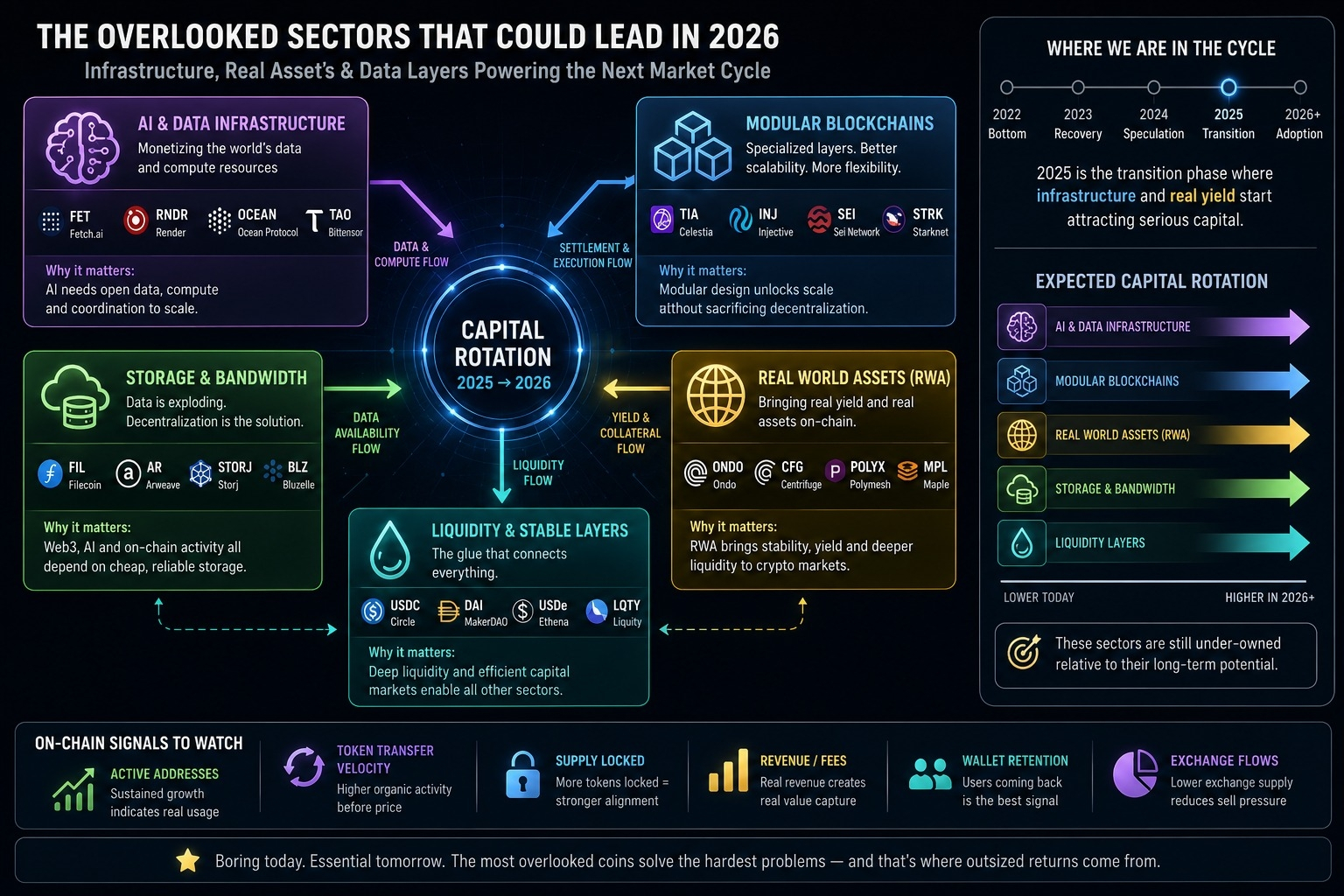
One of the biggest examples for me is the emerging infrastructure layer around AI data and decentralized compute. At first glance, many of these projects looked like recycled narratives from previous cycles. A lot of them were launched during the AI mania when almost every token claimed to be building “the future of intelligence.” Most of them deserved to be ignored. But after watching how quickly AI models are scaling and how dependent they are becoming on proprietary datasets, I started paying closer attention to projects trying to create decentralized data economies.
What changed my view wasn’t the technology itself. It was the realization that AI has started developing the same centralization problems traditional finance had years ago. The companies with the best datasets become impossible to compete against. Smaller developers get locked out. Training costs rise. Access becomes gated. Some crypto projects are trying to solve that problem by turning data contribution into an economic system instead of a closed corporate advantage.
That idea sounded abstract to me initially. Now it doesn’t.
I think the market is slowly beginning to understand that AI infrastructure may become more valuable than AI applications themselves. Applications change every few months. Infrastructure tends to compound. That distinction matters more than most people realize.
The same thing happened with modular blockchain infrastructure. For a long time, I ignored projects focused on data availability and execution layers because they felt too technical and disconnected from actual users. Retail traders usually don’t care about architecture during bullish phases. They care about velocity. But underneath the surface, crypto has been hitting the same scalability wall repeatedly. Every cycle brings more users, more bots, more automated systems, and more fragmented liquidity.
What’s interesting now is that newer infrastructure projects are no longer trying to become “Ethereum killers.” That entire framing feels outdated. Instead, many are positioning themselves as specialized layers that optimize a single function extremely well. Some focus on cheap execution. Others focus on interoperability. Others prioritize high-frequency settlement or data compression.
That shift feels more mature to me.
The market used to value chains based on theoretical TPS numbers and aggressive marketing. Now I think capital is slowly rotating toward ecosystems that actually attract meaningful activity. Not fake wallet numbers. Real usage. Real transaction demand. Real liquidity retention.
I’ve also changed my view on RWA-related projects. I was skeptical for a long time because tokenized real-world assets sounded like one of those narratives institutions loved discussing more than actually using. But over the last year, I’ve noticed something different. Stable yield is quietly becoming one of the most important products in crypto again.
After multiple speculative blow-offs, a large part of the market looks exhausted. Traders still want upside, but many are no longer comfortable parking everything in hyper-volatile assets for years at a time. RWAs started making more sense to me when I stopped viewing them as “bringing TradFi on-chain” and started viewing them as liquidity stabilization tools.
That changes the conversation entirely.
If crypto eventually becomes a full financial system instead of a speculative casino, it needs lower-volatility collateral layers. Treasury-backed products, tokenized credit markets, and yield-bearing stable instruments start becoming structurally important in that environment. The irony is that many of these projects look boring right now, which is exactly why they’re interesting.
I’m also paying much closer attention to storage and bandwidth-related protocols than I did before. Most people underestimate how quickly data demand is growing across crypto and AI simultaneously. On-chain systems are becoming heavier, not lighter. AI-generated content alone is pushing massive increases in storage requirements. Centralized cloud providers still dominate this market, but decentralization starts becoming attractive once cost, censorship, and redundancy matter at scale.
The problem is that these sectors move slowly until suddenly they don’t.
Infrastructure projects usually spend years looking dead while building invisible foundations nobody talks about. Then one catalyst appears and the repricing happens violently because liquidity in these assets is often thin relative to future demand assumptions.
What I’ve learned over time is that markets tend to underestimate boring systems before they suddenly overprice them.
That doesn’t mean all of these projects succeed. Most won’t. Some have weak token economics. Some still rely too heavily on speculative emissions instead of genuine demand. Others have ecosystems filled with inactive users farming incentives. Those problems matter. In fact, I think the market is becoming much harsher about them now than it was during previous cycles.
Token utility has become one of the clearest dividing lines.
If a token only exists as a fundraising mechanism, eventually the market notices. But when the token becomes directly tied to network demand, usage costs, governance influence, collateral requirements, or infrastructure access, the pricing structure starts behaving differently. You can often see it in on-chain behavior before price fully reacts. Wallet retention improves. Transfer activity becomes more organic. Large holders stop rotating as aggressively. Liquidity stabilizes during corrections.
Those are the signals I trust more now.
Not influencer excitement. Not trending hashtags. Not sponsored threads pretending to be research.
Just behavior.
One thing I find especially important heading into 2026 is that the market appears to be transitioning from pure speculation toward utility-backed speculation. That doesn’t sound dramatic, but I think it’s a major shift. Previous cycles rewarded visibility above all else. This cycle might reward systems that quietly integrate themselves into larger economic flows.
That’s why some of the coins I ignored initially now feel difficult to dismiss.
Not because I suddenly became emotionally attached to them. Actually the opposite. The longer I stay in markets, the less emotionally attached I become to narratives. I’m more interested in structural positioning now. I care more about where liquidity could logically flow if adoption deepens.
And honestly, some of the most interesting opportunities right now are still sitting in sectors most people find too boring to study carefully.
Maybe they never explode the way people expect. Maybe the market stays irrational longer than fundamentals deserve. Crypto has always been capable of that. But when I look at where infrastructure, AI, stable yield demand, and decentralized coordination are heading together, I can’t ignore the possibility that a few overlooked projects are positioning themselves far earlier than the market currently understands.
That’s usually where the biggest asymmetry exists.