
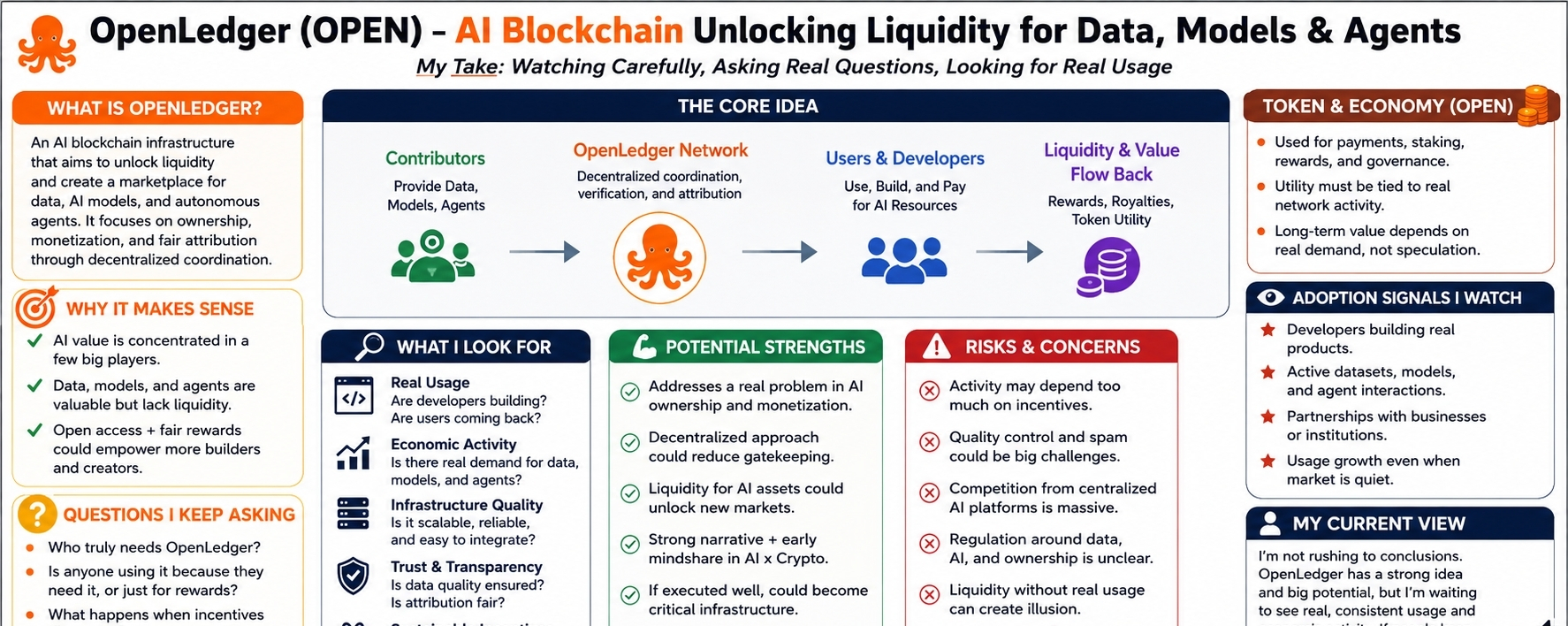
I’m watching OpenLedger more carefully than I normally watch most new crypto projects because I’ve noticed something about this market: the loudest stories are not always the ones that survive. OpenLedger keeps showing up in conversations around AI, data, and digital ownership, and while the idea sounds interesting, I’m trying not to get carried away by the excitement. I remember when I thought differently and used to chase narratives just because they sounded big. Now I find myself slowing down and asking basic questions first. Does OpenLedger solve something people actually struggle with? Is anyone using it because they truly need it, or because the market is simply excited about anything connected to AI?
I started paying attention to real usage because crypto has a habit of making possibilities feel like reality long before they actually become real. When I look at OpenLedger, I understand the idea behind it. A system that tries to unlock value from data, AI models, and autonomous agents sounds relevant in a world where artificial intelligence is growing so fast. Right now, most of the power in AI feels concentrated in large companies with access to huge datasets, expensive infrastructure, and massive computing power. Because of that, I can understand why a project like OpenLedger attracts attention. The thought of creating an open system where people can contribute, monetize, and coordinate around AI resources sounds useful. But I stopped looking at narratives alone because I’ve learned that a strong story is only the beginning, not proof that something lasts.
What I keep asking myself is very simple: who genuinely needs OpenLedger enough to keep using it over time? That question matters more to me than token price or short-term market excitement. If developers are building on OpenLedger, I want to know why. Is it cheaper? Easier? More transparent? Does it create opportunities that traditional AI systems do not offer? If businesses are participating, what problem is OpenLedger solving for them that they cannot already solve somewhere else? I think these questions matter because technology only survives if it becomes useful enough to fit naturally into people’s lives or workflows.
I focus a lot on economic activity because that usually tells a clearer story than marketing ever can. If OpenLedger is serious about creating liquidity around data, models, and agents, then there needs to be real demand somewhere inside the system. People need reasons to contribute valuable data. Developers need reasons to keep building. Users need reasons to interact with the network instead of ignoring it. Otherwise, activity can become artificial. I’ve seen many crypto projects look incredibly active while incentives are high, but the moment rewards slow down, participation disappears. That always makes me pause because incentives can attract people, but they do not automatically create long-term value.
Trust is another thing I think about when I look at OpenLedger. AI already raises difficult questions around ownership, accuracy, and reliability. If OpenLedger wants to build an ecosystem around AI resources, then people have to trust what exists inside it. If someone contributes data, how is quality measured? If models are being monetized, how do users know what actually works? What prevents spam or low-quality contributions designed only to collect rewards? These things matter because systems built around incentives sometimes accidentally encourage quantity over quality, and that becomes difficult to fix later.
I’ve noticed liquidity is another word that sounds impressive until I think more deeply about it. OpenLedger talks about unlocking liquidity, and I understand why that matters. Liquidity helps markets function. But liquidity without meaningful activity can sometimes create the illusion that something bigger is happening underneath. A token can trade heavily while actual usage stays small. That’s why I try not to confuse market interest with adoption. For me, real adoption looks quieter. It looks like developers consistently building, users returning, partnerships becoming useful, and activity continuing even when people stop talking about price.
I also think OpenLedger exists at an interesting moment because governments and institutions are becoming increasingly serious about AI. Data ownership, digital identity, and control over intelligent systems are becoming bigger conversations globally. Some countries may eventually support open systems because they reduce reliance on large technology companies. Others may prefer more centralized control because AI is becoming economically and politically important. I think regulation could eventually shape how projects like OpenLedger grow, especially if questions around privacy, ownership, and accountability become more serious.
I keep watching developer activity because builders usually tell the truth before markets do. If people continue building on OpenLedger during quiet periods, that tells me more than social media excitement ever will. Healthy infrastructure projects usually grow slowly before they become obvious. The strongest systems often look boring in the beginning because real work takes time. I’m less interested in hype and more interested in whether OpenLedger quietly becomes useful enough that people continue using it without needing constant excitement.
I’m waiting before reaching strong conclusions because I think projects like OpenLedger need time to prove themselves. I’m not rushing to buy into the story, but I’m not ignoring it either. I just want to understand what keeps the system alive when attention moves elsewhere. If OpenLedger can create real usage, real coordination, and real economic activity around AI resources, then I think it becomes much more interesting over time. But if participation depends mostly on rewards and market excitement, then sustainability becomes harder to believe in.
For now, I’m simply watching OpenLedger as an independent observer, trying to understand whether it is building something people will actually rely on or whether it is still a strong idea searching for lasting demand. In crypto, that difference matters more than almost anything else.