The phrase "AI agent" has been used so many times in so many contexts in the past two years that it has lost almost all specificity. An "AI agent" in one product is an LLM with a for-loop wrapper. In another it is a multi-step reasoning pipeline with tool access. In another it is a fully autonomous system executing real-world tasks with economic consequences. OpenLedger's OctoClaw, launched in May 2026, falls somewhere in the third category, and what makes it technically interesting from my perspective is not the task automation capability, which is not unique, but the staking and slashing mechanism that the platform's tokenomics attach to agent operation.
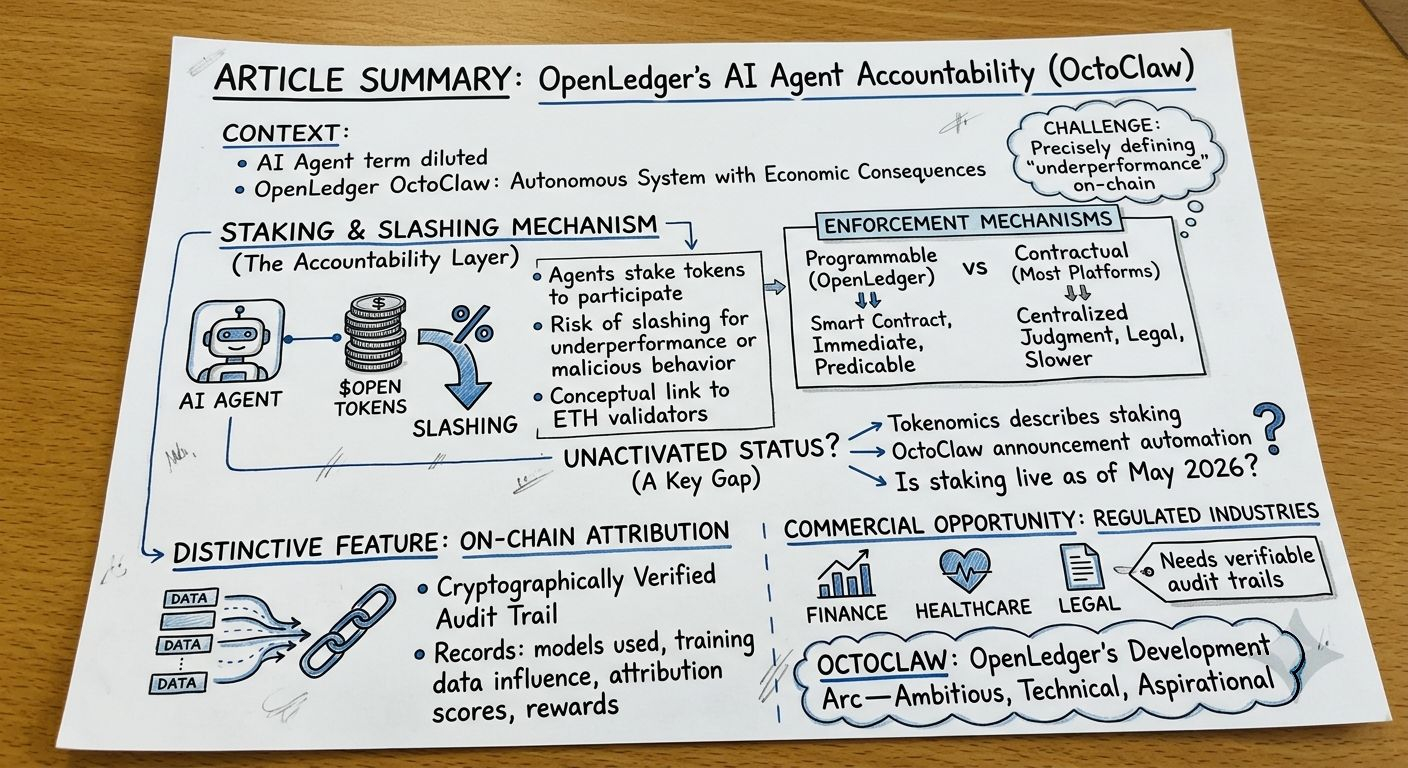
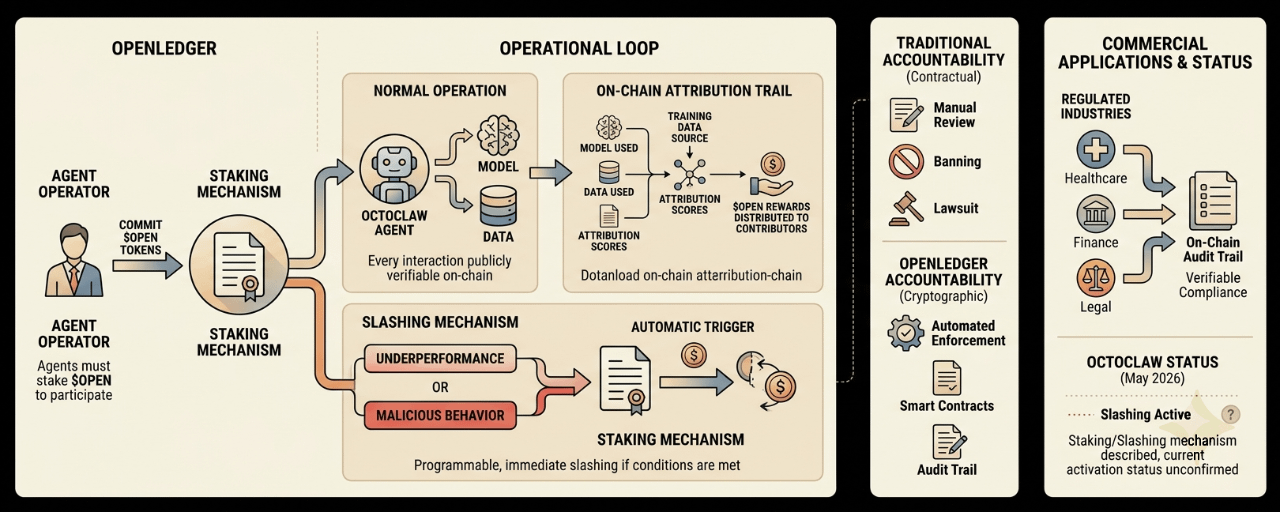
OpenLedger's tokenomics documentation describes the following: AI agents operating on the platform must stake OPEN tokens to participate. The staked amount is at risk: if an agent underperforms on its declared task or behaves in ways the protocol classifies as malicious, the stake can be slashed, meaning a portion is taken from the agent operator and redistributed or burned. This mechanism is conceptually borrowed from Ethereum validator economics, where validators stake ETH and face slashing for provable misbehavior, applied to AI agents rather than consensus participants. The application is interesting because it extends economic accountability to AI behavior in a way that most agent platforms do not.
Most AI agent platforms have accountability mechanisms that are essentially contractual: if your agent behaves badly, you can be banned from the platform, sued under the terms of service, or have your API access revoked. These are real consequences, but they operate through centralized judgment and enforcement. OpenLedger's staking mechanism makes the accountability programmable and immediate: if the protocol's slashing conditions are met, the stake reduction happens automatically via smart contract without requiring a human decision. This is the same governance advantage that on-chain enforcement has over legal enforcement in speed and predictability. It is also subject to the same limitation: slashing conditions must be precisely defined and verifiable on-chain, and defining what counts as "underperformance" or "malicious behavior" for an AI agent in a way that is both precise enough to automate and general enough to cover the relevant failure modes is a genuinely hard problem.
The gap I keep running into with the OctoClaw staking mechanism is activation status. The tokenomics documentation describes agent staking and slashing. The OctoClaw launch announcement describes the platform's capability to build, automate, and execute tasks with AI agents. What neither document clearly specifies is whether the staking and slashing mechanism is live and operational as of May 2026 or whether it is a documented future state that has not yet been activated. This is the kind of precision gap that matters enormously for evaluating the accountability layer: a described but unactivated slashing mechanism is architecturally interesting and operationally irrelevant.
The on-chain attribution integration with OctoClaw is the feature I find most genuinely distinctive. When an OctoClaw agent executes a task using OpenLedger's models, every model interaction generates an attribution record: which model was used, which training data influenced the output, what the attribution scores were, and what OPEN rewards were distributed to contributors. The agent's entire model interaction history is on-chain and publicly verifiable. This creates an audit trail that is qualitatively different from an internal log: it is not self-reported by the platform, it is cryptographically verified by the blockchain. For a healthcare agent, a financial analysis agent, or a legal research agent operating in regulated contexts, a cryptographically verified audit trail of AI model interactions is not just a nice feature. It is potentially the compliance mechanism that makes the agent legally deployable in regulated contexts at all.
The commercial opportunity here is specific: regulated industries that need AI agents but cannot deploy them without verifiable audit trails are the natural market for OctoClaw's accountability layer. A financial firm deploying an AI agent for client communication needs to document every AI-generated output it sends. A healthcare organization deploying an AI agent for patient support needs to document every model interaction. A legal firm deploying an AI agent for contract analysis needs a record of every source and model used in the analysis. These are real compliance requirements that OctoClaw's on-chain attribution could address. Whether the platform's enterprise readiness, documentation quality, and sales approach are sufficient to reach those markets is a separate question that the May 2026 desktop app launch is only the beginning of answering.
I keep returning to OctoClaw as the product that reveals most clearly where OpenLedger is in its development arc. It is ambitious, technically coherent in its design, and underdocumented in its operational details. The staking mechanism is described but not confirmed as active. The attribution integration is designed but not benchmarked at the agent scale OpenLedger needs for commercial relevance. The use cases are compelling but not yet backed by disclosed enterprise deployments. OctoClaw is OpenLedger at its most aspirational, which is also OpenLedger at its most important to watch for the next chapter of the project's story.