
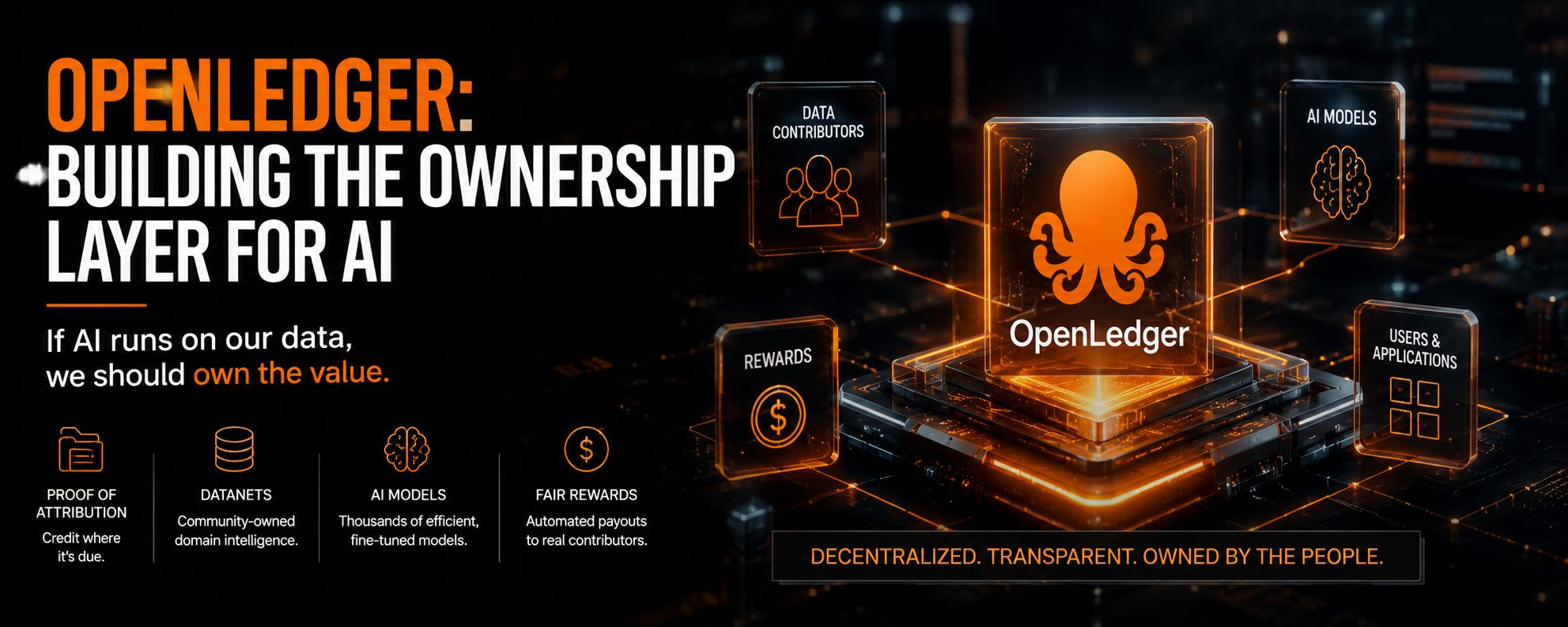
I almost rolled my eyes when I heard “AI + blockchain” again. Then I started reading about OpenLedger.
At first I had the exact same reaction most people probably have. Another AI + crypto project? Cool buzzwords, fancy graphics, same old story. Most of these projects sound huge at the start and then when you look deeper there’s honestly not much there.
But the more Iread about OpenLedger, the more I kept thinking…..
wait,
these guys might actually understand the real problem.
Because right now the AI industry feels kinda weird if you think about it.
All of us create data every day. ..We post online, write content, share ideas, build communities, create niche knowledge, everything. AI companies take all that data, train giant models on it, and make billions. Meanwhile normal people get basically nothing back.
That’s the part that always felt off to me.
OpenLedger is looking at it differently.
Their main idea is pretty simple:
If AI is trained using human data, then humans should also get paid when that data creates value....
Sounds obvious right? But actually building that system is insanely difficult.
You can’t just say “decentralized AI” and call it innovation. You need away to track where the data came from, which model used it, what output it helped create, and then somehow reward the right people automatically.
That’s the part where OpenLedger’s “Proof of Attribution” system got my attention.
Imagine in the future there’s some finance AI model. Maybe you contributed finance-related datasets a year earlier. Then later a company uses that AI model through an API. OpenLedger traces the contribution behind the scenes and recognizes your data helped train that output. Then you automatically earn from it...
That attribution layer honestly feels super underrated right now.
Because the biggest issue in AI may not even be intelligence anymore. It’s ownership.
And regulators are already starting to care about this stuff. Europe’s AI Act is asking questions like:
What data trained this model?
Did you have permission?
Can this data legally be used commercially?
Those questions are becoming real problems now, not just future debates.
Another thing that caught my attention was their partnership with Story Protocol. At first I thought it was just another random crypto partnership announcement. But the more I thought about it, the more strategic it looked.
A lot of people still think “open-source AI” automatically solves everything. It doesn’t. Companies care about legal clarity and compliance too. Big enterprise money only enters when they feel safe.
And honestly most crypto AI projects barely even talk about legal infrastructure.
Then there’s the Datanets idea.
This part is actually interesting because they’re not only talking about storing datasets. They want communities to build specialized domain intelligence together. Like healthcare AI, legal AI, biotech AI, trading AI, stuff like that...
Not every AI model needs to be another giant ChatGPT competitor.
Smaller niche models are probably gonna become massive because specialized data is extremely valuable. And OpenLedger seems to want an economy where those datasets and models can actually be owned and monetized by communities.
Now obviously there’s also reality here.
Some of what they’re talking about is already technically possible. LoRA models and lightweight fine-tuning changed a lot. You don’t always need giant GPU farms anymore to create useful specialized AI systems.
So when OpenLedger talks about running thousands of efficient fine-tuned models, that actually sounds realistic in theory.
But AI infrastructure is still crazy expensive.
And this is where things get difficult.
A blockchain narrative alone won’t create sustainable revenue. The real challenge is whether businesses actually adopt it.
Because enterprise companies care about reliability more than hype.
They want uptime.
Low latency.
Compliance.
Security.
Stable infrastructure.
They’re not gonna spend millions on something experimental just because it sounds futuristic.
So for me,
OpenLedger’s future really depends on two things:
Can they actually build enterprise-grade AI infrastructure?
And can this attribution system really work at large scale?
Because making a cool demo is one thing. Running aglobal AI economy is a completely different level.
Most AI tokens right now honestly just feel like attention farming. Everyone throws around words like “AI agents” and “autonomous economies” but when you look deeper there’s usually not much substance there....
OpenLedger feels different mainly because there’s an actual thesis underneath it.
If AI becomes as huge as people expect, then ownership, attribution, and revenue sharing probably become unavoidable eventually. Not optional.
And OpenLedger seems to be betting on that future really early.
I also checked their 9-layer roadmap and it’s pretty obvious they’re aiming much bigger than just launching another token. They’re trying to build an entire onchain AI operating layer around data, models, attribution, and monetization.
Will it work? Honestly I don’t know.
Token economies are difficult to sustain long term. Buyback models sound exciting at first but eventually real revenue matters more than hype. And decentralized governance can get messy fast because most token holders don’t fully understand complex protocol decisions anyway...
Maybe OpenLedger fails.
Maybe it pivots completely.
Maybe it ends up creating a whole new category.
Too early to know.
But one thing I genuinely believe after reading more about it:
This doesn’t feel like another empty
“next AI coin” project.
There’s real infrastructure ambition here. And in a market full of copy-paste narratives and fake hype, that alone makes it worth watching.
Let’s see where it goes.🚀