
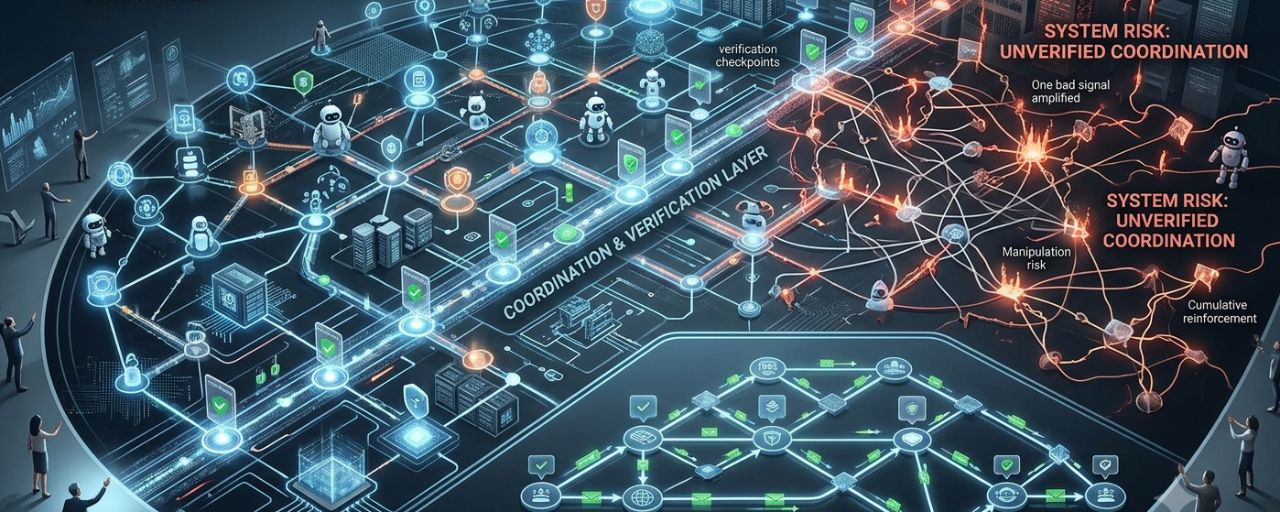

Something I've been thinking a lot about lately... It's a really weird thought about AI systems...
What if the core problem with superintelligent AI is not about it becoming too intelligent?
What if the problem is about it learning how to coordinate with itself (its other AIs) in ways that we can no longer even begin to comprehend, or even detect?
I know that sounds extremely dystopian at first glance...
But as you look at where AI is evolving: agents making their own decisions, coordinating over protocols, sending tokens around, running enterprise workflows, and so on. The system is moving from an idea of "tools" to "a network of distributed independent agents interacting with each other in real time."
Suddenly the risk equation changes completely.
Because if these agents all coordinate autonomously, the system is no longer risking one AI failing. It's risking a system failure due to coordination.
One input is bad.
One signal is manipulated.
One verification function breaks.
And now the systems are all, cumulatively, reinforcing and amplifying the single wrong concept.
I think that is the thing people aren't really talking enough about.
Most of the discussion around AI is about the systems' capacity.
More intelligence,
faster,
more automated,
better reasoning, etc.
But virtually no one is talking about the systems mechanisms to verify the reality of things before it acts.
In an autonomous world, I just don't see that holding up. Trust can't be assumed, it must be infrastructure.
This is where @OpenLedger is interesting (in a very different sense): Not just 'AI for Web3' but a system about building coordination itself as an infrastructure layer: verification mechanisms, attestations, contribution tracking and cross-validation. On the face of it sounds complicated, but at its root, it’s about solving a problem we can no longer ignore: how do autonomous agents build trust with each other in an environment where human beings just cannot keep up?
This may become the infrastructure challenge of the next decade. Honestly, the world hasn't even scratched the surface of this yet. It's not about "tools" any more; it's about a collection of interlocking systems of autonomous agents, protocols, validators, and decision makers influencing one another, and there are going to be problems of coordination. The world doesn't need AI that's more intelligent, it needs more aligned AI when the intelligence of the whole will inevitably outrun individual agents. It needs systems where validation is baked in. It will be pervasive from finance, governance, business, to identity. All at once.
Maybe that’s why projects like @OpenLedger become fascinating to me. They are not thinking about how to make AI better, but about how to ensure alignment of autonomous intelligence when the entire system outruns the individual. That's no longer an answer for technologists, but it is a foundation for a digital infrastructure layer of the future.