
Most people still look at OpenLedger as if it is only trying to become another AI blockchain. But that view may be far too small for what is actually happening.
Right now, many investors treat $OPEN like a short-term AI narrative token. Whenever AI hype increases, attention flows toward it. When hype slows down, interest fades again. But beneath the surface, OpenLedger appears to be building something much bigger than a simple AI ecosystem.
The real opportunity may not come from owning one AI chain. It may come from connecting many different AI ecosystems together.
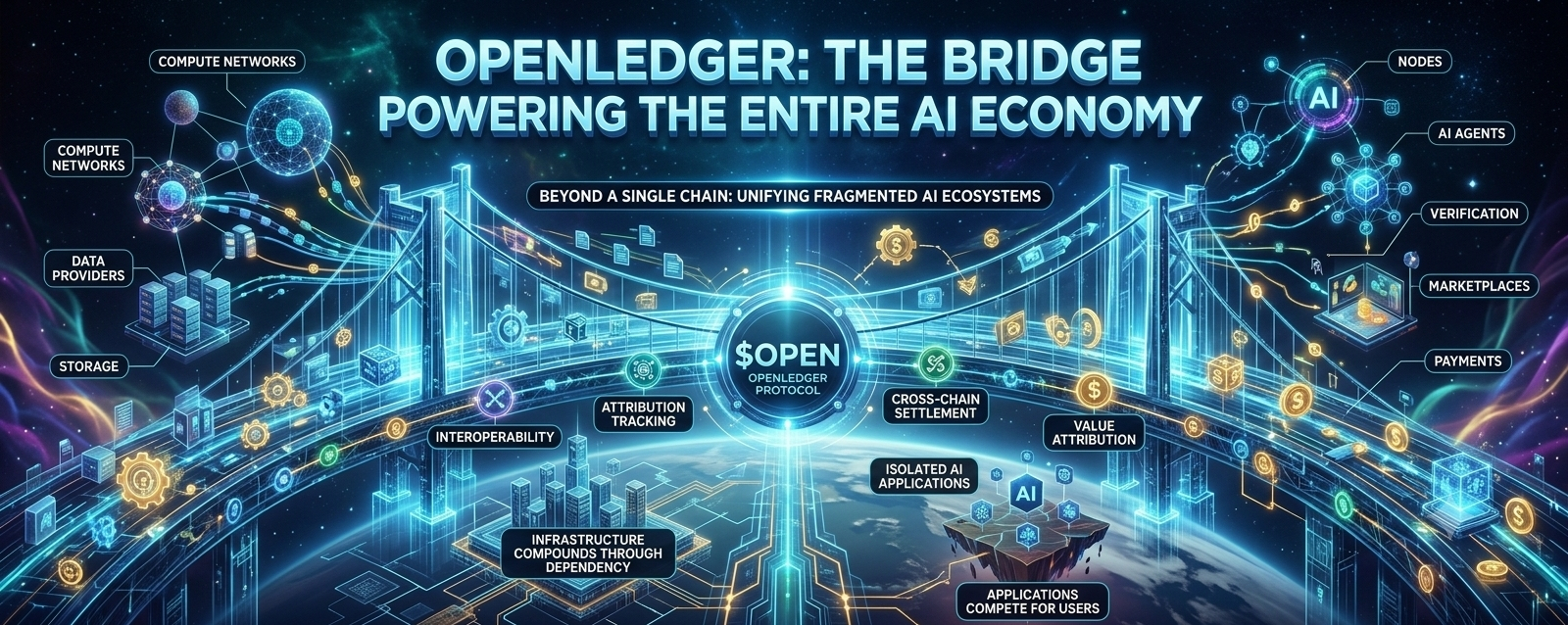
The future of decentralized AI already looks multi-chain. Data providers, AI agents, compute networks, and marketplaces are spreading across different blockchains because users and liquidity are fragmented everywhere. One chain may specialize in compute, another in payments, while another handles verification or storage. This means AI systems are no longer operating inside isolated environments.
That creates a major challenge.
How can value, trust, attribution, and payments move smoothly between all these ecosystems without breaking the economic structure behind them?
This is where OpenLedger’s direction becomes interesting.
Instead of focusing only on hosting AI applications, the project seems increasingly focused on interoperability infrastructure. In simple terms, it is working toward allowing AI-related activity to move across chains while keeping attribution, tracking, and settlement connected.
That matters more than many people realize.
In decentralized AI, value does not come from one single participant. A dataset may come from one network, verification may happen on another, compute may run somewhere else, while payments and monetization happen on an entirely different chain. Traditional blockchain structures are not designed for this type of coordination.
OpenLedger appears to be positioning itself as the layer that connects all these moving parts together.
If that model succeeds, $OPEN could evolve beyond being tied to one isolated ecosystem. Instead, it could become infrastructure supporting activity across multiple AI economies at once.
Markets often overlook infrastructure projects early because most attention goes toward flashy consumer applications. But history shows that infrastructure can become more valuable over time because entire ecosystems begin depending on it.
Applications compete for users.
Infrastructure compounds through usage and dependency.
That difference is important.
As decentralized AI grows, distribution and coordination may become more valuable than simply launching new models. AI agents of the future may not care which blockchain users prefer. They will care whether liquidity, verification, payments, and attribution can move seamlessly between networks.
Protocols capable of enabling that connectivity could become essential parts of the AI economy.
This is why OpenLedger may deserve a different valuation framework than most AI narrative tokens. It is not only competing to become another AI blockchain. It may be attempting to become the connective layer that allows fragmented AI ecosystems to function as one larger market.
And if decentralized AI truly becomes cross-chain by default, infrastructure that connects those economies could end up far more important than the applications built on top of them.