I used to wonder where the big AI companies like OpenAI or Google actually get their data to train models. Then I kind of answered my own question — they pull it from the internet, from books, from articles written by millions of people, and most of those contributors have never seen a single cent. OpenLedger is a project trying to flip that around, and the mechanism they use starts from something that sounds almost too simple — a hash on a blockchain.
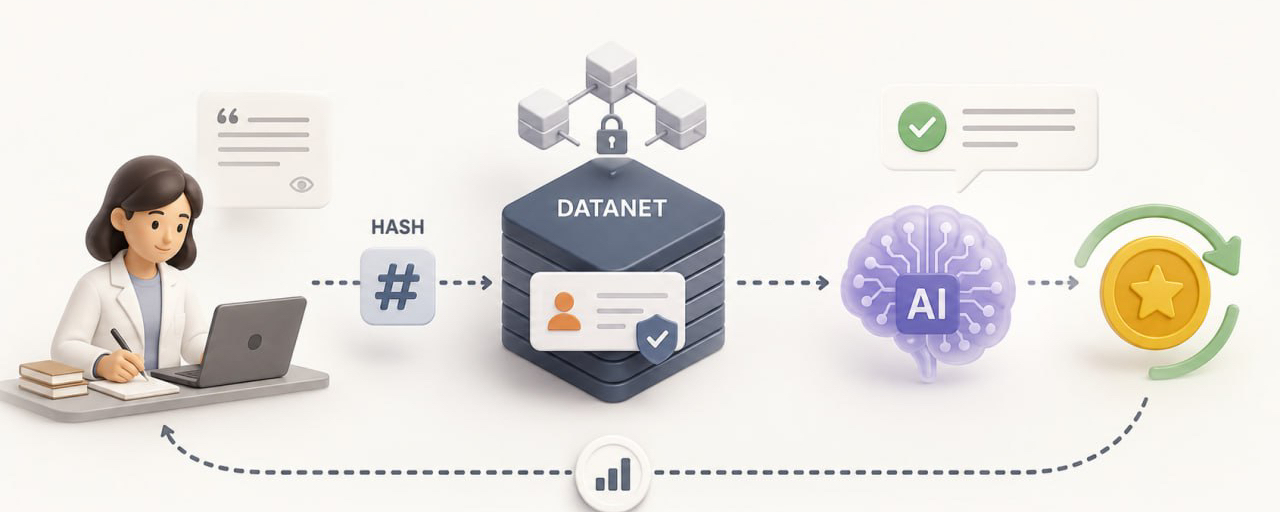
The data registration process on OpenLedger isn't complicated on first read, but when you sit with it for a bit it's actually pretty deep. The contributor picks a DataNet that fits their field, or deploys a new one if nothing exists yet. Then they submit data through a signed transaction that includes both the content and its metadata. OpenLedger hashes that datapoint in a deterministic way — meaning the same content always produces the same hash — to prevent duplicates and make tracing possible later. The actual content gets stored offchain through the DA layer, while the metadata and hash get committed directly to the DataNet's onchain contract.
What impressed me is that once indexed, the datapoint doesn't just sit there as a passive record. It becomes what OpenLedger calls an attribution-ready record — meaning it can be traced during AI inference later down the line, and if that data actually influenced a model's output, the contributor gets rewarded. Not just once at the time of submission, but every single time that data has real impact. OpenLedger calls this mechanism Proof of Attribution, or PoA.
The example they use in their documentation is about Maya, a healthcare researcher who submits a short snippet about red-green color blindness. That small piece of text, once hashed and indexed into an ophthalmology-focused DataNet, becomes a traceable part of the entire system. If a medical AI later answers a related question and that snippet contributed to the answer, OpenLedger will know — and Maya receives the corresponding reward. Sounds pretty clean on paper, but the more important thing is that accountability is recorded permanently. Nobody can wipe it.
This idea from OpenLedger lines up with something that's been gaining serious traction across both crypto and AI — the question of who actually owns data and who actually benefits from it. Over the past few years OpenAI and Google have been facing lawsuits over taking data without permission or payment. AI users are growing more skeptical about how their data gets used. OpenLedger approaches this from a different angle. Instead of waiting for regulators to step in, they build a system where the protocol itself enforces fairness from the start.
Another thing I found interesting is that a DataNet isn't just a storage layer — it maintains an internal index that tracks every datapoint, every contributor, and their accumulated influence score over time. That means the more your data gets used, the higher your score, and OpenLedger has mechanisms for that score to carry weight in governance too. That's pretty different from the usual "submit data, get token, done" setup you see in most other projects.
But honestly, the thing I keep thinking about isn't the technical side — it's the product design philosophy. OpenLedger is building in a direction where value flows from the product to the user, not the other way around. Most Web3 projects I've seen pull users in first with tokens, airdrops, hype, and worry about the product later. OpenLedger starts with a real problem — AI data has no attribution — then builds the technical mechanism to solve it, then attaches the reward system on top of that. That order of operations just feels more correct.Of course I wouldn't say OpenLedger has solved everything. There are still open questions about how accurate the attribution algorithm actually is in practice, whether large models can realistically integrate with it, or whether OPEN token has enough liquidity for the rewards to mean anything. But the direction is clearly right, and the technical foundation they're laying from that very first hash looks solid enough.
I always tell people who are new to crypto — look at what problem the project is actually solving before you look at the token price. OpenLedger is at least showing you they know exactly what problem they're trying to solve. @OpenLedger $OPEN #OpenLedge $EDEN $BNB #OpenLedger