
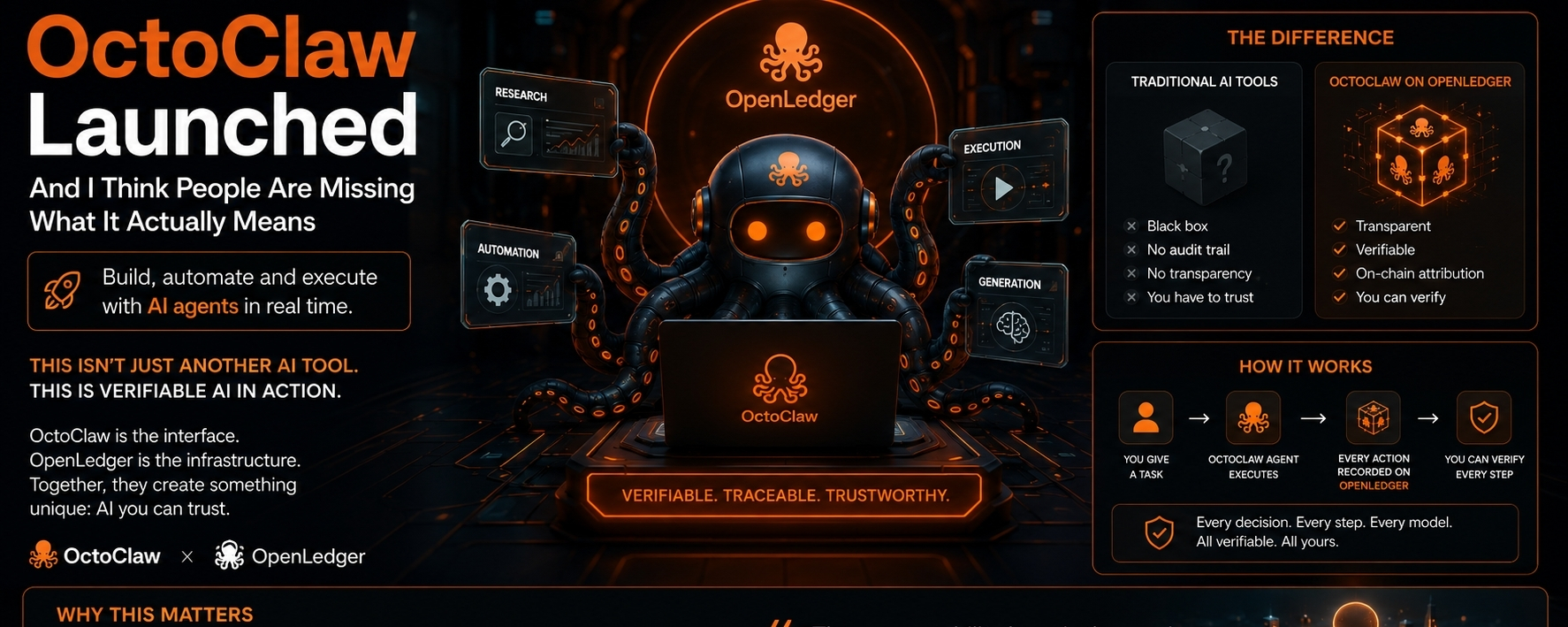

There is something about the way OctoClaw was announced that I keep thinking about. Most project launches in this space come with a lot of noise. Numbers. Comparisons. Lists of features. OctoClaw launched with a simple line. Build, automate and execute with AI agents in real time.
That simplicity is either confidence or overstatement. After spending time with it I am leaning toward confidence.
Here is what I think most people are not fully grasping yet.
OctoClaw is not just an automation tool sitting on top of OpenLedger. It is closer to a proof of concept for the entire vision. OpenLedger has been building infrastructure for verifiable ownable AI since its mainnet launched. Data attribution, model training, inference tracking. All of that exists at the infrastructure layer. But infrastructure without a usable interface is hard to evaluate.
OctoClaw is the interface.
When the agent connects research, automation, execution and generation inside one platform, it is not doing that independently. It is doing it on OpenLedger's infrastructure. Which means every action the agent takes, every task it executes, every on chain workflow it triggers, that is all being recorded and attributed. You can trace what happened, why it happened, which model made the decision.
That is completely different from using any other AI agent tool right now.
Most agent tools operate as black boxes. You give them a task, they do something, you see a result. You cannot audit the path from input to output. With OctoClaw running on OpenLedger's verifiable stack, the decision trail exists. It is not invisible.
I think for regular users that might sound abstract right now. Like okay the agent's decisions are on chain, so what? But think about it from a slightly different angle. Imagine you are using an AI agent to handle something important. Research for a decision. Execution of a transaction. Automation of a workflow that has real consequences. Would you rather have a tool that produces a result and expects you to trust it or a tool where you can actually check what information it used, what path it took, what model version was running?
The accountability layer is the product. OctoClaw just makes that product actually usable.
There is also something worth noting about timing. AI agents are everywhere right now. Every major platform is launching something. Most of them are racing to add features. OpenLedger did it differently. They built the infrastructure layer first, got the attribution mechanics working, and then released an agent product on top of that foundation. That sequence matters.
It is much harder to retrofit transparency into an existing product than to build it in from the beginning.
OctoClaw feels like the beginning of something bigger than a single product launch. It feels like the moment the infrastructure started showing its face to regular users.
Whether that connection lands with the broader market or stays technical for now I genuinely do not know. But for anyone paying attention to what verifiable AI infrastructure actually means in practice, this launch is worth more than the usual attention a product launch gets.
What do you think about it? Feel free to share your experience and opinion.