
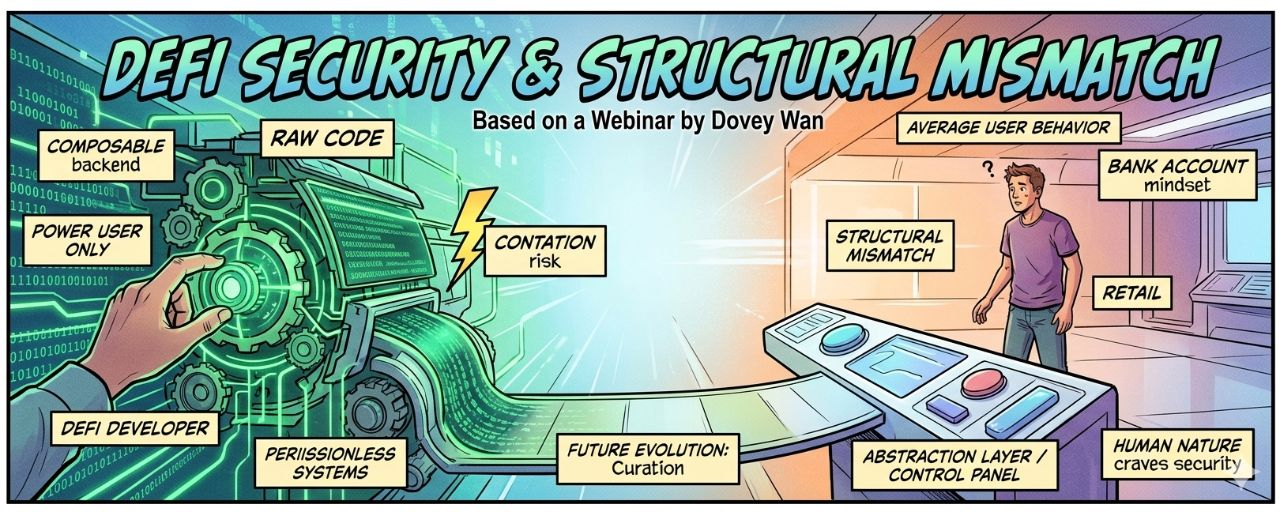

I just caught an incredibly sharp webinar on Binance Square featuring Dovey Wan, and she dropped a reality check that completely changed how I look at decentralized finance. While the industry spends billions trying to patch smart contract exploits and perfect cryptoeconomic models, Dovey pointed out a much deeper, systemic flaw: we are building infrastructure for cypherpunks but marketing it to everyday savers.
If you’ve been feeling like something is fundamentally misaligned in the DeFi space lately, this is exactly why.
The Power-User Paradox DeFi was built on the core pillars of being permissionless and completely composable. That sounds amazing on paper, but here is the brutal truth: the average person interacts with a DeFi protocol the exact same way they interact with a traditional bank account.
Most users don't have the technical skills to audit raw Solidity code before hitting "confirm" on a transaction. In crypto, we love to talk about "democratizing finance," but when you drop retail habits into a raw, adversarial, code-is-law environment without any guardrails, you aren't empowering people—you are weaponizing technical asymmetry against them.
Composability: Superpower vs. Contagion We always celebrate composability (the ability for different protocols to plug into each other like Lego bricks) as DeFi’s ultimate superpower. And during a raging bull market, it absolutely is. It creates a beautiful, hyper-efficient loop where capital can scale exponentially.
But there is a dark side we rarely admit. In a structural downturn or a massive shock, that tight interconnectedness acts as a lightning-fast conductor for systemic contagion. When one brick cracks, the whole tower shakes instantly.
Quote to Ponder: "Composability is a superpower in the bull market, but it can come with contagion in a very structural situation."
The Optimistic Flip: Enter the "Abstraction Layer" So, is DeFi doomed to be a playground exclusively for elite power users? Absolutely not. In fact, acknowledging this structural mismatch is exactly how we get to the next level of mass adoption.
Human nature inherently craves security, curation, and simplicity. The market is starting to realize that the average user shouldn't be interacting directly with raw backend protocols. This friction is birthing a massive new frontier in Web3: The Abstraction Layer. Instead of forcing everyone to become a code auditor, the next wave of successful projects will build simplified, intelligent control panels on top of DeFi's complex machinery. We are moving toward a highly functional, dual-layered financial system: hyper-efficient, decentralized rails on the backend, and secure, intuitive, curated experiences on the frontend.
The Big Shift DeFi isn't failing; it’s growing up. The chaos we see today is just the natural friction of an infrastructure trying to scale to fit human psychology. By abstracting the complexity away, we can finally protect users without losing the trustless, sovereign foundation that makes decentralization worth fighting for in the first place.
What’s your take? Do you think the future of Web3 lies entirely in these curated "control panels," or does abstracting the tech away ruin the true spirit of permissionless finance? Let’s spark a discussion in the comments below! 👇
Replay : https://www.binance.com/en/square/audio?id=40384885552369