
What are they actually using?
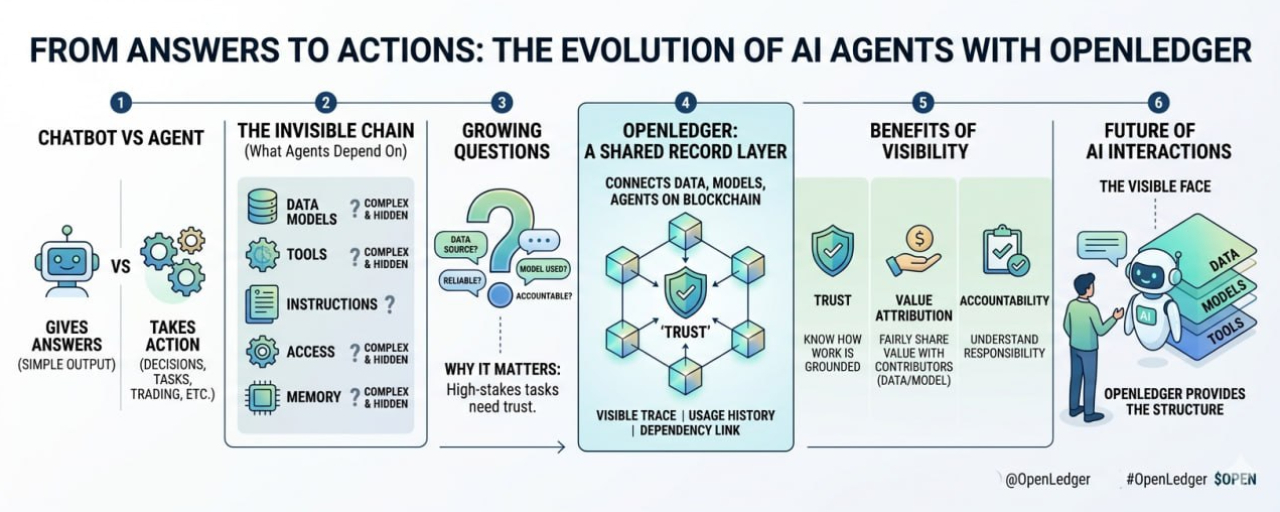
At first, agents look simple from the outside. You give them a task. They search, decide, write, sort, trade, book, compare, summarize, or automate something. The output arrives, and if it works, most people do not think too deeply about the layers behind it.
But agents are not working from empty space.
They depend on data.
They depend on models.
They depend on tools, instructions, access, memory, and sometimes other agents.
That whole chain can become hard to see.
And maybe that is where OpenLedger becomes interesting from a different angle. Not only as a place for AI data or models, but as a possible record layer for the things agents depend on while they work.
Because once agents begin doing more serious tasks, the old way of looking at AI may not be enough.
A chatbot gives an answer. An agent takes action.
That difference sounds small, but it changes the whole conversation.
If an AI agent only writes a paragraph, maybe people mostly care about whether the paragraph is useful. But if an agent makes a decision, recommends a financial move, filters business leads, handles customer tasks, manages digital assets, or interacts with other systems, then people start asking more careful questions.
Where did the agent get its information?
Which model did it use?
Was the data current?
Was the tool reliable?
Who benefits if the agent creates value?
Who is responsible if something goes wrong?
These questions are not always loud at the beginning. They usually appear later, after people start depending on the system.
You can usually tell when a tool is becoming important because people stop asking only what it can do. They start asking what it is connected to.
OpenLedger seems to sit inside that shift.
Its idea of connecting data, models, and agents is not just about making AI assets easier to monetize. There is another layer underneath that. It is about making the working parts of AI less invisible.
That matters more with agents than with simple outputs.
An agent may use a specialized dataset to understand a market. It may rely on a model trained for a certain type of reasoning. It may call another service to complete part of a task. It may produce results that people act on. If all of this happens in a closed system, the agent may look useful, but the path behind its work remains unclear.
That can be fine for small things.
But not for everything.
As agents become more active, people may want some kind of proof of what was used. Not a long explanation every time. Not a technical report that nobody reads. Just a clearer record. A way to know that the agent’s work did not come from nowhere.
That is where blockchain can become more than a label.
A shared record can help show how pieces connect. Data can have a trace. Models can have usage history. Agents can be linked to the resources they depend on. Contributions can become part of the structure rather than disappearing after the output is produced.
It is not about making AI feel less intelligent.
It is about making AI work feel less mysterious.
There is a difference.
People do not need to see every detail to trust a system. But they often need enough visibility to feel that the system has some ground under it. In AI, that ground is usually made of training data, model design, feedback, and use. If those pieces are hidden completely, trust becomes harder.
OpenLedger appears to be trying to create a place where those pieces can be treated as part of a living network.
That phrase can sound abstract, but the idea is simple enough. AI agents will probably not work alone. They will use many resources. If those resources are recorded and connected, it becomes easier to understand how value is being created.
And also easier to ask who should share in that value.
An agent that performs well might not be valuable only because of its code. It might be valuable because it uses a rare dataset, or a fine-tuned model, or expert feedback that shaped its behavior. If those inputs are invisible, the agent becomes the only visible asset. Everything behind it becomes background.
That is often how value gets lost.
OpenLedger’s approach suggests something different. Maybe the background should not stay background forever. Maybe data, models, and agents should have clearer relationships with each other. Maybe the system should remember what contributes to what.
Not in a perfect way. These things are difficult. Attribution in AI is messy. Data quality is hard to judge. Agents can behave unpredictably. And building a useful market around all of this is much easier to describe than to actually make work.
Still, the direction feels understandable.
AI is moving from answers to actions. That means the systems around AI need to mature too. It is not enough for agents to be fast. They may need to be accountable. It is not enough for models to be powerful. They may need a visible connection to the inputs that shaped them. It is not enough for data to be useful. It may need a path to keep earning value when it continues to matter.
That is the quieter side of OpenLedger.
It is not only asking how AI can become more advanced. It is asking how AI activity can leave a record. How the invisible parts can be connected. How agents can operate in a way where the resources behind them are not completely erased.
That feels important because agents may become one of the main ways people interact with AI.
Not by opening a model directly, but by using agents that sit between the user and the system. Agents that choose, combine, act, and respond. When that happens, the agent becomes the face of many hidden layers.
And hidden layers need structure.
Maybe OpenLedger is trying to provide some of that structure. A place where data, models, and agents can be linked with more memory. A place where value does not have to stop at the final output. A place where the work behind the work has a better chance of being seen.
It is still early, and the real test will always be whether people use it for real tasks.
But the question it raises feels like one that will stay around.
When agents start doing more for us, we may want to know what they are carrying with them…