
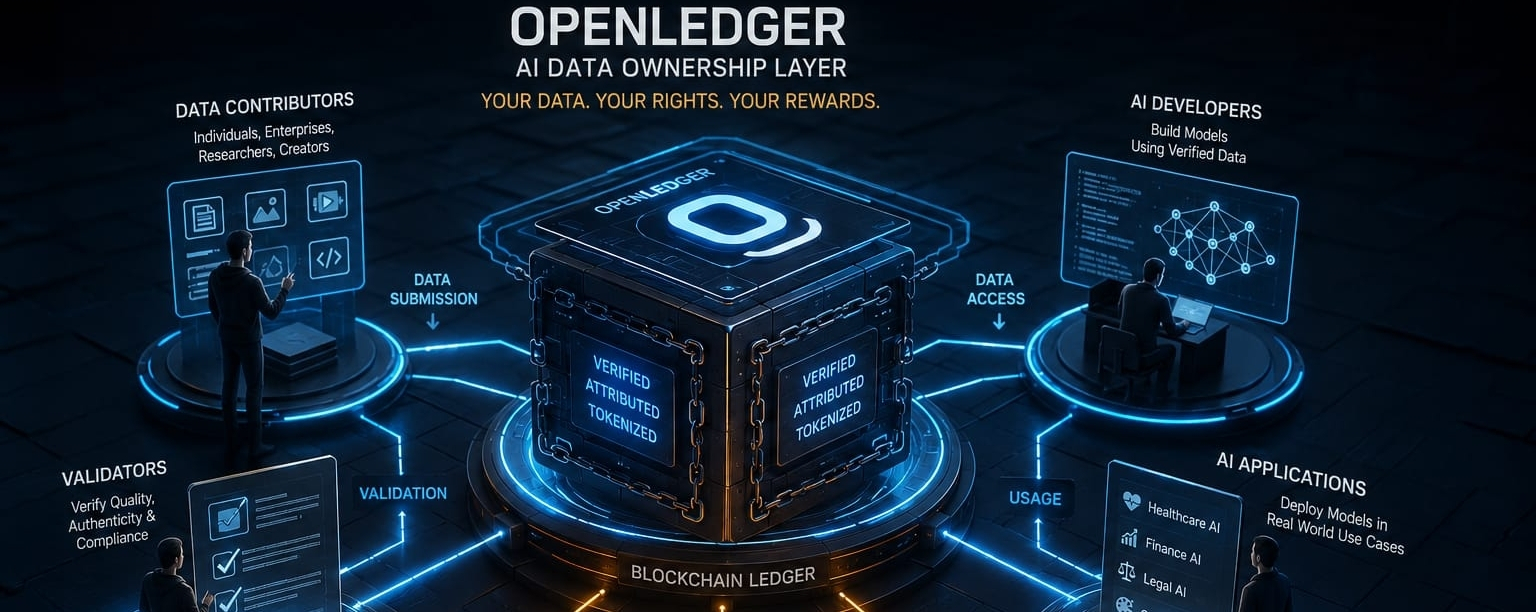
Look, the core pitch behind OpenLedger sounds smart the first time you hear it.
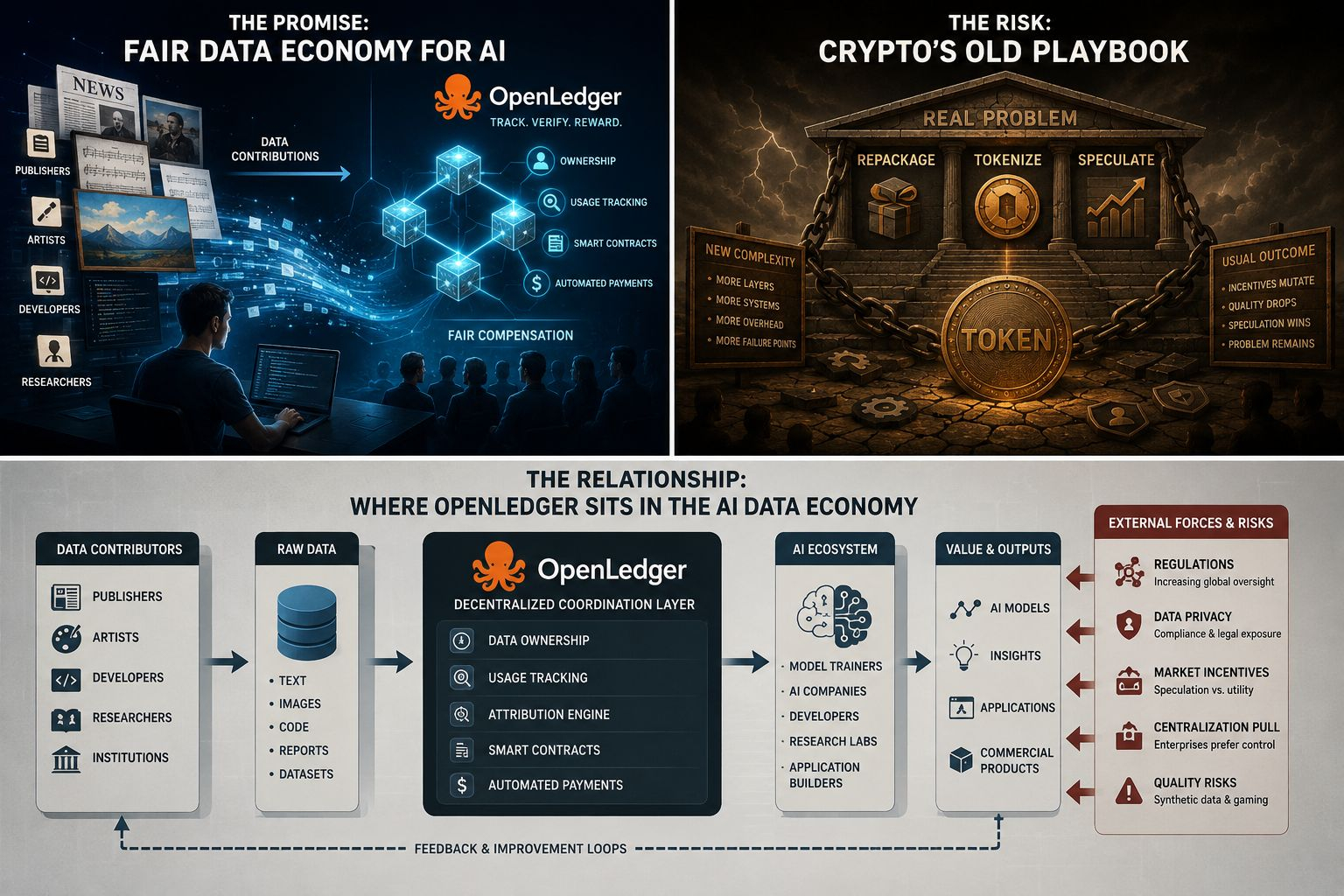
Artificial intelligence systems are consuming massive amounts of data. Nobody really knows who should get paid when their data gets folded into an AI model. Companies scrape the internet, train giant systems, then monetize the outputs while the original contributors often get nothing. OpenLedger steps into that mess and says: “We can track data ownership, verify contributions, and distribute rewards fairly using blockchain.”
Clean story. Very clean.
And to be fair, the problem itself is real.

AI companies are running into growing resistance from publishers, artists, developers, researchers, and governments. Data ownership is turning into a legal and economic battlefield. Courts are getting involved. Regulators are circling. Media companies suddenly realize that years of archived reporting may have been quietly absorbed into training datasets worth billions.
So OpenLedger positions itself as infrastructure for the new AI economy. A neutral coordination layer where datasets, AI models, contributors, and developers interact transparently. Data goes in. Usage gets tracked. Payments flow back automatically.
It sounds tidy.
On paper, at least.
But I’ve seen this movie before. Many times.
The crypto industry has a long history of taking a genuine problem, wrapping it in a token economy, and then introducing an entirely new category of operational headaches in the process. Sometimes the original problem remains unsolved while the new complexity becomes the actual business.
That risk hangs all over OpenLedger.
Because when you strip away the diagrams and whitepapers, the project is basically trying to answer one brutally difficult question: can blockchain realistically coordinate the messy economics of AI data better than traditional systems can?
That is a much harder challenge than the marketing implies.
Let’s start with the problem they claim to fix.
The AI industry absolutely has an attribution issue. Modern machine learning systems are built on oceans of data pulled from countless sources. Once information enters a training pipeline, tracing precise contribution value becomes messy fast. One dataset influences another. Outputs become probabilistic. Models compress and remix information in ways that even the engineers themselves often struggle to interpret clearly.
Now insert blockchain into that environment.
The promise is transparency. Immutable records. Contributor tracking. Smart contracts. Automated compensation. The dream is that every piece of data becomes economically traceable.
But here’s the catch nobody likes talking about.
AI systems are not neat accounting systems. They are statistical engines.
The relationship between a specific dataset and a model’s eventual output is rarely linear. How exactly do you measure the value of one contributor’s dataset inside a model trained on millions or billions of interconnected inputs? What percentage of a generated medical insight belongs to one hospital dataset versus another? What happens when datasets conflict? Or degrade? Or contain synthetic contamination?
This is where the elegant blockchain narrative starts colliding with the ugly reality of machine learning.
Attribution inside AI is not just a technical problem. It is a philosophical one.
And OpenLedger’s answer appears to be: put more infrastructure in the middle.
That’s where my skepticism kicks in.
Because every new coordination layer creates friction. More validation systems. More governance systems. More token mechanics. More identity management. More operational overhead. More things that can fail.
Crypto people love the phrase “decentralized infrastructure.” Fine. But infrastructure only matters if it becomes simpler than the existing alternatives. Otherwise businesses ignore it.
And businesses are usually ruthless about simplicity.
A pharmaceutical company building proprietary AI tools does not care about blockchain ideology. It cares about legal liability, compliance, reliability, and operational control. If something breaks, executives want somebody accountable. They do not want a decentralized governance debate happening across token holders on Discord.
This is the part crypto founders consistently underestimate.
Human institutions prefer centralization when money and risk are involved.
They may tolerate decentralization around the edges. But when core operations are at stake, somebody always wants authority, enforcement, and a phone number to call during a crisis.
OpenLedger says it wants to create decentralized coordination for AI ecosystems. Fine. But coordination itself tends to centralize over time. It always does.
Look at cloud computing.
The early internet promised distributed infrastructure. Then Amazon, Microsoft, and Google absorbed huge portions of global computing into centralized hyperscale systems because enterprises prioritized convenience and reliability over ideological purity.
The same gravitational force exists here.
Even if OpenLedger succeeds technically, large AI players may simply replicate similar attribution systems internally while keeping control centralized. Why share economics openly if you already dominate the market?
That brings us to the token.
Ah yes. The token.
Every crypto infrastructure project eventually reaches this moment where the economics become impossible to ignore. OpenLedger’s token is supposed to incentivize participation, reward contributors, coordinate settlement, and secure the network.
Maybe.
Or maybe it becomes the real product.
I’ve watched this pattern repeat for two decades across different waves of technology hype. The infrastructure narrative attracts serious investors. The token creates liquidity. Communities form around speculative upside. Early backers position themselves before broader market attention arrives. Suddenly everyone starts talking about “ecosystem growth.”
Translation: people are betting the token price goes up.
And that changes behavior immediately.
Instead of optimizing for stable infrastructure, participants optimize for extraction. Low-quality contributors flood the network because incentives reward activity. Speculators dominate governance. Short-term token appreciation becomes more important than long-term operational reliability.
The incentives quietly mutate.
OpenLedger is especially vulnerable here because AI itself is already suffering from quality degradation problems. Synthetic data contamination is becoming a growing concern across the industry. Models increasingly train on outputs generated by other models. Feedback loops form. Accuracy drifts.
Now imagine adding token farming behavior into that environment.
You think people won’t game the system for rewards?
Come on.
They absolutely will.
And then there’s regulation. This is where things become genuinely uncomfortable.
OpenLedger sits directly between two industries regulators increasingly distrust: crypto and AI.
That is not a comfortable place to build infrastructure.
Governments are tightening rules around data ownership, AI transparency, privacy controls, and digital assets simultaneously. Europe is moving aggressively on AI governance. Copyright lawsuits are multiplying. Securities regulators still have not fully clarified how many crypto tokens should legally be classified.
OpenLedger is effectively trying to build a cross-border economic system around AI data flows during the exact moment governments are becoming more territorial about digital control.
That timing may turn out to be terrible.
Because despite all the talk about decentralization, nation states still control legal enforcement. They control courts. They control compliance requirements. And increasingly, they want visibility into AI systems touching sensitive industries.
Permissionless systems sound exciting right up until regulators show up asking who is legally responsible when something goes wrong.
That question matters more than whitepapers.
And here’s the deeper issue nobody in these ecosystems likes admitting openly: most users do not actually care about decentralization. They care about convenience.
If centralized AI platforms provide easier workflows, faster deployment, stronger support, and simpler compliance, enterprises will choose them almost every time. Ideology rarely beats operational efficiency in commercial markets.
That is the cold reality underneath all this.
Now, to be fair, OpenLedger is not a ridiculous idea. The underlying problem is legitimate. AI attribution and data economics are becoming major structural issues. Somebody will eventually build systems around provenance, compensation, and trust layers for machine learning infrastructure.
But building a useful system and building a sustainable crypto economy are two completely different challenges.
The marketing tends to blend them together.
That’s the part worth watching carefully.
Because sometimes the token exists to support the infrastructure.
And sometimes the infrastructure exists to support the token.
The difference usually becomes obvious only after the speculation fades.
