


Artificial intelligence has a massive ownership problem.
Most people just haven’t noticed it yet.
Every day, millions of users feed AI systems with prompts, conversations, images, behavioral data, and endless streams of digital exhaust. Developers train models for years. Researchers publish breakthroughs. Communities test products for free without realizing they’re acting as unpaid infrastructure.
Meanwhile, a small cluster of tech giants sits on top of the stack collecting the real value.
That imbalance is exactly where OpenLedger (OPEN) is trying to wedge itself into the conversation. The project is pitching something bigger than another AI-themed crypto token. It wants to build an economic layer where data, AI models, and autonomous agents can actually function as liquid assets instead of trapped corporate property.
Sounds ambitious. Maybe uncomfortably ambitious.
I’ve been watching crypto long enough to know most projects collapse somewhere between the whitepaper and reality. Usually under the weight of bad incentives, governance drama, or developer burnout. Sometimes all three at once. AI projects are even messier because now you’re stacking computational complexity on top of blockchain infrastructure that already struggles with scalability headaches.
Still, OpenLedger is tapping into a real pressure point inside the AI industry.
Ownership.
That’s the whole game now.
The current AI economy runs on centralized infrastructure. Large companies control the compute layers, cloud access, training pipelines, and massive datasets required to build sophisticated models. If you’re a smaller developer trying to compete, good luck. You’re entering a knife fight against firms with billion-dollar GPU budgets and entire legal departments dedicated to keeping competitors boxed out.
Here’s the catch.
AI systems don’t magically appear out of nowhere. They’re trained on oceans of human-generated information. Text. Images. Voice recordings. Medical records. Financial activity. Online behavior. Every digital breadcrumb matters.
Data became the fuel. Quietly.
The real kicker is that the people generating this data rarely own anything connected to the systems they help create. They feed the machine while corporations monetize the output at industrial scale.
OpenLedger wants to flip that dynamic by creating what it calls “AI liquidity.” Underneath the buzzword soup, the concept is actually pretty straightforward. The protocol is trying to make AI-related assets — datasets, models, and AI agents — tradable, monetizable, and economically interoperable through blockchain infrastructure.
Think of it like turning intelligence itself into a marketplace.
Weird sentence. But that’s where this industry is heading.
Take datasets. Right now, most valuable AI training data sits locked inside private silos controlled by corporations, institutions, or cloud providers. OpenLedger is betting that contributors should be able to monetize access to high-quality datasets the same way creators monetize digital assets elsewhere online.
In theory, a healthcare researcher with anonymized diagnostic data could contribute to decentralized AI training systems and receive ongoing compensation tied to usage or model performance.
In theory.
Reality is uglier.
Healthcare data alone opens a minefield of privacy laws, compliance issues, and regulatory headaches capable of killing projects before they even leave beta. Governments are already nervous about AI. Add tokenized data economies into the mix and regulators start reaching for aspirin.
But the idea itself isn’t crazy.
And that’s why people are paying attention.
The same logic applies to AI models.
Building high-performance machine learning systems is brutally expensive. Most independent developers can’t afford the infrastructure costs required to train competitive models, especially now that GPU prices look like they were designed by luxury watch dealers.
OpenLedger’s answer is model liquidity.
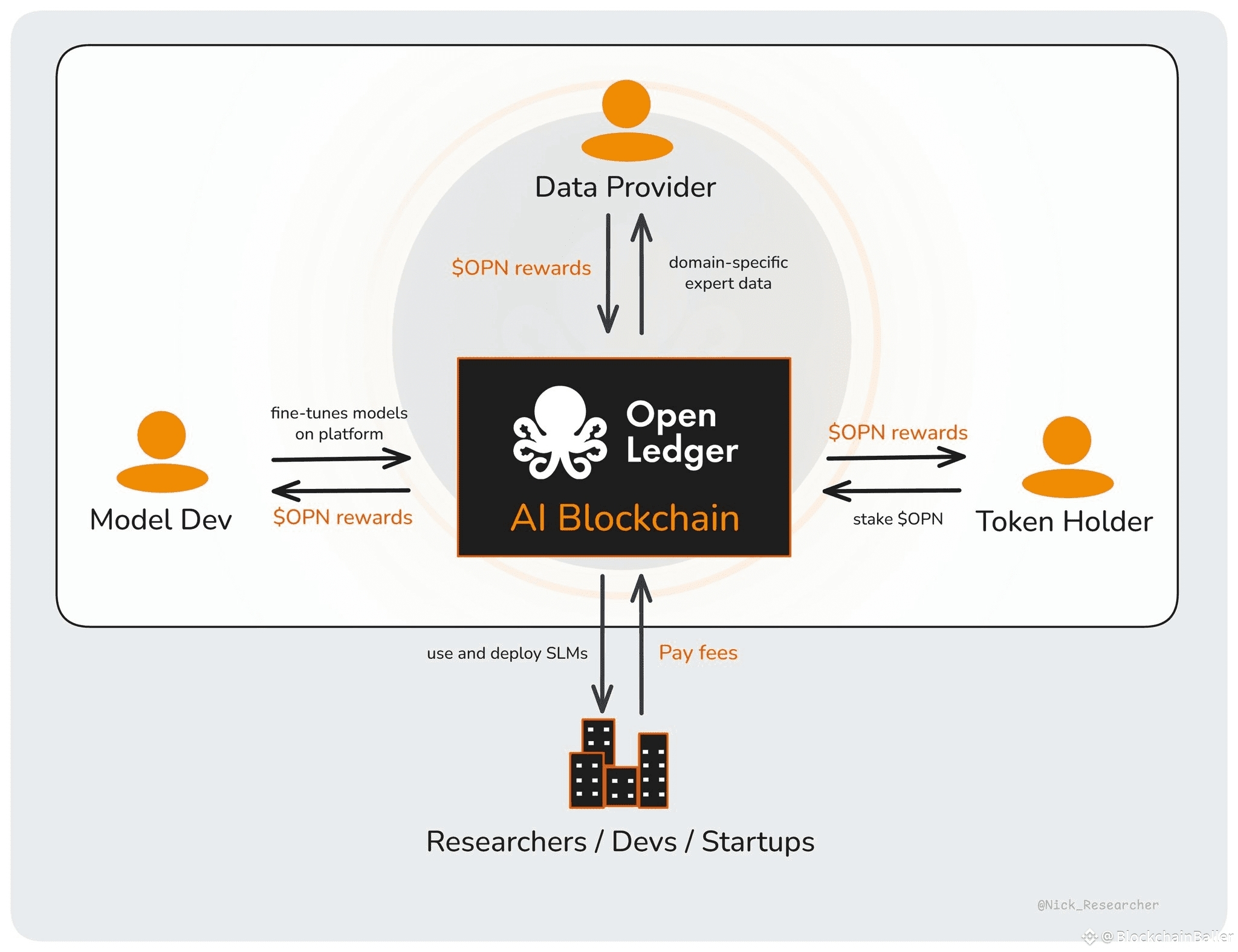
Instead of treating AI models as isolated software products, the protocol frames them as productive digital assets capable of generating continuous value inside decentralized ecosystems. Developers deploy models. Users access them. Payments flow automatically through blockchain rails.
Simple concept. Hard execution.
Because once you move beyond the pitch deck, things get chaotic fast.
Latency becomes a problem. Scaling becomes a problem. Validation becomes a problem. Bad actors become a problem. You suddenly need mechanisms to verify whether datasets are legitimate, whether models actually perform as advertised, and whether contributors are gaming reward systems.
I’ve seen this pattern before in crypto infrastructure projects. Elegant tokenomics diagrams collapse the second real users show up and start stress-testing the network in unpredictable ways.
And then there’s the AI agent layer. This is where OpenLedger starts drifting into territory that feels less like fintech and more like early-stage cyberpunk economics.
AI agents are autonomous systems capable of acting independently. Trading bots. Research assistants. Customer service engines. Automated workflow operators. OpenLedger envisions these agents functioning almost like economic participants inside decentralized ecosystems.
Picture an autonomous trading agent running 24 hours a day across digital markets, analyzing volatility and executing strategies without human oversight. Revenue generated by the system gets distributed automatically between developers, data providers, validators, and infrastructure operators.
Tiny machine economies.
That’s the direction this space is moving toward whether people are comfortable with it or not.
Now things get interesting.
Because decentralized AI doesn’t just challenge technical infrastructure. It challenges power structures. Large AI firms benefit enormously from controlling the full stack — data, compute, distribution, and monetization. Open ecosystems threaten parts of that dominance.
And corporate ego rarely gives up territory quietly.
The AI industry already feels increasingly concentrated. A few firms control massive portions of the compute market while smaller developers depend on infrastructure they don’t own. That creates fragility. If you’ve followed tech long enough, you know what usually happens when too much power accumulates in too few places.
Pressure builds.
OpenLedger is part of a broader movement trying to decentralize pieces of the AI economy before those power structures fully harden into permanent monopolies.
Whether that actually works is another question entirely.
Because decentralized systems come with their own flavor of chaos.
Governance fights. Funding pressure. Community fragmentation. Smart contract bugs hiding deep inside protocol architecture. Incentive systems that look brilliant until market conditions shift and the entire thing starts wobbling sideways.
Crypto history is filled with projects that sounded revolutionary right up until liquidity evaporated and Discord channels turned into digital ghost towns.
That skepticism matters.
But skepticism cuts both ways. Ignoring decentralized AI entirely would be shortsighted too. There’s growing demand for alternatives to closed AI ecosystems. Developers want more ownership. Researchers want transparency. Smaller startups want infrastructure access without begging giant cloud providers for permission.
That demand is real. I hear it constantly.
And honestly, OpenLedger’s timing makes sense. AI is no longer just a software category. It’s becoming economic infrastructure. Whoever controls the intelligence layer will shape massive chunks of the digital economy over the next decade.
That’s why projects like this matter even if they never fully achieve their original vision.
The bottom line?
OpenLedger is trying to build a system where intelligence behaves less like locked corporate property and more like an open marketplace. Data contributors get incentives. Developers monetize models directly. Autonomous AI agents plug into decentralized financial rails.
It’s ambitious. Complicated. Probably vulnerable to the same bugs, scaling failures, and governance headaches that haunt most crypto infrastructure projects.
But underneath the chaos sits a legitimate question the tech industry still hasn’t answered properly:
Who should own artificial intelligence?
Right now, the answer is “whoever owns the servers.”
OpenLedger is betting that answer eventually changes.
