Why I Think OpenLedger Could Become One of the Most Important AI Infrastructure Projects in Crypto
Over the last few months, I’ve been spending more time researching AI related crypto projects than almost any other sector.
Not because AI is simply trending.
Not because every token with “AI” in the name suddenly starts pumping during market hype.
And definitely not because influencers on crypto Twitter keep repeating the same narratives every day.
The reason is much simpler.
I genuinely believe AI is slowly becoming part of almost everything people do online.
Trading.
Search.
Content creation.
Gaming.
Automation.
Business workflows.
Customer support.
Data analysis.
Even the way applications themselves interact with users is changing.
And once you start thinking from that angle, you begin realizing something important:
The biggest long term opportunities may not come from AI apps themselves.
They may come from the infrastructure layer powering the entire AI economy behind the scenes.
That’s exactly why @OpenLedger started catching my attention recently.
At first glance, I honestly assumed it was another project trying to combine blockchain and AI because the narrative is hot right now.
We’ve already seen hundreds of projects do that.
Most launch with big promises.
Most get temporary attention.
Most disappear once hype fades.
But after digging deeper into OpenLedger, I think the project is trying to solve a much bigger problem that very few people are talking about properly yet.
Ownership inside AI systems.
And honestly, I think this conversation becomes much bigger over time.
Today, most AI systems operate like closed economies.
Huge amounts of value are created from data contributors, evaluators, human feedback, model trainers, specialized researchers, and distributed infrastructure providers.
But almost nobody outside the top layer captures meaningful value from that process.
People contribute.
Models improve.
Companies monetize.
The contributors disappear into the background.
That structure works for centralized corporations.
But it creates massive inefficiencies for an open internet economy.
And this is where OpenLedger feels different from many AI narratives I’ve seen recently.
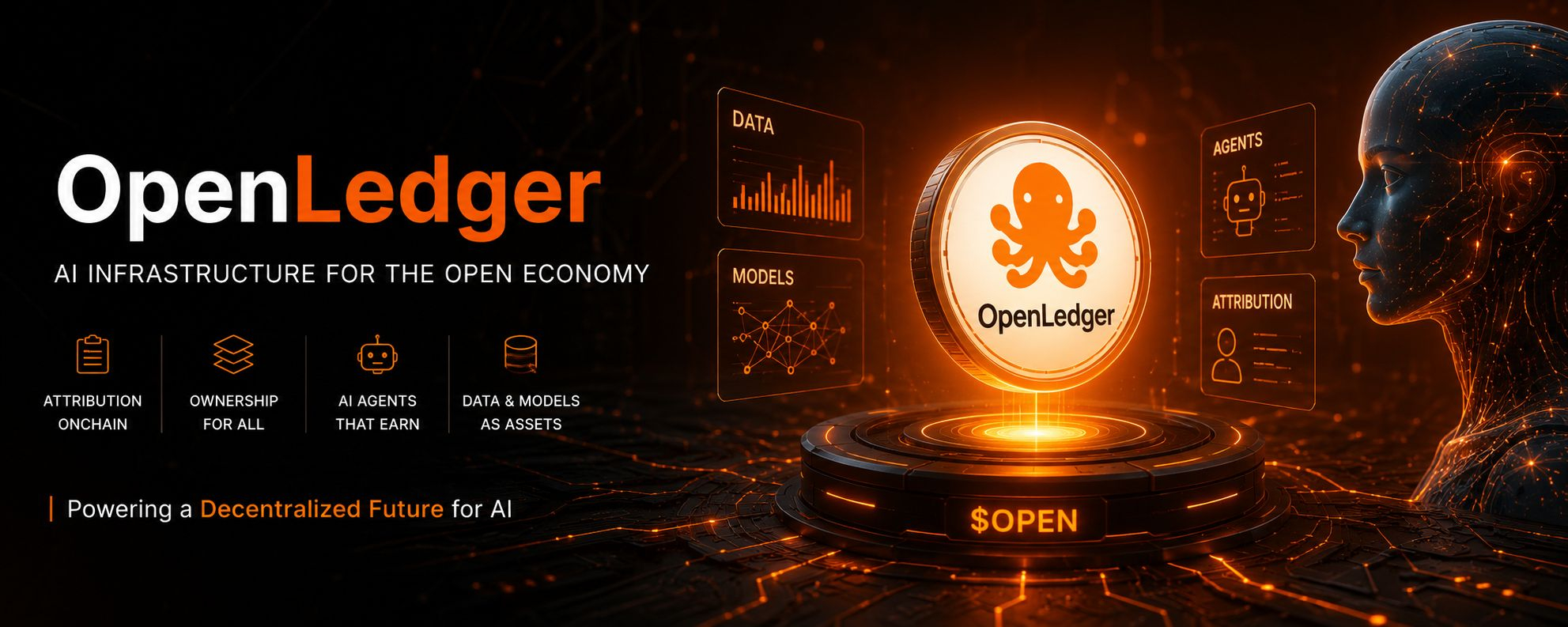
Instead of focusing only on AI outputs, OpenLedger appears focused on attribution, ownership, coordination, and monetization around AI itself.
That distinction matters.
Because AI is no longer only about building smarter models.
The future challenge is how intelligence gets coordinated, distributed, verified, monetized, and trusted across decentralized systems.
And honestly, most crypto projects are still not solving that layer properly.
One thing I found especially interesting is the project’s approach toward turning datasets, AI models, and autonomous agents into onchain economic assets.
That idea may sound simple at first.
But if AI becomes deeply integrated into global internet infrastructure over the next decade, then ownership rails around intelligence could become extremely valuable.
Right now, contributors rarely know how much their data improved a model.
Developers rarely receive transparent attribution.
Communities rarely participate in the upside generated from systems they helped build.
OpenLedger is trying to create infrastructure where attribution itself becomes part of the economic layer.
That’s a very different direction compared to most speculative AI tokens.
And personally, I think infrastructure narratives usually become much bigger later in market cycles.
The market often starts with hype.
Then eventually capital rotates toward systems actually powering the narrative underneath.
We’ve seen this happen multiple times before in crypto.
At first people chase applications.
Later they realize the infrastructure layer captures enormous long term value.
The same thing happened with exchanges.
Layer 1s.
Cloud infrastructure.
Data availability.
Oracles.
DeFi liquidity rails.
And now I think AI infrastructure could follow a similar path.
Another reason OpenLedger caught my attention is because the conversation around AI trading itself is evolving fast.
Most AI trading discussions still focus heavily on prediction.
People obsess over signals.
Price forecasts.
Trend detection.
Sentiment analysis.
But honestly, in fragmented onchain markets, the real differentiator increasingly looks like execution.
Execution quality.
Routing logic.
Cross venue coordination.
Liquidity access.
Risk management.
Continuous feedback systems.
As autonomous systems mature, AI agents will likely require far more sophisticated infrastructure behind the scenes.
And that infrastructure cannot rely entirely on centralized systems forever.
This is where OpenLedger’s broader positioning starts becoming more interesting to me.
Instead of building another short term AI product, they appear to be thinking about the economic coordination layer behind autonomous systems themselves.
That feels far more important long term.
Especially as decentralized AI ecosystems continue growing.
I also think many people underestimate how early we still are.
The AI sector inside crypto remains extremely immature compared to where it could eventually go.
Right now, most market participants still focus mainly on narratives and short term price action.
But eventually the market starts asking harder questions:
Who owns the data?
Who gets rewarded?
Who controls attribution?
How is trust verified?
How are contributors compensated?
How do autonomous agents coordinate economically?
How do decentralized AI systems interact across ecosystems?
Those are infrastructure questions.
And infrastructure questions usually become extremely valuable once adoption scales.
That doesn’t mean every AI infrastructure project succeeds.
Most probably won’t.
Crypto moves fast.
Narratives rotate constantly.
Speculation dominates attention.
But I do think OpenLedger is positioning itself inside one of the more important long term conversations happening right now.
And personally, I’d rather spend time researching projects building foundational layers than simply chasing temporary hype every week.
Because if AI truly becomes integrated into everything online over the next decade, then the systems coordinating ownership, attribution, execution, and monetization may quietly become some of the most valuable layers in the market.
That’s why I’ve been paying much closer attention to $OPEN recently.
Not because of hype.
Because the infrastructure thesis itself actually makes sense to me.
And in crypto, the narratives that make the most sense early are often the ones people understand much later.