
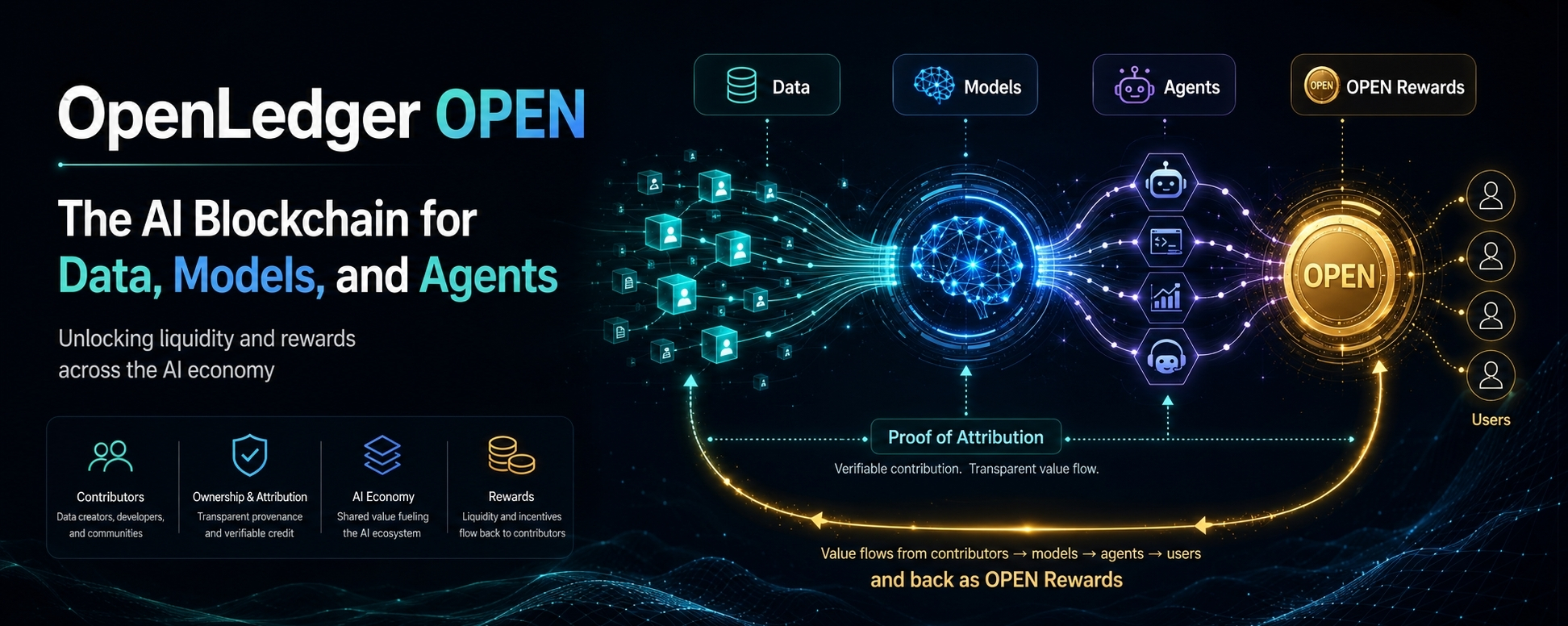

@OpenLedger OPEN feels like one of those ideas that comes from a real frustration people have been carrying for a long time. AI is growing fast. Everyone can see it. It is changing how people write, build, research, trade, learn, work, and make decisions. But there is one uncomfortable truth behind all of this growth. AI did not become powerful on its own. It learned from data. It learned from people. It learned from communities, developers, writers, researchers, users, and builders who created useful information for years. And still, many of those people never receive any credit, ownership, or reward when their work helps an AI system become valuable. That is the problem OpenLedger is trying to fix. It is built to make data, models, and agents easier to track, easier to use, and easier to reward. In simple words, OpenLedger wants AI to stop forgetting the people who helped build it.
This is why the project feels important. The AI world has created a strange situation where millions of people helped create the knowledge layer of the internet, but the rewards often go to the platforms that package that knowledge into products. A person can write helpful content. A developer can publish useful code. A community can collect rare information. A researcher can share insight. A user can generate valuable activity. Later, that value may help train or improve an AI model, but the original contributor may never know. There is no thank you. There is no payment. There is no ownership. OpenLedger is trying to create a different path. It wants AI value to have a memory. It wants the system to remember where useful data came from, who built the model, who improved it, who used it, and who should be rewarded when value is created.
The easiest way to understand OpenLedger is to think of it as an economy for AI assets. In this economy, data is not just background material. It is an asset. Models are not just hidden tools sitting inside private systems. They are assets too. Agents are not just simple bots. They can become useful digital workers that create value. OpenLedger is built to connect all of these pieces together. Data can help train a model. A model can power an application. An agent can use that model to complete tasks for users. Users can pay for useful outputs. Then the system can send rewards back to the people and assets that helped make those outputs possible. That is the emotional heart of OpenLedger. It is not only talking about technology. It is talking about fairness.
The way OpenLedger works starts with data because data is the foundation of AI. Without data, AI cannot understand anything. It cannot understand language, markets, code, images, user behavior, business problems, or real-world patterns. But not all data has the same value. Good data needs to be collected, cleaned, organized, updated, and trusted. OpenLedger uses the idea of Datanets, which are community-driven data networks. A Datanet is like a living pool of useful data with a history attached to it. It is not just a random file that gets uploaded and forgotten. It has contributors. It has ownership records. It has a purpose. If that data later helps a model become better, the network can connect that value back to the people who helped create the dataset.
This is a big shift because in many traditional AI systems, data gets swallowed. Once it enters the model, it becomes almost invisible. Nobody can easily see which data mattered, who contributed it, or how much it helped. OpenLedger is trying to make data visible again. If a community builds a strong dataset, that dataset should not disappear into someone else’s product without recognition. If it helps create useful AI results, it should have a chance to earn. That is a more respectful way to think about data. It treats contribution as something alive, not something that gets used once and thrown away.
After data comes the model. A model is the system that learns from data and produces results. It can answer questions, write content, analyze information, make predictions, support business workflows, or power agents. OpenLedger is designed so builders can create, improve, register, and deploy models with a clearer record of ownership and usage. When a model is registered on-chain, it gets an identity inside the ecosystem. That identity can help show who created the model, what kind of data shaped it, and how it is being used. This matters because many AI models today feel hidden. People use them, but they do not always know what is behind them. OpenLedger wants models to be more open, more traceable, and more connected to the value they create.
Agents are another major part of the OpenLedger vision. An AI agent is not just something that gives a reply. It can work through tasks, use tools, follow instructions, and help people get things done. As agents become more common, they may become a major part of the internet economy. They may help with research, customer support, finance, automation, content, development, and daily work. But if agents are going to create real value, then the world needs a better way to track what powers them. Which model does the agent use? Which data helped that model? Who built the agent? Who should earn when the agent performs useful work? OpenLedger is trying to give answers to those questions by connecting agents to the wider data and model economy.
One of the most important parts of OpenLedger is Proof of Attribution. The term may sound complicated, but the idea is very easy to understand. Proof of Attribution is about figuring out what helped an AI output happen. When a model gives an answer, that answer did not appear from nowhere. It came from training, data, model updates, and builder work. Proof of Attribution tries to trace the influence behind the result. If certain data helped produce a useful answer, that data can be recognized. If a builder created the model, the builder can be rewarded. If an agent delivered that answer to a user, that role can also be part of the reward flow. In a simple way, Proof of Attribution gives AI a way to remember who helped it become useful.
This matters because people are tired of black boxes. They do not want to keep feeding systems that never tell them where value goes. They do not want their work to be used silently. They do not want to see AI become powerful while the contributors behind it remain invisible. OpenLedger tries to open that black box. It wants value to leave a trail. That trail can create trust because users can better understand where outputs come from. It can also create rewards because contributors can be paid when their work helps create something useful. That is why Proof of Attribution is more than a technical feature. It is a fairness feature.
The architecture of OpenLedger can be explained in simple layers. The blockchain layer is the base. It records important actions such as payments, model records, dataset records, usage, and reward flows. This gives the ecosystem a shared record that cannot be easily changed in secret. The registry layer works like a record book for AI assets. It gives datasets, models, and agents an identity. The attribution layer tries to understand which data helped create value. The builder layer gives developers tools to create models, launch applications, and build agents. The user layer is where people interact with those models and agents and pay for useful results. All of these layers work together to create a system where AI value can move more clearly.
The reason this kind of architecture matters is that AI needs more than simple payments. A normal blockchain can show that one wallet paid another wallet, but AI needs to track deeper relationships. It needs to know what data was used, which model was created, which agent used the model, which user paid for the output, and which contributors deserve part of the reward. OpenLedger is trying to build around these AI-specific needs. It is not only about moving tokens. It is about moving value across the full AI supply chain. Data feeds models. Models power agents. Agents serve users. Users pay for results. Rewards move back to contributors and builders. Then more people have a reason to join.
OPEN is the token that connects this whole system. It can be used to pay for activity on the network. It can be used when users access AI models or services. It can reward model builders when their models are used. It can reward data contributors when their data helps create value. It can also support governance, which means holders may help shape the future of the network. The token becomes meaningful when the ecosystem has real activity. If people are building models, using agents, contributing data, and paying for AI outputs, OPEN becomes the fuel that keeps the system moving.
The reward flow is easy to imagine. Someone contributes a useful dataset. A developer uses that data to improve a model. The model gets registered in the OpenLedger ecosystem. An agent or application uses that model to help a user. The user pays in OPEN because the output is useful. The system checks which data and model helped create the value. Then rewards can move back to the data contributor, the model builder, and the network participants. That is the kind of loop OpenLedger wants to create. It gives people a reason to contribute instead of feeling used. It gives builders a reason to build instead of struggling to monetize. It gives users access to specialized AI services while supporting the people behind them.
This is especially important for specialized AI. General AI can answer many things, but real-world use cases often need something deeper and more focused. A finance model needs accurate market and transaction data. A healthcare model needs trusted medical information. A mapping model needs location data. An environmental model needs sensor data. A customer support model needs product knowledge. A Web3 model needs blockchain activity and ecosystem context. These models cannot be strong without specialized data. And specialized data usually comes from people or groups who understand that specific area. OpenLedger is trying to give those people a reason to bring their knowledge into the AI economy.
For builders, OpenLedger can make AI monetization feel more direct. Many developers know how to build useful models or agents, but turning that work into income is not always easy. They need infrastructure, users, payment systems, distribution, and trust. OpenLedger tries to bring these pieces together. A builder can create a model, register it, make it available, and earn when it is used. If the model relies on community data, the contributors can also earn. This creates better alignment. Builders and data providers are not standing on opposite sides. They are part of the same value chain.
For data contributors, the idea is even more emotional. These are the people who have often been ignored in the AI story. They create useful information. They collect knowledge. They maintain communities. They build resources. But when AI systems become valuable, they usually do not get a share. OpenLedger gives them a different message. It says your data can matter. Your work can be seen. Your contribution can have a record. If your data helps create value, you should have a path to rewards. That is powerful because people do not want to be treated like free fuel for machines. They want respect. They want ownership. They want a fair chance to benefit from the future they helped build.
For users, OpenLedger can also create a better experience because it may make AI more transparent. When someone receives an AI answer, they often wonder where it came from. Is it reliable? Is it based on useful data? Did the model just make something up? A system with attribution can help build more trust because the output can be connected to traceable sources and registered models. Users may also get access to more specialized tools because different builders can create different models and agents inside the same ecosystem. That can make the AI market more open, more competitive, and more useful.
Adoption is where OpenLedger has to prove itself. A strong vision is not enough. The network needs real users, strong datasets, useful models, active builders, working agents, and rewards that feel meaningful. If contributors do not earn enough, they may not stay. If models are not useful, users will not pay. If agents do not solve real problems, the ecosystem will not grow. But if the system works, OpenLedger can create a powerful loop where better data leads to better models, better models lead to better agents, better agents attract more users, and more usage creates more rewards. That is how the ecosystem can become stronger over time.
Binance Exchange can matter as a place where more people may discover OPEN, follow its market activity, and learn about the project. For many crypto users, Binance is a major gateway for research, access, and visibility. But attention alone is not enough. OpenLedger’s future depends on real usefulness. The project has to show that data can be rewarded, models can earn, agents can create value, and users can trust the system. Visibility can bring people to the door, but real utility is what keeps them inside.
What comes next for OpenLedger is bigger than one token or one project. AI is moving toward a world where models are specialized, agents are active, and data becomes more valuable than ever. That future needs infrastructure that can track contribution and reward value properly. It needs systems where builders can earn from usage. It needs data networks where contributors are not ignored. It needs users who can trust where AI outputs come from. OpenLedger is trying to become that missing layer between AI creation and AI monetization.
The bigger reason OpenLedger matters is that it gives Web3 a real role in the AI age. Web3 is strongest when it gives people ownership, access, and participation. AI is strongest when it helps people solve real problems. OpenLedger brings these two ideas together. It uses blockchain as a way to record contribution, move payments, support ownership, and share rewards. If this works, Web3 becomes more than speculation. It becomes the economic foundation for AI systems that people actually use.
OpenLedger’s story is powerful because it is really about fairness. It asks a simple question that matters more every year: who should benefit when AI becomes valuable? Should the value stay trapped inside closed systems, or should contributors, builders, and communities have a share? OpenLedger chooses the more open path. It is built to make data visible, models rewardable, agents monetizable, and AI value traceable. OPEN ties the system together through payments, rewards, governance, and usage. If OpenLedger succeeds, it could help create a future where intelligence is not controlled only by a few closed systems, where contributors are not forgotten, and where AI value flows back to the people who helped create it. That is why OpenLedger matters for Web3. It gives Web3 a human mission in the AI era: to make intelligence more open, more fair, and more shared.
