
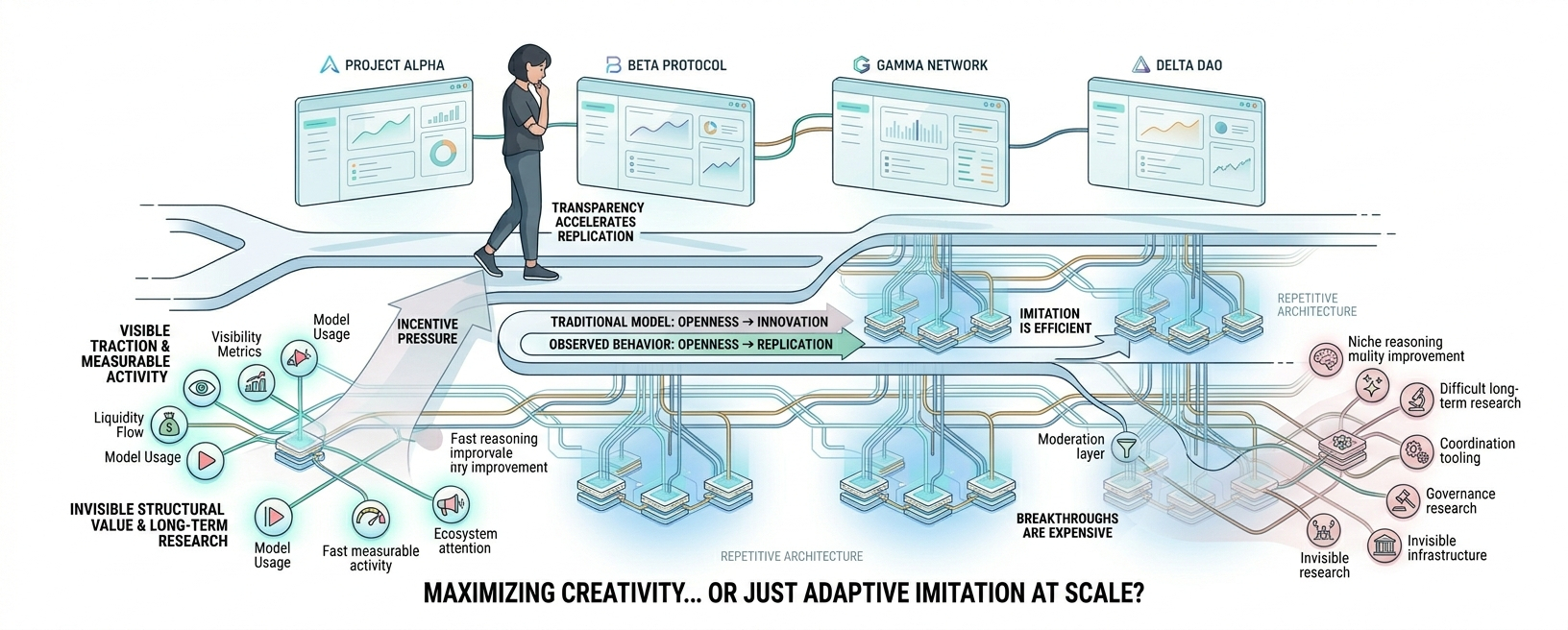


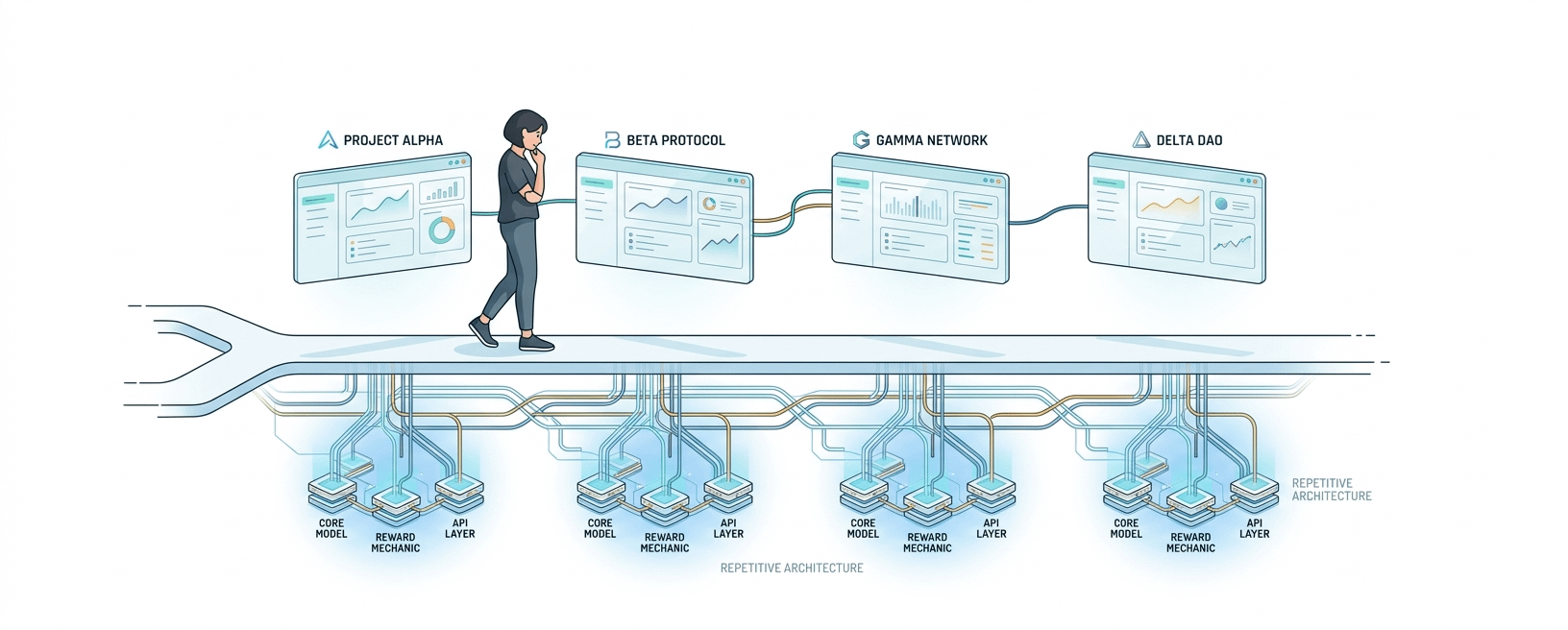
Ran through a few OpenLedger contributor dashboards earlier and something felt strangely repetitive.
Different teams. Different branding. Almost identical model behavior.
One builder slightly adjusted response latency, another changed reward mechanics around access tiers, but underneath, the architectures looked heavily derivative of whatever already had traction inside the ecosystem.
That kept bothering me more than I expected.
Most people assume open model economies naturally accelerate innovation because more people can build publicly. Honestly, I used to think that too. But the more I observe contributor behavior in decentralized AI systems, the more it feels like openness can quietly incentivize imitation over experimentation.
Because breakthroughs are expensive.
Copying is efficient.
And incentives rarely reward difficulty evenly.
If OpenLedger rewards visibility, engagement, liquidity flow, or model usage, then builders slowly adapt toward whatever already performs well inside those metrics. Not necessarily because they lack creativity. Sometimes because surviving economically inside open ecosystems requires reducing uncertainty first.
That changes builder psychology in subtle ways.
I noticed one contributor recently stop working on a niche reasoning model they had been refining for months. A week later they pivoted toward lightweight agent infrastructure because similar projects were receiving more ecosystem attention and liquidity incentives. Rational decision probably.
Still felt revealing.
The tension here is fairness across contribution types.
Some contributors produce infrastructure no one notices directly. Others create datasets, moderation layers, coordination tooling, or governance research that improves ecosystem quality indirectly over time. But financial markets tend to reward visible traction faster than invisible structural value.
And honestly, liquidity incentives make this harder.
Once tokenized rewards become central to ecosystem growth, builder priorities can slowly drift away from difficult long-term research toward faster measurable activity. Systems begin optimizing around participation metrics because participation is easier to quantify than genuine intellectual advancement.
What I kept coming back to is the contradiction between transparency and profitability.
Open ecosystems improve collaboration because architectures, data structures, and behavioral patterns remain visible across the network. But transparency also accelerates competitive replication. The moment a profitable strategy emerges, dozens of variations appear almost immediately.
That creates this strange cycle where originality becomes economically fragile.
And decentralized AI does not automatically solve power concentration either. People assume value distribution becomes fairer because ownership fragments across participants. But powerful agents can still dominate ecosystem attention through coordination advantages, liquidity access, narrative shaping, or sheer operational scale.
Attention itself becomes infrastructure.
The protocol may decentralize contribution access while attention markets quietly centralize influence underneath. That part feels under-discussed to me.
I also think ecosystem openness increases manipulation surfaces more than people admit.
The more transparent the coordination layer becomes, the easier it is for sophisticated actors to study incentive structures, identify behavioral weaknesses, and optimize influence strategies around them. Bots learn faster. Narrative loops tighten. Participants begin reacting to visibility mechanics almost subconsciously.
And maybe that’s the deeper contradiction inside decentralized AI economies.
The same openness designed to distribute innovation more widely might also distribute behavioral optimization pressures more efficiently across the entire ecosystem.
So I keep wondering whether open model economies are actually maximizing creativity…
or just maximizing adaptive imitation at scale.
