

A few months ago I would’ve separated AI infrastructure from crypto infrastructure almost automatically.
Now the boundary looks artificial. Or maybe temporary.
Crypto spent years building mechanisms for liquidity because idle assets annoyed the market. Everything moved toward circulation eventually tokens, collateral, synthetic exposure, governance rights. Once markets could touch an asset, the pressure to financialize it usually arrived fast.
AI capability accelerated at the same time, but the layers underneath still feel oddly frozen.
Datasets disappear into private systems. Compute access narrows around companies that secured hardware early enough. Even powerful models behave more like controlled industrial assets than open infrastructure. People keep describing the AI race as a competition between models while the deeper struggle increasingly looks logistical.
Warehouses full of GPUs. Energy contracts. Data pipelines nobody outside the companies ever sees.
After enough time around these systems, the model layer starts feeling almost secondary.
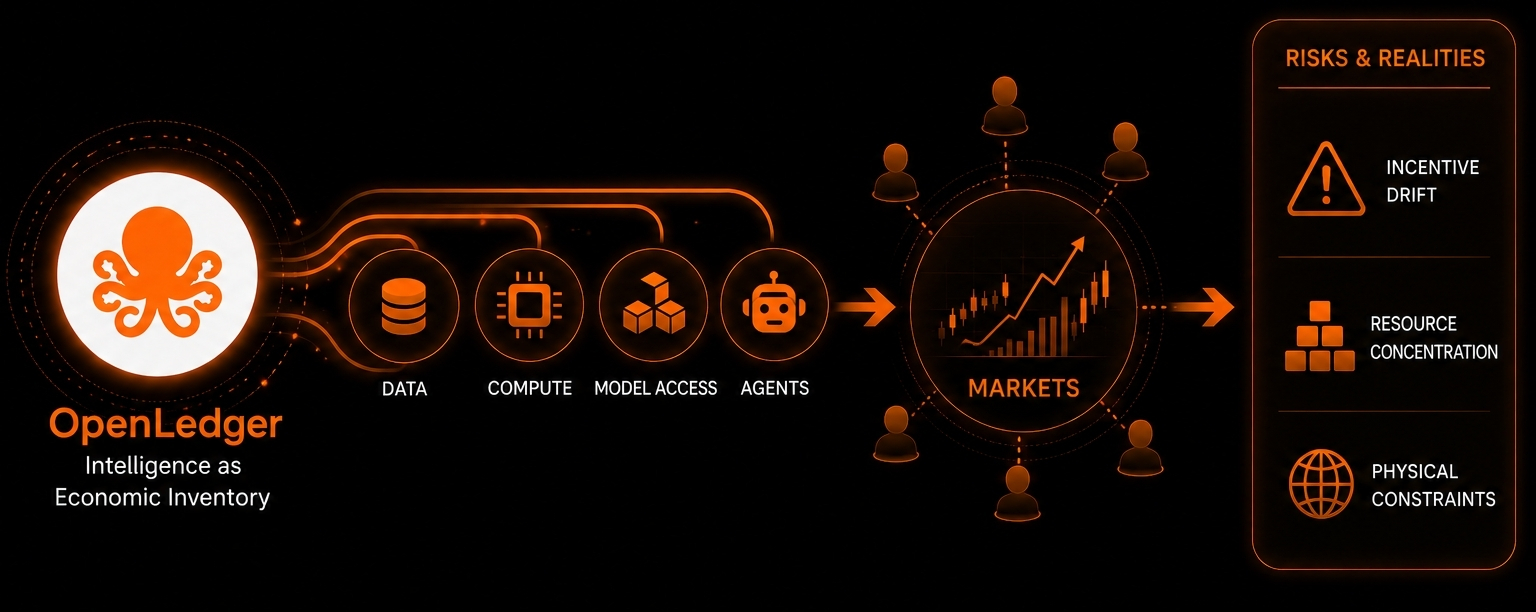
OpenLedger kept pulling me back to that thought for one reason. Not the blockchain framing itself. Crypto can wrap almost anything in a token narrative now. The stranger part is watching a system treat intelligence production as something markets can coordinate directly instead of something corporations fully warehouse internally.
Data starts circulating economically instead of sitting dormant inside closed platforms. Compute access becomes negotiable infrastructure. Fragments of models, inference access, eventually agents themselves begin behaving less like software products and more like economic inventory moving between participants.
Not quite software anymore.
I still don’t completely trust where that leads.
Markets mobilize dormant assets incredibly well. Nuance usually gets crushed somewhere a few layers later. DeFi already exposed that pattern repeatedly. Once yield enters the picture, incentives reorganize faster than verification systems do.
Inside something like OpenLedger, contribution probably stops feeling ideological very quickly.
Low quality datasets would inevitably get monetized before reputation systems mature enough to filter them properly. Smaller groups controlling scarce compute during supply bottlenecks accumulate leverage regardless of how decentralized the coordination layer appears on paper. Agents optimized for monetizable behavior drift away from reliable behavior because markets rarely reward restraint naturally.
And none of this removes the physical concentration problem underneath AI.
That part keeps lingering in the background no matter how abstract the conversation becomes. Hardware supply chains remain concentrated. Energy infrastructure remains concentrated. Advanced compute still depends on real-world industrial systems that decentralization narratives can’t fully abstract away.
Which makes the whole thing feel less like a clean technological transition and more like financial infrastructure slowly crawling underneath cognition itself.
Maybe that was unavoidable once intelligence became modular enough to distribute across networks.
Maybe not.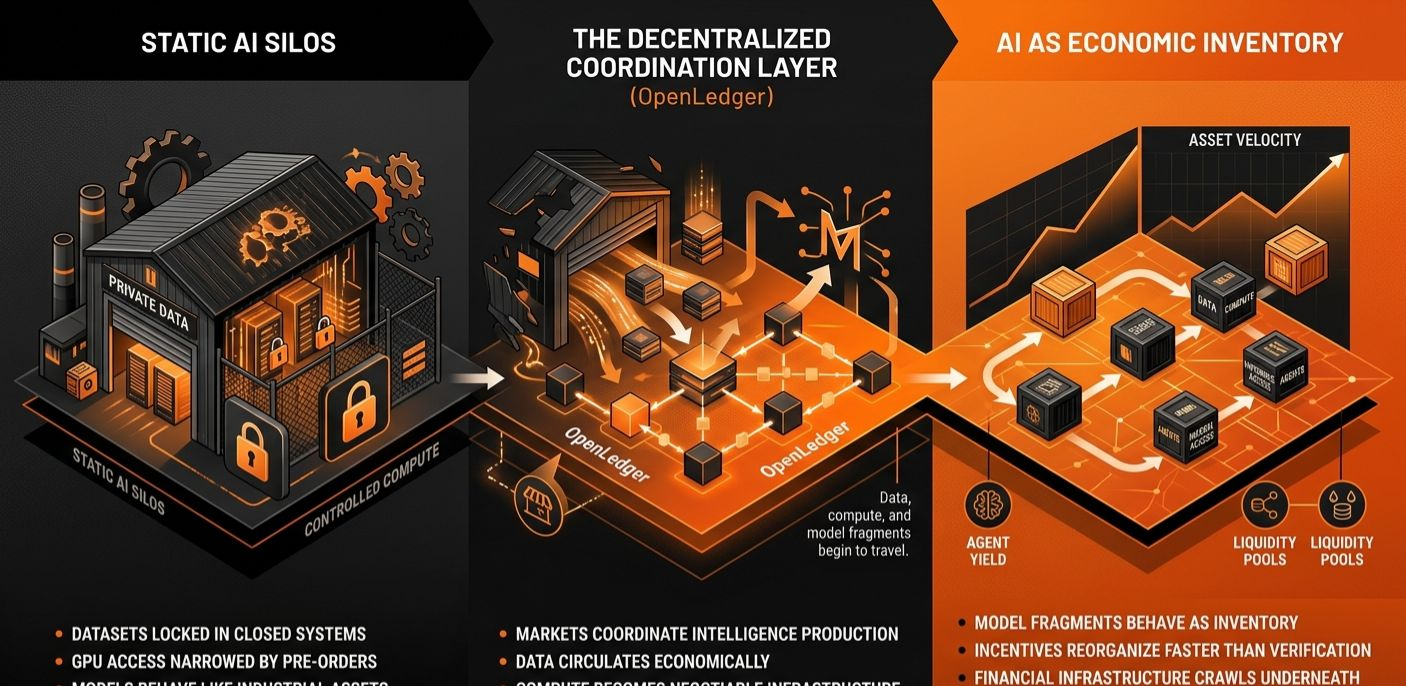
What keeps bothering me is how familiar the behavioral pattern already feels. Crypto spent the last decade building systems that convert static assets into circulating economic objects. OpenLedger just applies similar logic lower in the stack closer to the production of intelligence rather than the currencies surrounding it.
Not AI as a product.
AI as inventory.
And markets tend to reach further once they realize something can move.
