While scanning the bridge contracts late Tuesday. While pulling up the OpenLedger EVM bridge at something like 1 a.m., I wasn't expecting to spend two hours there. I'd gone in to confirm one simple thing — how $OPEN actually moves between Ethereum, BSC, and the L2. What I found was something the project narrative barely surfaces: the bridge isn't just a transfer mechanism. It's the load-bearing structure of the entire AI economy. OpenLedger buried the lead.
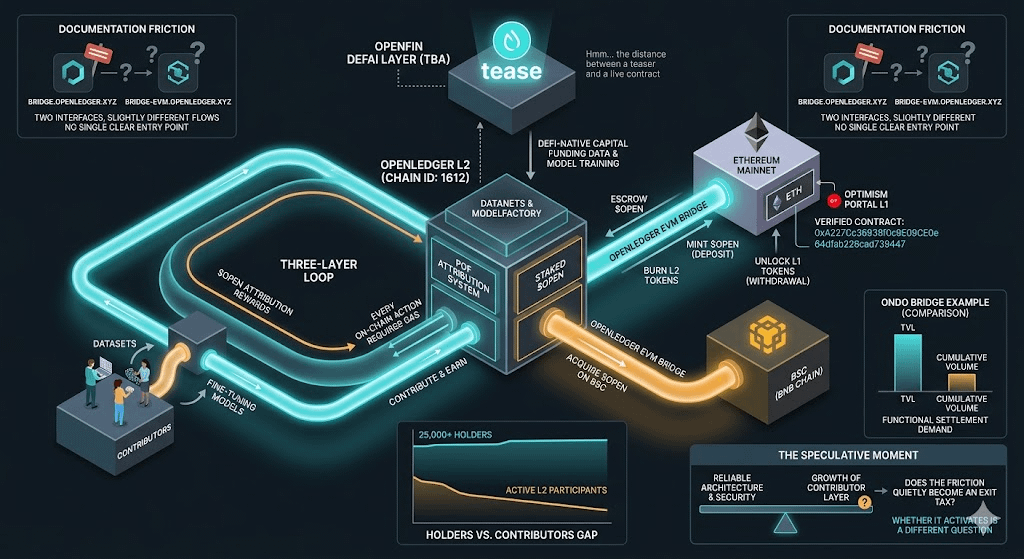
The team built the bridge on OP Stack's standard architecture, deployed through AltLayer as the rollup-as-a-service partner. The Open token gets escrowed inside the OptimismPortal on L1 and minted on L2 upon deposit confirmation. On withdrawal, L2 tokens burn and L1 tokens unlock. Audited by OpenZeppelin and Trail of Bits. Clean architecture.
But here's what paused me. Most OP Stack rollups use ETH as gas. OpenLedger chose Open itself as the native gas token on its L2. That's a deliberate choice — and it means every meaningful on-chain action on the network, data uploads, model training calls, inference requests, requires Open to have crossed a bridge first.
That's a different kind of dependency than it first appears.
The friction the documentation doesn't quite explain
Here's what I kept bumping into: the EVM bridge interface handles transfers between Ethereum, BSC, and the OpenLedger L2 directly. But the mainnet bridge still presents the Ethereum to L2 path as canonical. Two interfaces, slightly different flows, both live.
I ran through it mentally. A data scientist working primarily on BSC wants to contribute a dataset to a Datanet. She needs Open, acquires it on BSC, and then needs to navigate which bridge path actually lands her tokens as spendable gas on the L2. Two bridges. No single clear entry point in the docs. I was confused for a solid twenty minutes — and I've done this before.
That gap between "EVM-compatible" (technically true) and "frictionless for non-ETH-native contributors" (implied) is where the story starts diverging from the on-chain reality. Cross-chain gas token bridging is a very specific engineering choice, and it makes the bridge a prerequisite rather than an option for anyone wanting to actually participate.
This isn't a security concern — the contracts are sound. It's an adoption funnel concern.
A three-layer loop I didn't expect to find
Here's the conceptual piece that stuck. OpenLedger's Proof of Attribution (PoA) system routes rewards back to data contributors and model builders in Open every time their work influences an inference output. Those rewards settle on the L2. To realize liquidity, contributors either spend them as gas on the L2 — staying in the ecosystem — or bridge back out to Ethereum or BSC.
This creates a closed three-layer feedback loop: bridge in → contribute and earn attribution rewards → bridge out or recirculate. The bridge isn't infrastructure sitting beside the AI economy. It is the circulatory system. Every token crossing in either direction is the system breathing.
What makes this interesting right now: on March 23, 2026, the OpenLedger team teased "OpenFin" — a DeFAI product layer being built on top of the existing infrastructure. No deployed contracts yet, no formal spec. But the signal is clear. If OpenFin routes DeFi-native capital directly into this loop — not just to hold $OPEN, but to fund Datanet participation and model training — the bridge's role transforms from a gas-acquisition step to a genuine liquidity channel between AI workloads and broader DeFi.
That evolution matters enormously. It just hasn't arrived on-chain yet. Hmm… the distance between a teaser and a live contract has burned people before.
Still sitting with the gap between holders and contributors
I keep returning to one tension I can't quite resolve. The Open token currently has over 25,000 holders with daily trading volume running in the low millions. That's distributed. But distributed holding and active L2 participation are two different curves, and I haven't found on-chain evidence that they're converging yet.
Compare this to something like Ondo's recent bridge launch between Ethereum and BNB Chain, which showed significant TVL and cumulative volume because it was connected to actual settlement demand — tokenized assets people needed to move for functional reasons, not speculative ones. The bridge had a job to do. OpenLedger's bridge has that same potential, but only once the Datanets and ModelFactory start generating consistent economic activity that requires cross-chain movement rather than inviting it passively.
That's the honest reassessment I arrived at around 2 a.m. The architecture is real. The attribution model is grounded in actual research. The bridge security is solid. What remains speculative is whether the contributor layer — the people uploading datasets, fine-tuning models, running AI agents with staked Open — will grow fast enough to make the liquidity loop self-reinforcing rather than theoretical.
I've watched too many L2s treat "EVM-compatible" as a growth strategy unto itself. The ones that found durable traction had a functional reason for capital to stay on-chain. OpenLedger has designed one. Whether it activates is a different question.
If OpenFin launches and DeFi-native liquidity starts flowing into Datanet participation rather than just price speculation, the three-layer loop could become genuinely reflexive — more usage, more rewards, more bridge activity, more usage. That would be the moment the bridge earns its architecture.
And the thing I'm genuinely uncertain about: if contributors earn Open attribution rewards into an L2 they still need to bridge out of — does the friction quietly become an exit tax that gradually unwinds the whole loop?