
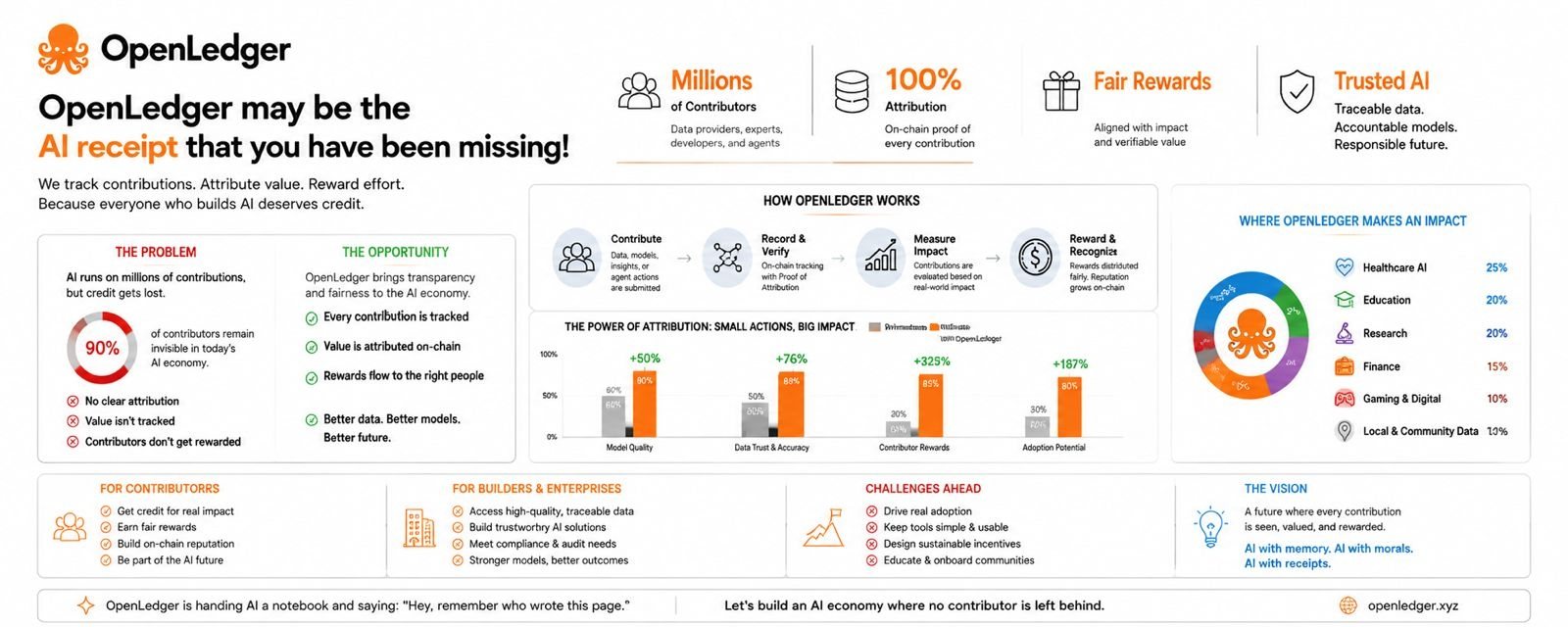
There's one of those rare projects that asks one of those never-thought-of-about questions, which is who is really contributing to the growth of AI? OpenLedger is one of them. “I think most platforms are focused on models, agents, networks, but OpenLedger is a platform that wants to focus on the invisible force, so to speak? The people who curate the data, the niche experts, the ones we update information that powers the AI engines, they typically get out of the spotlight. OpenLedger is also committed to returning them to the frame not loudly nor with much marketing hype, but with responsibility.
I like the simplicity of the idea. Track contributions. Attribute value. Reward effort. The problem with AI isn't as apparent as it sounds; it's just that there's a lot of flux in it today. All of the data being fed into the models is generated by millions of inputs, and it is unclear who collected it or who was the most helpful to offer insight into the model. OpenLedger's idea of aligning rewards with contributions in small terms, and potentially large consequences is a small thing in a word; but enormous in effect.
I also notice the slight nifty factor to the design too. The above isn't merely Web3 for Web3's sake. It's not about developing the technology for specialized AI algorithms to survive in it, but it is about building the infrastructure where trained algorithms in AI can survive on verified and traceable data. Consider the implications of healthcare AI, educational resources, research simulations, applications which require precision, clarity, and belief. In the ecosystem, if OpenLedger is successful it could provide a space for any individual or small group of people, for their work to be useful, valuable and recognised.
Challenges, of course, abound. This system is in need of adoption, usability and incentives that work. Blockchain interfaces can be confusing, there can be no incentives for tokens, and people may disengage when they perceive the journey as complicated. Even conceding these are challenges is a part of what makes OpenLedger interesting. It's not just promising utopia, it's testing the framework which could solve a real problem.
I think the key for me is the “what if”....what if it actually happened?For me, it's the superimplifying of “what ifs.”: What if it actually happened? What happens if OpenLedger should really gain popularity? AI could no longer be a black box and can start to be recorded by human efforts. But what if the adoption didn't materialize? If it's that then it's a great experiment, that teaches us about the failures of incentives. There is learning—about attribution, community and AI's social economy—between success and failure.
At the moment anyhow, OpenLedger is like handing AI a notebook and saying: “Hey, remember who wrote this page…” a subtle, but surely clever, endeavor to make something invisible a little more visible. And larger models might be the “billions” the world of responsible AI desperately needs, but rather than that, maybe it deserves more intelligent, less biased systems that don't forget the individuals behind the computers.