
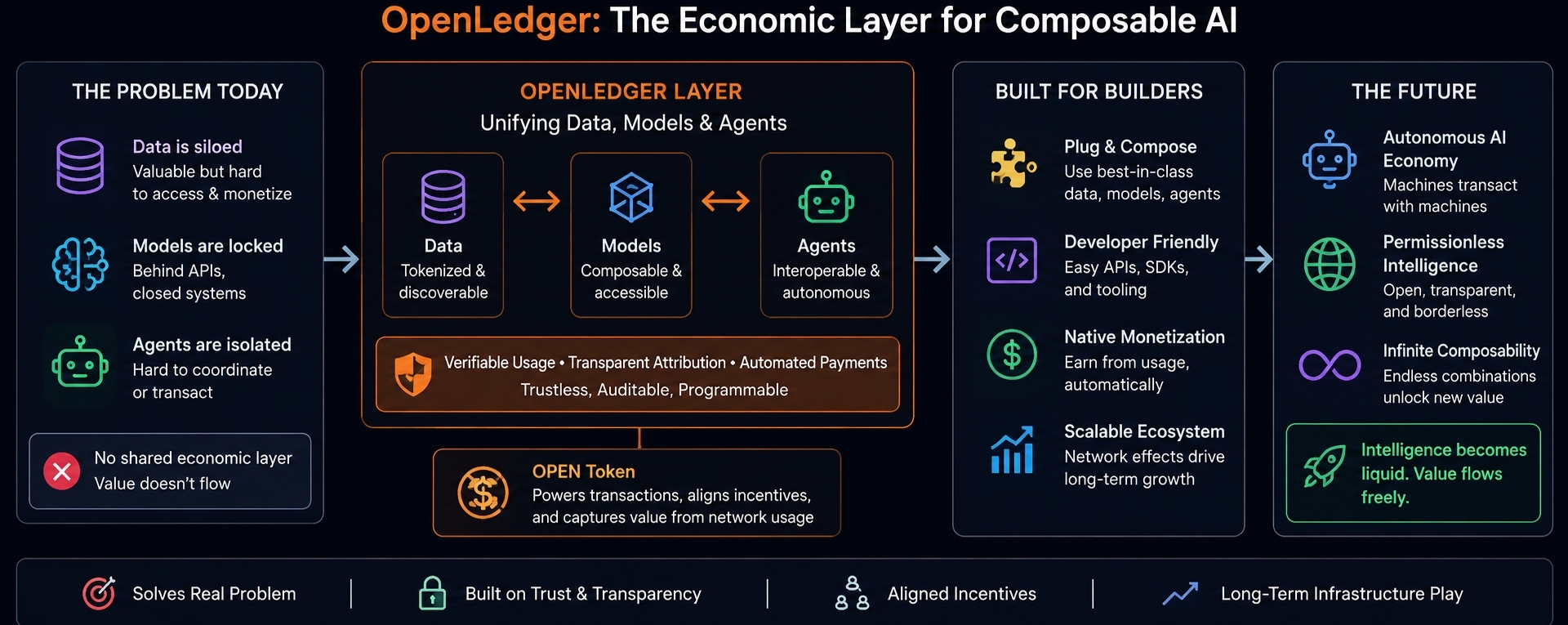
I’ve been thinking a lot about why certain projects stay in my mind longer than others. Not because they’re trending, and definitely not because of price — but because something about their structure feels… necessary. That’s the feeling I got when I first came across OpenLedger.
It didn’t immediately click as a typical “AI crypto” play. If anything, it felt harder to explain. And I’ve learned that when something is harder to simplify, it’s sometimes because it’s sitting closer to the foundation rather than the surface.
What pulled me in wasn’t the token or even the narrative — it was the type of question the project seems to be asking underneath everything:
If data, models, and agents are going to define the next phase of technology, how do they actually interact with each other economically?
Because right now, they don’t. Not really.
In Web2, companies like Amazon Web Services and Google didn’t just succeed because they had better infrastructure — they succeeded because they made that infrastructure usable, accessible, and most importantly, priced correctly. They turned complexity into something you could plug into without thinking twice.
But in the world we’re moving toward — where AI isn’t just a tool but a network of systems — we still don’t have that layer. Data sits in one place, models in another, agents somewhere else entirely. And even when they work together, the way value flows between them is clunky, manual, or completely abstracted behind centralized systems.
So I started asking myself: what if the real bottleneck isn’t intelligence, but coordination?
That’s where OpenLedger starts to make more sense to me.
The way I’ve come to see it is simple, even if the system behind it isn’t: it’s trying to turn intelligence into something that can move — something that can be accessed, used, and paid for without needing trust in a central party. Almost like turning ideas into assets that can interact on their own.
What makes this interesting isn’t just the ambition, but how it reduces complexity. Instead of forcing you to understand how a model works internally or where data is stored, it compresses everything into something usable: what does this do, and what does it cost to use it? That’s it. That’s the interface.
And that kind of simplification is what usually allows systems to scale.
If I think about it like a product builder, it changes the way applications could be created. Instead of building everything from scratch, you start composing — pulling in data from one place, models from another, letting agents interact, and having the system handle attribution and payments in the background. It’s a quieter kind of innovation, but it reduces friction in a way that actually matters.
Of course, none of this matters if it doesn’t work reliably. And that’s where I think the design leans in the right direction — toward verifiability. The idea that interactions are recorded, usage is measurable, and value exchange is transparent. It doesn’t remove risk, but it replaces blind trust with something more mechanical, more observable.
Still, I try not to get carried away when it comes to the token side of things.
Because even if the system makes sense, the market doesn’t always price logic — at least not immediately. I find myself wondering how much real usage will exist early on, whether demand for the token will actually reflect activity, and how supply dynamics will play out before the ecosystem matures. These aren’t small questions. They’re usually where good ideas struggle in the beginning.
And I think it’s important to admit that.
There’s a lot I like about the positioning — especially how it doesn’t try to compete on building better models, but instead focuses on connecting everything around them. If it works, it could benefit from network effects that are hard to replicate. But it also depends heavily on developers choosing to build within this framework, and that’s never guaranteed.
Timing is another uncertainty. Sometimes the market isn’t ready for a layer like this yet. Or it takes longer than expected for the need to become obvious.
But when I step back and look at where things are heading — more data, more models, more autonomous systems — it feels like coordination becomes inevitable. Not optional.
And if that’s true, then something like OpenLedger starts to look less like a niche experiment and more like early infrastructure.
From an investment perspective, I don’t see this as something I need to rush into or chase. If anything, I feel the opposite. This is the kind of idea I would approach slowly, with the expectation that it takes time to prove itself. I’d rather treat it like a long-term system bet than a short-term opportunity.
If I do take a position, it would be with the understanding that progress might be quiet, that validation might not come quickly, and that there will be periods where it feels like nothing is happening.
But I’ve also seen that those are often the phases where real foundations are being built.
So I remind myself of something simple: not everything valuable is immediately visible. Some things take time to become obvious — and by then, they’re no longer early.
The real challenge isn’t finding ideas. It’s having the patience to understand them deeply enough to hold on when they’re still forming.
That’s where conviction comes from. And over time, that’s usually what makes the difference.