The AI narrative inside crypto is becoming crowded very fast. Every week, a new project claims it will power intelligent agents, decentralized computation, or autonomous economies. Most of those narratives sound exciting on the surface, but when I look deeper, I usually ask one simple question:
Where does the real value come from?
In my view, the answer is almost always the same: data.
Not hype. Not token branding. Not temporary social momentum. Data is the foundation that makes AI useful, scalable, and commercially valuable. Yet one of the biggest problems in today’s AI economy is that the people generating valuable data rarely benefit from it in a meaningful way.
That is why OpenLedger caught my attention.
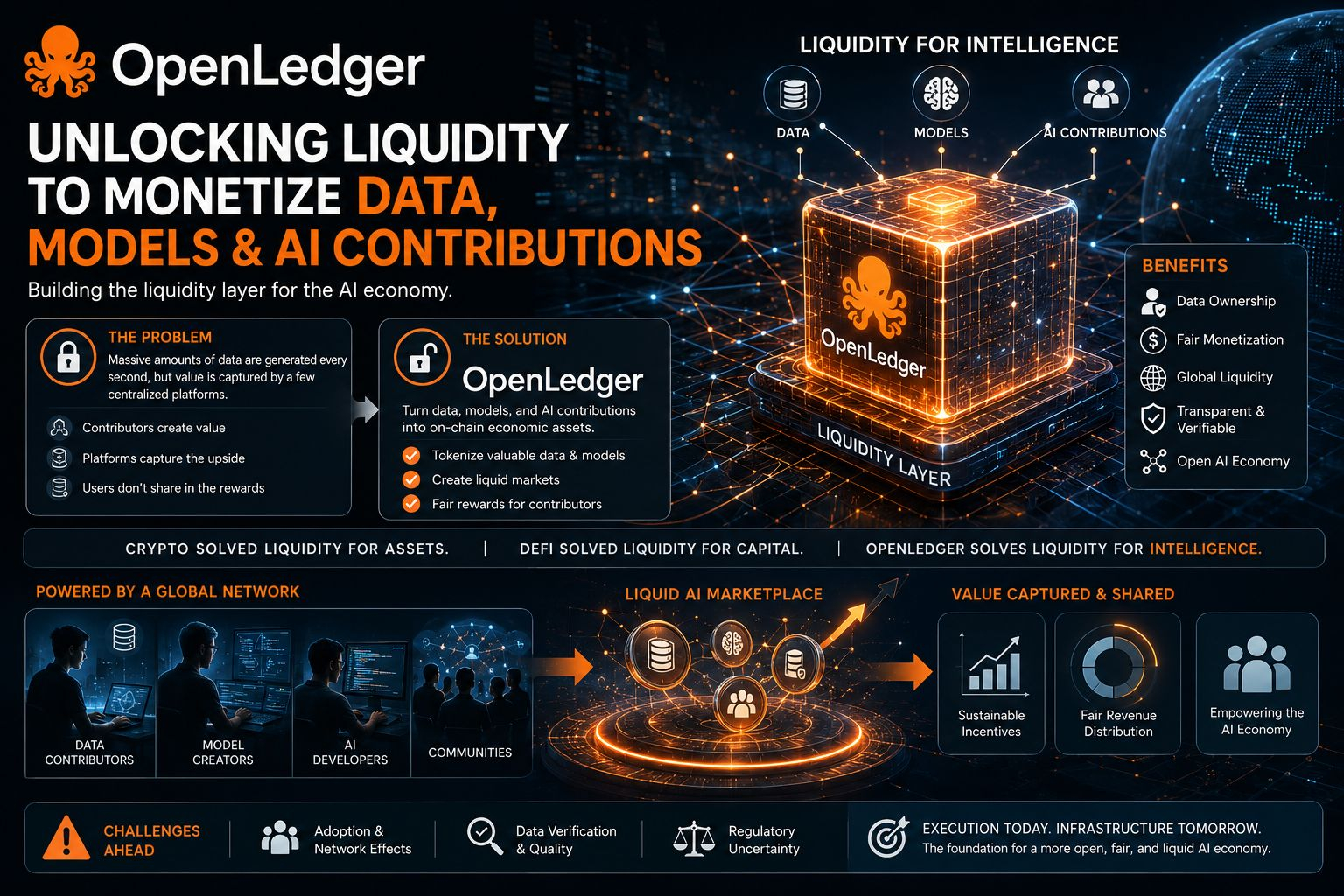
OpenLedger is positioning itself around a very specific idea: unlocking liquidity to monetize data, models, and AI-driven contributions. I think this narrative is far more important than many people currently realize because it targets a structural problem inside both AI and Web3 at the same time.
Right now, massive amounts of data are being created every second across the internet. Users generate it, developers organize it, communities refine it, and AI systems consume it. But economically, the rewards are still concentrated among centralized platforms.
Most users contribute value without owning any part of the upside.
I believe this imbalance becomes even more important as AI adoption accelerates. The demand for quality datasets, specialized models, and intelligent agents is increasing rapidly. Companies building AI products need fresh, reliable, and constantly evolving information. The problem is that data markets remain fragmented, illiquid, and difficult to monetize fairly.
That is where OpenLedger’s concept starts becoming interesting.
Instead of treating data as something hidden behind closed corporate systems, OpenLedger appears to focus on turning data into an on-chain economic asset. That changes the conversation entirely. If liquidity can flow around datasets and AI models the same way liquidity flows around tokens today, the economics of AI could evolve dramatically.
I think many investors still underestimate how powerful this idea could become.
Crypto solved liquidity for digital assets.
DeFi solved liquidity for capital.
What if AI blockchains solve liquidity for intelligence itself?
That possibility is much bigger than people think.
One thing I find particularly important is the timing of this narrative. AI is entering a phase where infrastructure matters more than excitement. During the early AI boom, people mainly focused on flashy demos and speculative momentum. Now the conversation is shifting toward sustainability, ownership, and monetization.
Who owns the data?
Who gets paid when AI models generate value?
How can smaller contributors participate in the AI economy without relying on centralized gatekeepers?
These are not small questions anymore. They are becoming core economic questions for the next phase of the internet.
From my perspective, OpenLedger is attempting to build infrastructure around that transition rather than simply benefiting from short-term speculation. That distinction matters because infrastructure narratives usually survive longer market cycles compared to purely trend-driven narratives
Another reason I think this sector deserves attention is because data itself is becoming increasingly scarce in terms of quality. AI models do not just need large amounts of information; they need reliable, updated, context-rich datasets. The internet is already flooded with duplicated content, synthetic outputs, and low-quality noise.
This creates a hidden opportunity.
Projects capable of organizing, validating, and monetizing high-quality data could become extremely valuable over time. In many ways, data may become the new digital commodity of the AI era.
And commodities need marketplaces.
They need incentives.
They need liquidity.
That is why the phrase “unlocking liquidity to monetize data” is more significant than it first sounds.
I also think OpenLedger benefits from aligning itself with two powerful narratives simultaneously: AI and blockchain infrastructure. Usually, when narratives overlap successfully, capital attention follows. We already saw this happen with AI-related GPU plays, decentralized compute projects, and modular blockchain ecosystems.
The difference here is that OpenLedger appears to focus less on pure computation and more on economic coordination around data itself.
That angle feels smarter to me.
Computation eventually becomes competitive. Hardware advantages narrow over time. But proprietary, valuable, and continuously improving datasets create long-term defensibility. The companies dominating AI today understand this very well, which is exactly why they aggressively protect their data ecosystems.
Crypto has always challenged closed systems.
OpenLedger seems to be pushing that challenge directly into the AI economy.
Of course, there are risks too, and I think ignoring those risks would make any analysis incomplete.
One major challenge is adoption. Building decentralized infrastructure is one thing; attracting meaningful data contributors and developers is another. Many blockchain projects have strong concepts but struggle to create sustainable ecosystems because network effects are difficult to build from scratch.
There is also the question of data verification. If data becomes monetizable, systems must ensure quality and authenticity. Otherwise, markets can easily become flooded with spam or manipulated information. Incentive structures will matter heavily here.
Regulatory uncertainty could also become important over time. Data ownership laws differ globally, and AI governance is still evolving. Any project operating at the intersection of AI, monetization, and blockchain will eventually face complex legal and ethical discussions.
Still, despite those risks, I think the broader direction makes sense.
The market increasingly rewards platforms that create real economic coordination rather than temporary speculation. In previous crypto cycles, attention mainly flowed toward tokens with hype-driven narratives. This cycle feels different. Investors are starting to ask deeper questions about utility, sustainability, and revenue generation.
That shift benefits projects connected to real infrastructure.
Personally, what I find most compelling about OpenLedger is not just the technology narrative. It is the economic narrative behind it. The idea that data contributors, model creators, and AI participants could directly monetize their value creation feels aligned with where digital economies are heading.
For years, users have generated enormous amounts of value online while platforms captured most of the rewards.
Web3 was supposed to change that.
AI may finally force that change to happen faster.
I think the next evolution of crypto will not simply be about financial decentralization. It may also become about intelligence decentralization — who owns intelligence, who contributes to it, and who benefits economically from it.
That is why OpenLedger feels more relevant to me than many short-lived AI tokens flooding the market right now.
It is trying to build around a real economic problem.
And historically, the biggest opportunities in crypto have emerged from solving problems that become impossible to ignore later.
Whether OpenLedger ultimately succeeds or not will depend on execution, adoption, and ecosystem growth. But the broader thesis behind monetizing data liquidity is something I believe the market will continue paying closer attention to over the coming years.
Because in the AI economy, data is no longer just information.
It is becoming an asset class.