
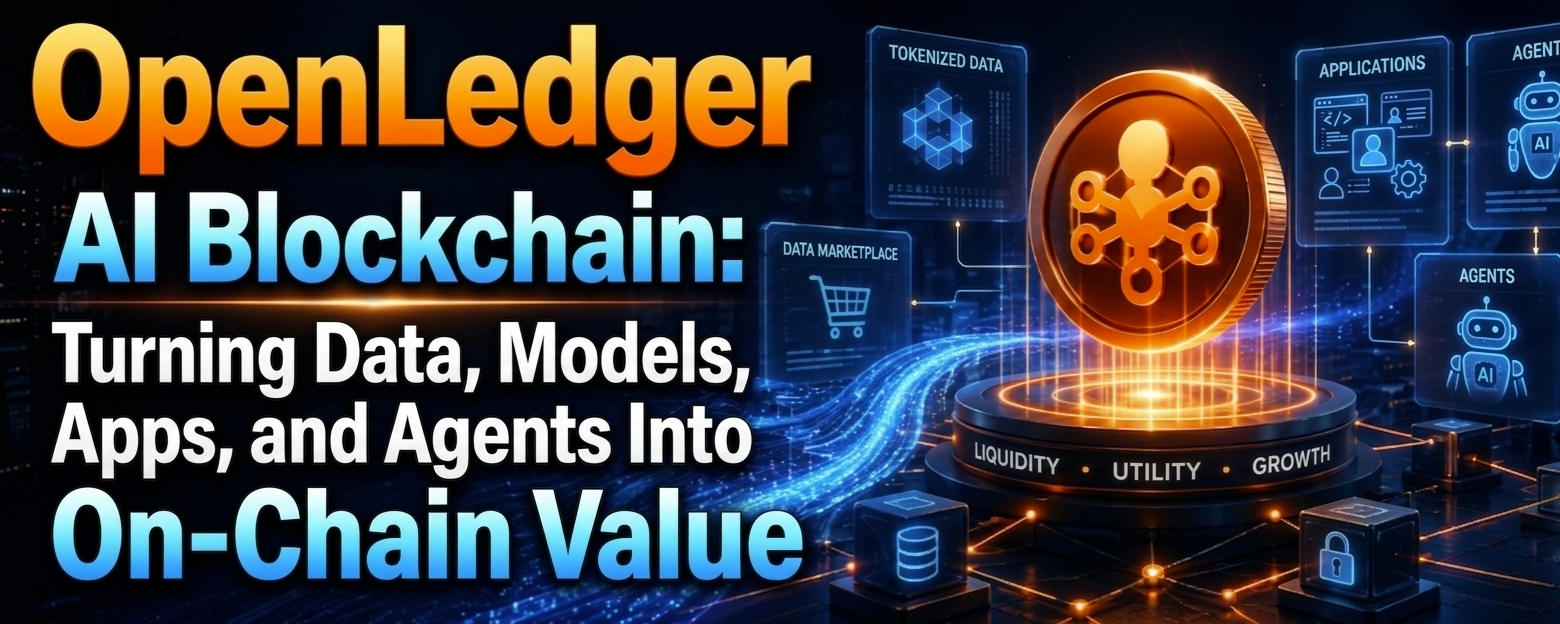
OpenLedger is not just another crypto project chasing the AI trend. It is trying to solve one of the biggest problems in artificial intelligence: who owns the value behind the data, models, apps, and agents that make AI useful? Today, most of that value is captured by large platforms. Millions of people create data, train systems indirectly, build tools, or improve models, yet they rarely receive clear ownership or rewards. OpenLedger AI Blockchain brings a different idea: make AI assets traceable, usable, and monetizable on-chain.
At its core, OpenLedger is building blockchain infrastructure for AI. Instead of treating data and models as hidden resources inside private servers, it aims to turn them into digital assets that can be recorded, verified, exchanged, and rewarded through blockchain systems. This matters because AI does not grow from code alone. It needs quality datasets, specialized models, useful applications, and intelligent agents that can perform tasks. If these parts can be connected to transparent ownership and payment rails, the AI economy becomes more open.
The main keyword here is value. OpenLedger gives value to things that were previously difficult to price. A dataset used to train a finance model, a model improved for medical research, an AI agent that helps automate business tasks, or an app powered by agent intelligence can all become part of a larger on-chain marketplace. The blockchain layer helps show who contributed what, where the asset came from, and how it is being used.
This creates several benefits. First, contributors can be rewarded more fairly. A developer, researcher, data provider, or community builder does not have to disappear behind a closed platform. Second, users can build more trust because ownership and usage records are easier to verify. Third, AI builders can access more specialized resources without starting from zero. Instead of every team collecting the same data again, they can use existing AI assets with clearer rights and incentives.
There are also real challenges. AI data can be messy, sensitive, or low quality. Models can be copied, misused, or trained on unclear sources. Blockchain can solve transparency and incentive problems, but it cannot magically make bad data good. That is why OpenLedger’s vision depends on strong verification, useful developer tools, and a real ecosystem of contributors. The technology must be simple enough for builders, but serious enough for enterprise-level trust.
In practical terms, imagine a small team creating an AI agent for crypto market research. The agent needs blockchain data, trading behavior patterns, sentiment inputs, and specialized models. With an AI blockchain like OpenLedger, those resources could be sourced, tracked, and monetized in a more structured way. The team could pay for useful datasets, reward model contributors, and later earn from the agent itself if others use it.
Another example is education. A group could build a learning app powered by AI tutors. The app may need language datasets, teaching models, and personalized agents. If every part has clear ownership, the people who create the data, improve the tutor model, or deploy the agent can share in the value. This is more powerful than the old model, where one company owns everything and users simply consume the final product.
From an expert view, OpenLedger sits at the intersection of three major trends: AI, tokenization, and decentralized ownership. AI creates demand for data and models. Tokenization creates markets for digital assets. Blockchain creates transparent coordination between people who do not fully trust each other. When combined correctly, these ideas can support a new kind of AI economy where contribution is visible and reward is programmable.
The bigger message is simple: AI should not only be intelligent; it should also be fair, open, and economically useful. OpenLedger is pushing toward that future by giving data, models, apps, and agents a place to live as on-chain assets. If it succeeds, it can help move AI from closed platforms into a more participatory digital economy.
