Not because AI is suddenly the trendy thing again.
And not because every token with “AI” in the bio immediately starts getting attention on CT.
The reason is actually pretty simple.
I genuinely think AI is slowly becoming part of almost everything people do online now.
Trading.
Search.
Content creation.
Automation.
Gaming.
Customer support.
Data analysis.
Even the way apps themselves interact with users is changing fast.
But the more I looked into this sector, the more I realized something important:
Most people are still focusing only on the front-end AI products.
Very few are paying attention to the infrastructure layer underneath everything.
That’s one reason why OpenLedger started catching my attention recently.
At first, I honestly thought it was just another project trying to combine blockchain and AI because the narrative is hot right now. Crypto markets have already seen hundreds of those.
Big promises.
Fancy graphics.
“AI powered ecosystem.”
Then eventually the momentum disappears.
But after spending more time reading through OpenLedger’s direction, the project actually feels like it’s aiming for something much bigger than short term hype.
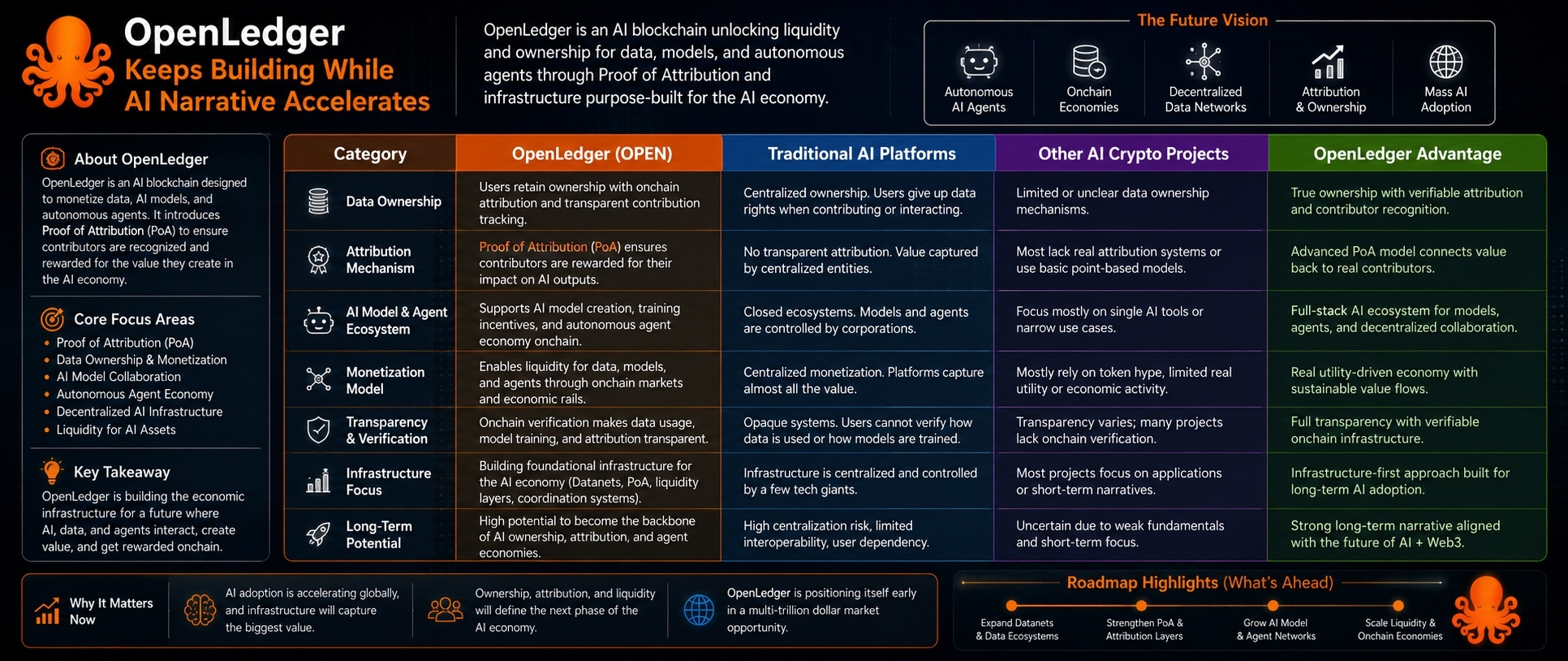
OpenLedger is positioning itself as an AI blockchain focused on monetizing data, models, and autonomous agents.
And I think that idea matters more than people currently realize.
Right now, most AI systems operate inside closed environments controlled by large companies. They collect the data, train the models, own the infrastructure, and capture almost all the economic value generated from it.
Meanwhile, the people contributing data, interactions, feedback, labeling, and behavioral information usually get nothing back long term.
That imbalance is becoming harder to ignore as AI keeps growing.
OpenLedger seems to be exploring a different model.
One of the biggest concepts connected to the project is Proof of Attribution, or PoA.
The basic idea is interesting.
If an AI model is improving because of data contributions, interactions, or knowledge coming from users and external sources, then those contributions should not become invisible forever. There should be some way to track attribution and eventually connect value back to the contributors behind the intelligence layer.
That completely changes the conversation around AI ownership.
Instead of AI becoming another extraction machine controlled entirely by centralized systems, projects like OpenLedger are trying to create frameworks where contributors can remain economically connected to the value being created.
And honestly, I think this conversation is still very early.
Most people still view AI through the lens of chatbots and automation tools.
But eventually AI agents themselves may become active economic participants online.
That’s where things start getting really interesting.
Imagine autonomous AI systems interacting with decentralized applications directly.
Managing liquidity.
Executing tasks.
Accessing services.
Monetizing outputs.
Coordinating with other agents.
Paying for compute or datasets automatically.
If that future actually develops over time, those systems will need infrastructure underneath them.
Not just models.
They will need economic rails.
They will need transparent attribution systems.
Liquidity frameworks.
Coordination layers.
Verification systems.
Ownership structures.
That’s the area OpenLedger seems to be building toward.
Another part that caught my attention was the project’s focus around Datanets.
From what I understand, the broader idea is to create structured data ecosystems where contributors can provide useful datasets while maintaining clearer attribution pathways connected to AI outputs.
And honestly, this feels very different compared to most AI narratives currently floating around crypto.
A lot of “AI projects” right now are mostly narrative driven tokens attached loosely to artificial intelligence branding.
OpenLedger feels more infrastructure focused.
That doesn’t guarantee success of course. Building decentralized AI coordination systems is extremely difficult technically. Attribution itself becomes complicated once models evolve over time and datasets continuously change.
But at least the direction feels meaningful.
And timing matters too.
The entire global AI race is accelerating aggressively now.
Big tech companies are competing across compute, models, inference efficiency, and data acquisition faster than ever. At the same time, crypto infrastructure keeps evolving toward more scalable onchain execution environments.
Those two worlds are slowly starting to collide.
I think many people still underestimate how big AI infrastructure could eventually become inside crypto.
We already watched previous cycles reward foundational infrastructure layers before.
Smart contract platforms.
Data availability projects.
Modular chains.
Decentralized storage.
Compute networks.
At first, most people ignored the infrastructure side because applications looked more exciting.
Then eventually the market realized infrastructure captures enormous value once adoption scales.
AI could follow a very similar path.
That’s partly why OPEN has been appearing more frequently across discussions lately.
The market is slowly moving beyond “AI hype” and starting to think more seriously about how ownership, attribution, liquidity, and coordination might actually function in an AI driven economy.
And that’s where OpenLedger becomes interesting to watch.
Especially because the project is not simply trying to build another chatbot narrative.
It’s attempting to build economic infrastructure around intelligence itself.
Whether OpenLedger fully succeeds long term still depends on execution.
That part matters most.
But I do think the broader direction makes sense.
Because in the future, AI may not only need smarter models.
It may also need better systems for ownership, coordination, attribution, and value distribution underneath everything.
And that’s exactly the conversation OpenLedger is trying to enter right now.