

I've been kicking around crypto long enough that most new projects just blend together after a while. Another chain, another token, another grand vision about fixing what's broken in tech or finance or whatever. The fatigue is real. You watch cycles come and go, see the same promises repackaged, and you start to tune out the noise. But every now and then something catches in the back of your mind—not because it's shouting the loudest, but because it quietly touches on a problem you've watched fester for years. OpenLedger is one of those for me right now.
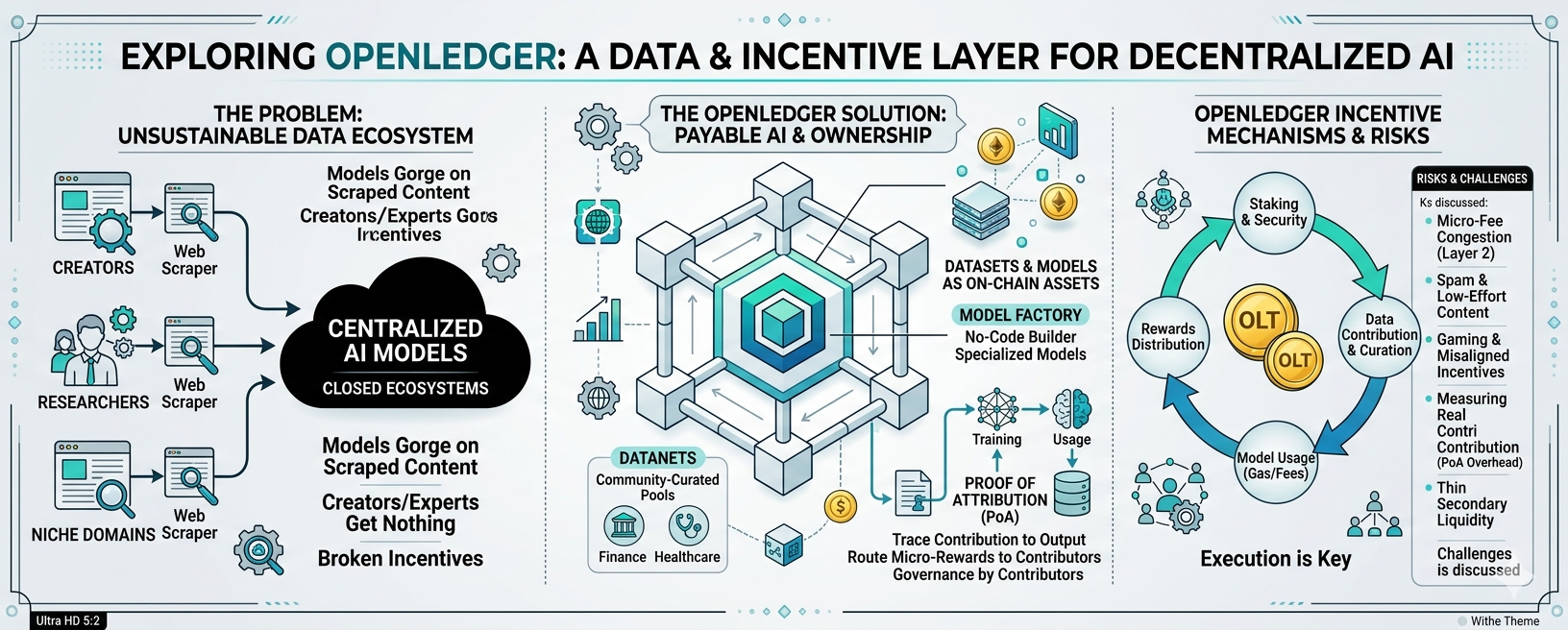
It's positioned as this AI-focused blockchain, basically trying to make data, models, and even agents something you can actually own a piece of and get paid for over time. Not just upload once and hope for the best. The thing they keep coming back to is Proof of Attribution—some mechanism to trace how a particular dataset or contribution actually influences a model's output later on, and then route tiny rewards back to the person who provided it. Datanets for community-curated pools in specific areas like finance or healthcare, a no-code Model Factory for building specialized stuff, the whole thing on an EVM-compatible L2. "Payable AI," they call it. Sounds almost too neat.
I keep thinking about how broken the data side of AI feels in practice. We've all heard the stories—models gorging on scraped content, creators and experts getting nothing while a few companies pile up insane valuations. It's not just unfair; it's unsustainable. Why would someone with real domain knowledge bother cleaning datasets or contributing niche examples if the upside all flows upward and away? I've seen enough "decentralized data marketplace" attempts over the years to know most of them fizzle. Incentives misalign, quality collapses, or it just never gets used beyond the initial hype.
What gives me a bit of pause with OpenLedger isn't the vision—it's whether the plumbing can hold up. Blockchain brings its own headaches: even on a Layer 2, fees add up when you're talking micro-rewards on thousands of inferences. Data quality is always the silent killer; communities start strong but spam, low-effort stuff, and gaming creep in fast. They've got staking and points to try aligning things, but I've watched too many incentive experiments turn into temporary farming games. Proof of Attribution sounds clever—using influence approximations or whatever for smaller models—but measuring real contribution without massive overhead or disputes feels tricky in the real world. I've been burned by "fair attribution" narratives before.
And yet... something about the narrow focus sticks with me. They're leaning into specialized models rather than trying to out-general the big labs. That feels more grounded. The industry does seem to be moving that way—smaller, efficient, domain-tuned things that actually get deployed. If they can make Datanets function like living, governed data commons with real provenance, and actually get models called and used enough for rewards to flow meaningfully, it addresses a friction I've heard devs and professionals complain about for a long time. Not revolutionary in the marketing sense, just... practical.
I'm still skeptical on the liquidity part. Turning datasets or fine-tuned models into tradable, composable assets on-chain sounds elegant on a slide deck. In practice, secondary markets for this kind of utility have been thin in most attempts I've followed. Token utility boils down to gas, staking for agents and security, and rewards distribution. Heavy community allocation is standard now, but we've all seen how inflation and early unlocks can undermine the whole thing if usage doesn't catch up.
Late at night, when I'm scrolling through docs and old project post-mortems, I land in this weird in-between. OpenLedger isn't pretending to solve AI's deepest technical problems or dethrone the centralized giants. It's poking at one stubborn layer: coordination and incentives around data. In a sea of recycled narratives and vapor, that's honestly rarer than it should be. I don't fully trust how it'll scale or whether the attribution tech will feel fair once real volume hits. Execution has killed better-looking ideas. But after watching so many things that felt exactly the same, this one has me paying attention longer than usual. Not excited, exactly. Just... watching.
