Artificial intelligence is moving fast, and almost every week there seems to be a new breakthrough, smarter model, or powerful AI tool entering the market. But behind all the excitement, there’s a bigger conversation slowly taking shape. AI systems are built using enormous amounts of data, trained models, and intelligent tools created by people around the world. The question is: who actually benefits from all that value? In many cases, individuals contribute data, ideas, or resources while large platforms capture most of the rewards. OpenLedger is stepping into this space with a different vision.
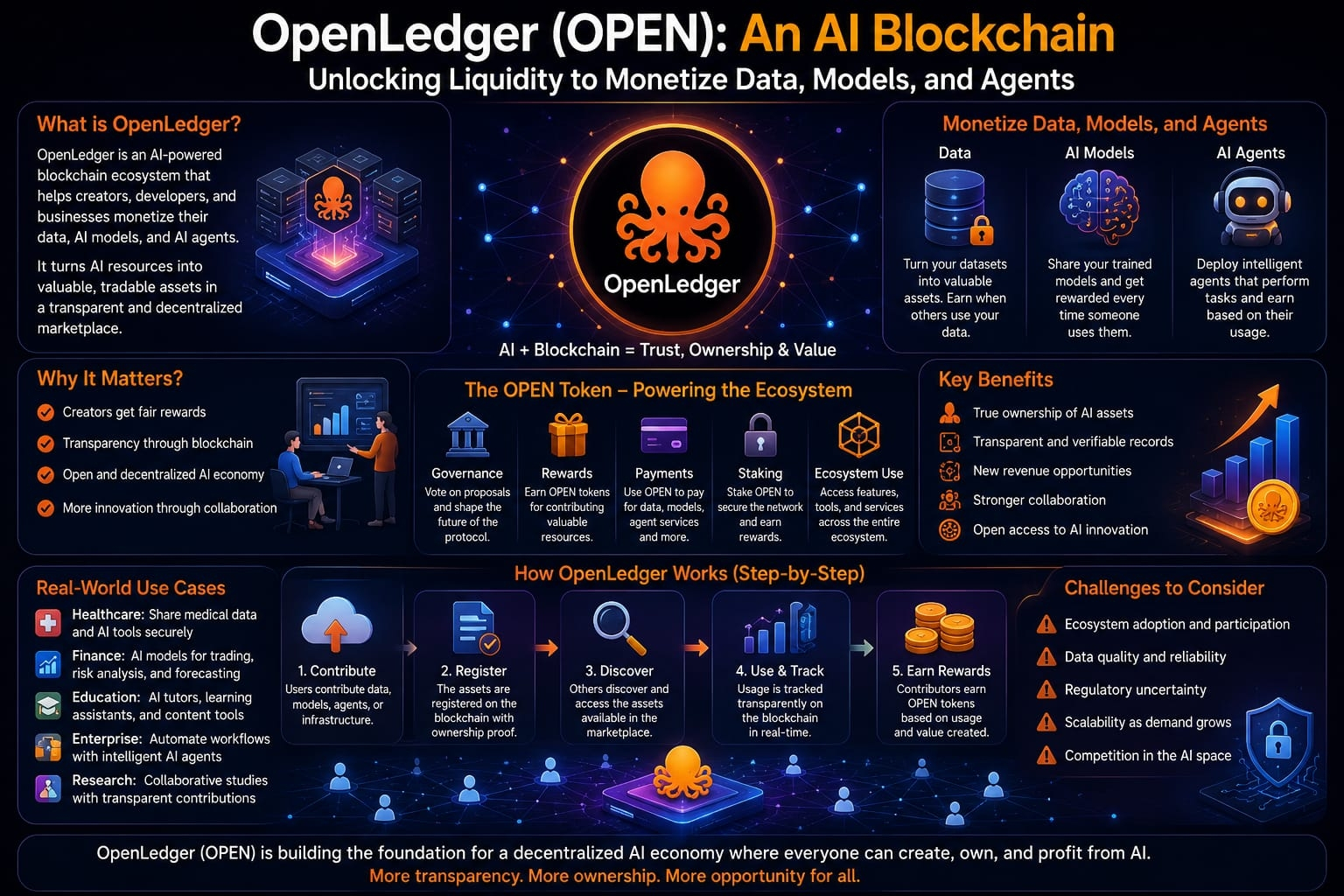
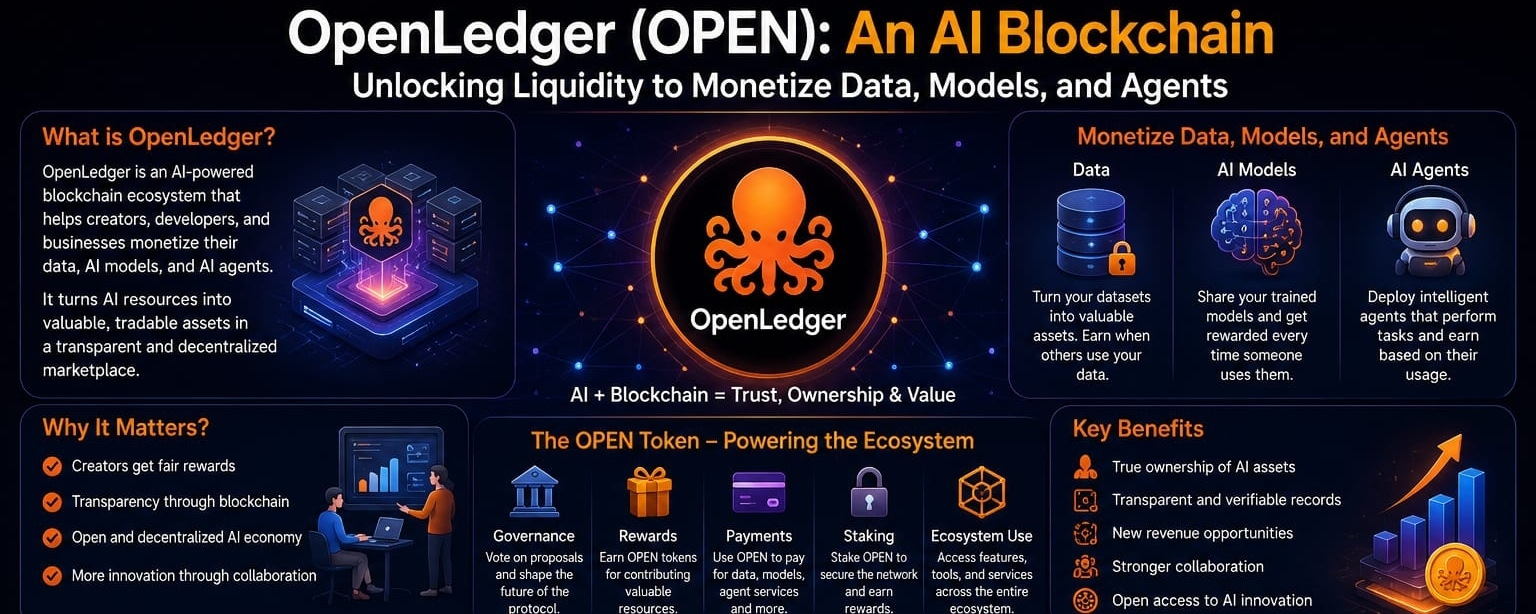
OpenLedger (OPEN) is building an AI-focused blockchain ecosystem designed to unlock value from data, AI models, and AI agents. Instead of allowing these resources to remain isolated or controlled by a few centralized platforms, OpenLedger wants to create an environment where they can become assets people can own, use, and earn from. It is trying to build a future where contributors are not just participants in AI growth but active beneficiaries of it.
For beginners, the idea can sound more complicated than it really is. Think of OpenLedger as a digital economy designed specifically for artificial intelligence. Imagine creating something valuable—whether it is a dataset, an AI model, or an intelligent assistant—and instead of uploading it into a closed system where you lose control, you place it into an ecosystem where every use of that asset can create value for you. In simple terms, OpenLedger wants AI resources to work more like income-generating digital assets rather than one-time creations.
What makes OpenLedger interesting is how it combines two powerful technologies that solve different problems. Artificial intelligence is excellent at learning, predicting, automating, and making decisions. Blockchain, on the other hand, focuses on trust, ownership, and transparency. AI can create intelligence, but blockchain can create accountability. OpenLedger brings both together to create a system where contributions can be tracked, ownership can be verified, and rewards can be distributed fairly. Instead of relying on centralized systems where users simply trust the platform, blockchain creates records that are visible and verifiable.
One of the most talked-about ideas around OpenLedger is the monetization of data, models, and AI agents. At first, that phrase sounds technical, but the concept is actually very practical. Data has become one of the most valuable resources in the AI world. Every intelligent system learns through information. Imagine a company collecting years of weather and crop information that could help train AI systems designed for agriculture. Instead of letting that information sit unused, OpenLedger creates possibilities where such datasets can generate value whenever others access or use them.
The same logic applies to AI models. Developers spend time building and training systems for specific tasks like image recognition, financial predictions, language processing, or medical analysis. Traditionally, monetizing these systems often requires creating a complete product around them. OpenLedger introduces another possibility where the model itself becomes valuable. A creator may allow others to access and use that model while receiving rewards based on activity and demand.
AI agents take this idea even further. Intelligent agents are becoming increasingly important because they can perform tasks independently rather than simply responding to commands. Think about customer support assistants, automated research tools, scheduling systems, or smart digital workers. Imagine building an AI assistant that automatically organizes travel plans by finding flights, comparing hotels, and arranging schedules. Instead of existing only inside one application, OpenLedger could create opportunities for such agents to operate in a wider ecosystem where usage itself creates value.
At the center of everything is the OPEN token, which serves as the ecosystem’s core utility asset. Like many blockchain projects, OpenLedger relies on a native token to support activity across the network. However, OPEN is intended to do more than simply exist as a tradable asset. It acts as an important part of how the system functions. Token holders may participate in governance decisions involving future updates and ecosystem changes, creating a more community-driven structure. Contributors who provide useful resources may receive rewards through OPEN tokens, helping encourage participation and growth.
The token may also support payments across the platform. Users accessing datasets, AI tools, or services within the ecosystem could potentially use OPEN as a transaction layer. Staking is another important function, allowing users to support network operations while participating more actively in the ecosystem. As more tools, services, and contributors join the network, the utility of OPEN could naturally expand alongside adoption.
The way OpenLedger operates follows a relatively understandable process. Participants contribute resources such as datasets, AI models, or intelligent agents. These assets become registered through blockchain infrastructure so ownership and contribution records can be maintained transparently. Once available within the ecosystem, developers and users can discover and access them. Activity can then be tracked, allowing value distribution mechanisms to reward contributors according to usage. The overall goal is to create a cycle where useful resources continue attracting activity while contributors continue receiving incentives.
Several strengths make the concept appealing. One major advantage is the attempt to create a decentralized AI economy rather than concentrating value inside a few large organizations. Transparency also becomes an important feature because blockchain records create visibility around contributions and ownership. Incentive systems can encourage people to provide useful resources, while creators gain additional opportunities to generate income from work that might otherwise remain unused.
The potential use cases stretch across multiple industries. In healthcare, researchers could contribute specialized datasets while maintaining transparent records of ownership and attribution. In finance, AI prediction systems and analytical tools could become accessible services. Educational institutions may create AI learning assistants, while businesses could deploy intelligent agents to automate repetitive work. Research communities could also benefit from systems where contributions become visible and measurable.
Despite the excitement, OpenLedger still faces important challenges. Technology alone rarely guarantees success. Building a strong ecosystem requires users, developers, and active participation. Data quality also remains a major concern because artificial intelligence depends heavily on accurate information. Poor datasets can create poor outcomes. Regulatory uncertainty is another issue because both AI and blockchain continue evolving under changing legal environments. Scalability may also become a factor as AI workloads become larger and more complex.
What stands out about OpenLedger is that it feels connected to a larger discussion happening across technology. Many projects use AI terminology simply because it attracts attention, but OpenLedger appears focused on a deeper issue: ownership and value distribution. The future of AI may not only depend on building smarter systems but also on deciding who benefits from them. As AI becomes woven into everyday life, questions around contribution and compensation may become increasingly important.
OpenLedger is still developing, and like every emerging project, there are uncertainties ahead.But its core idea feels relevant:creating an environment where data, AI models, and intelligent agents can function as valuable digital assets rather than resources controlled by a small number of platforms.Whether it reaches that vision remains to be seen, but the idea itself points toward a future where AI value becomes more open, transparent, and accessible.That possibility alone makes OpenLedger a project worth paying attention to.