
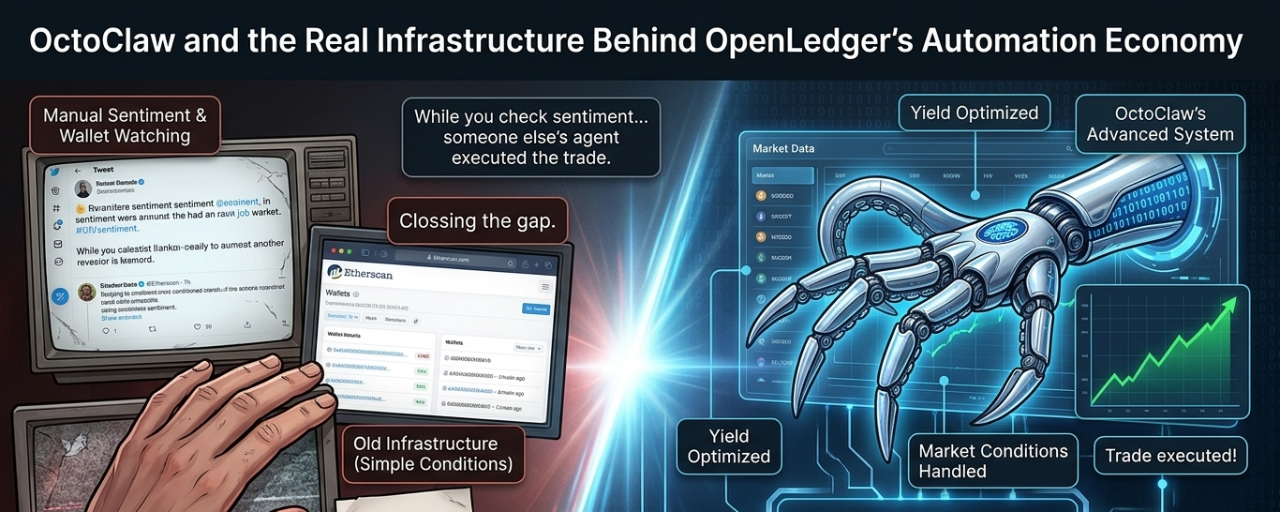
While you are manually checking sentiment and watching whale wallets someone else's agent already executed the trade. That is the gap OpenLedger is closing.
Most Web3 traders are still doing things by hand. Checking Twitter for sentiment. Watching wallets on Etherscan.
Moving capital between yield pools at odd hours. Then wondering why they are always one step behind.
That is not a skill problem. That is a tooling problem.
The infrastructure most traders work with today was built for simple conditions. If X happens do Y. That works fine in a stable environment.
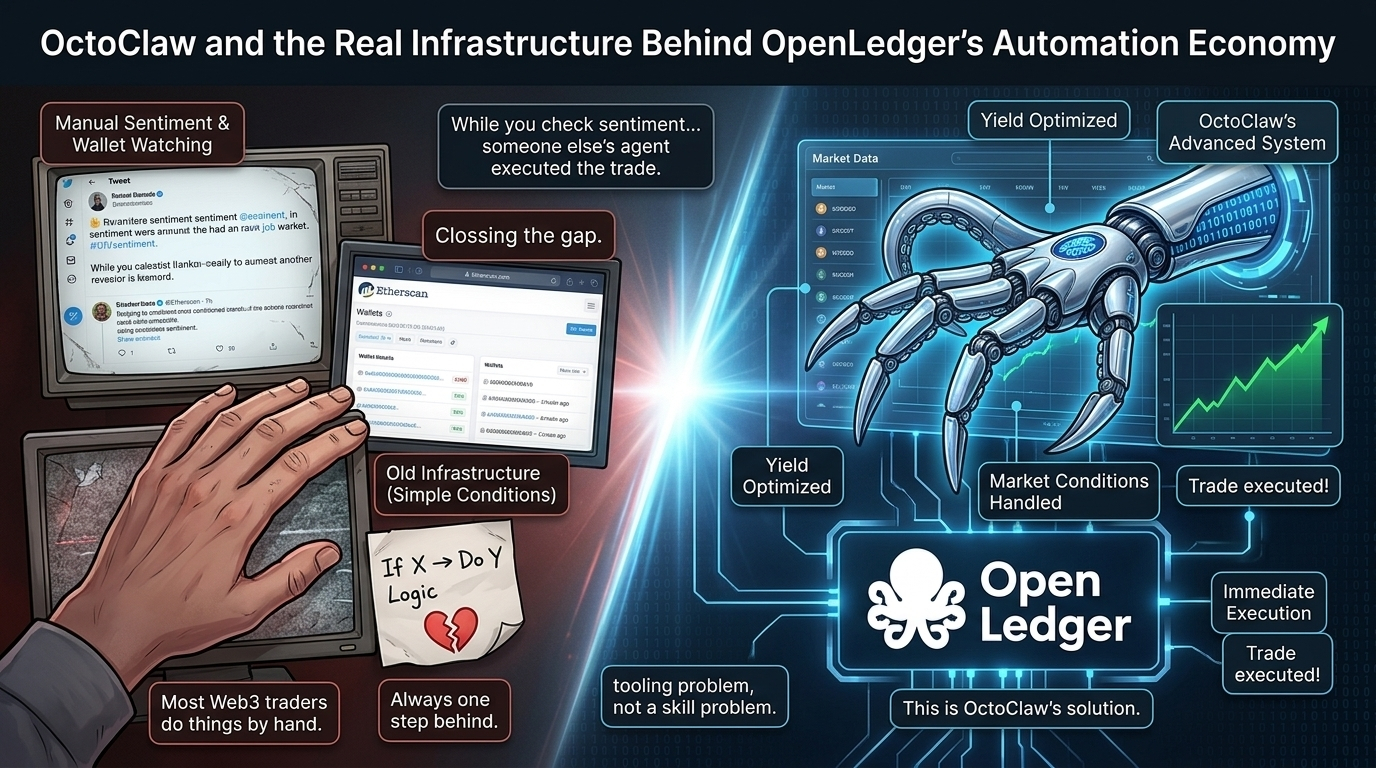
Markets are never stable. This is the exact problem OctoClaw was built to solve.
What OctoClaw Actually Does
OctoClaw is OpenLedger's all-in-one automation platform. Not a dashboard. Not a notification bot.
An execution layer that reads live data, processes it and acts on it without asking for your approval every single step.
It does four things and all four matter.
It reads market sentiment continuously. Not a vibe check from manually scrolling Crypto Twitter.
It scans unstructured social data and on-chain metrics together and produces a real-time read on where sentiment actually stands.
The difference between reacting to sentiment and getting ahead of it is almost entirely a speed problem. OctoClaw solves the speed problem.
It tracks whale wallets before the move shows up on charts. Large wallet flows from institutional and high-net-worth addresses.
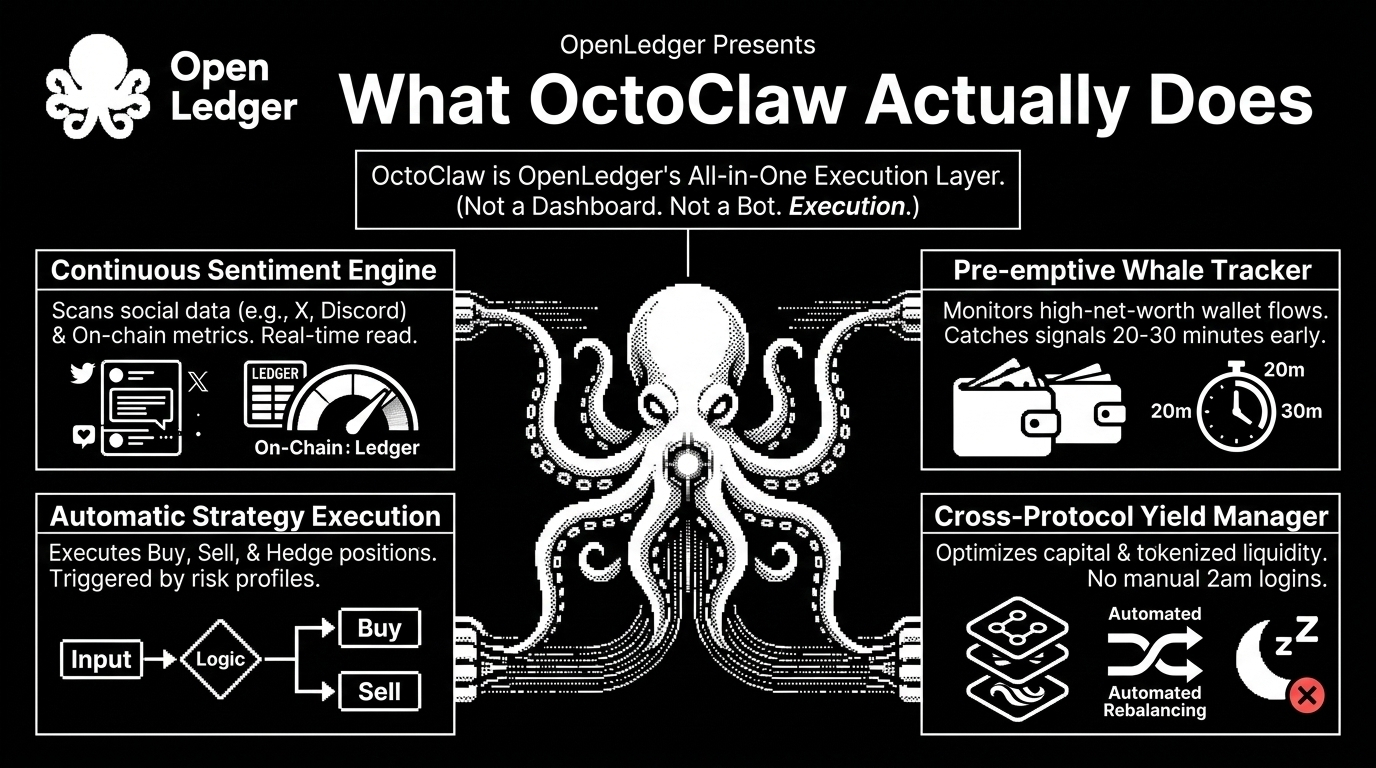
If you have ever watched a big price move and thought you should have seen that coming there was probably a wallet signal 20 to 30 minutes earlier that you missed. OctoClaw catches it.
It executes strategy-based trades automatically. Buy orders, sell orders, hedge positions. Triggered by predefined risk profiles running on live data. You set the conditions once. It handles everything after that.
It manages yield and tokenized liquidity across protocols without you logging into five platforms at 2am to move capital manually.
The Infrastructure Nobody Talks About
Most articles on OctoClaw skip this part. That is a mistake because this is where the real work is.
Running thousands of autonomous agent instances simultaneously is not a simple hosting problem. If nodes go down agents stop. If latency spikes trade execution becomes worthless. If secrets are stored carelessly the whole setup becomes a liability.
OpenLedger handles this through Cloud Config. It follows 12-Factor App principles which means every agent node is fully self-contained. Runtime configurations and cryptographic secrets live outside the core application code. Nodes can fail without taking everything else down. No single point of collapse.
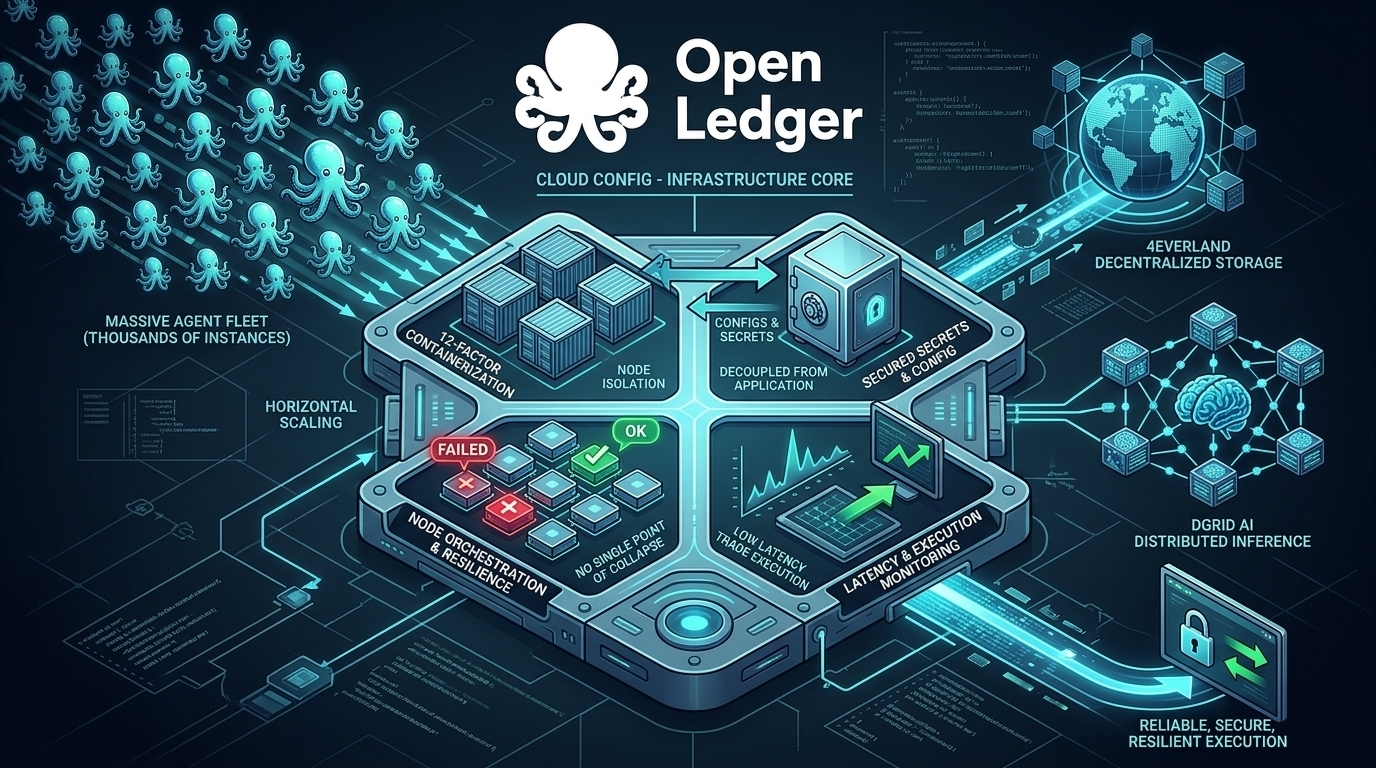
The platform connects with 4everland for decentralized storage and DGrid AI for distributed inference. That means agent infrastructure does not depend on any single server or provider. Horizontal scaling works. One provider going down does not stop your agents.
Centralized infrastructure providers have had major outages consistently over the last two years. If your trading agents run on centralized infra that outage is your problem too. Cloud Config is built specifically so that situation never applies.
$OPEN Is Doing Real Work Not Just Collecting Fees
Most Web3 projects attach a token to something that would work fine without one. Worth saying out loud because it makes people skeptical and that skepticism is usually earned.
$OPEN is different because the use cases were designed before the token not after.
Every data query, research pull and automated trade executed by an active agent settles gas in $OPEN. Real usage driving real demand. Not speculation holding the price up.
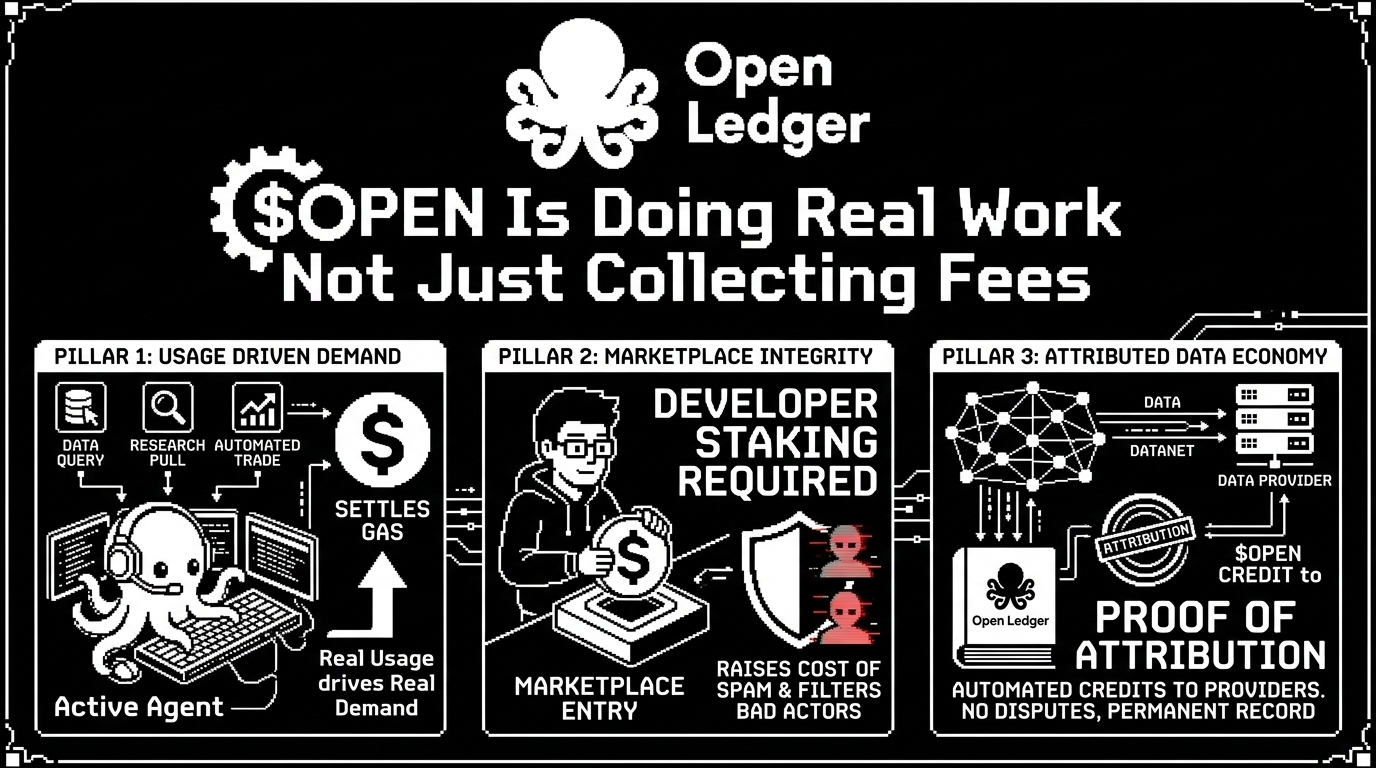
Developers launching high-frequency agent configurations in the marketplace must stake $-Open first. That single requirement raises the cost of spamming the network. Anyone flooding the system with low-quality agents has to put real capital behind it. The marketplace stays clean because bad actors pay a price to enter it.
Proof of Attribution handles the data economy underneath all of this. When an agent uses a specialized Datanet to execute a strategy the system automatically identifies which data provider contributed and credits them in $-OPEN. No manual accounting. No disputes. The ledger handles it and the record is permanent.
Why OctoClaw Is Different From Everything Else Claiming to Do the Same Thing
The AI agent conversation in crypto is mostly about chatbots and copilots. Things that answer questions or pull summaries. That is a narrow definition of what agents can actually do.
OpenLedger is building an autonomous financial operating system. Agents that do not just retrieve information but act on it.
Agents that are accountable because every action is recorded on an immutable ledger. Agents that pay their data sources automatically and scale without a human supervising each instance.
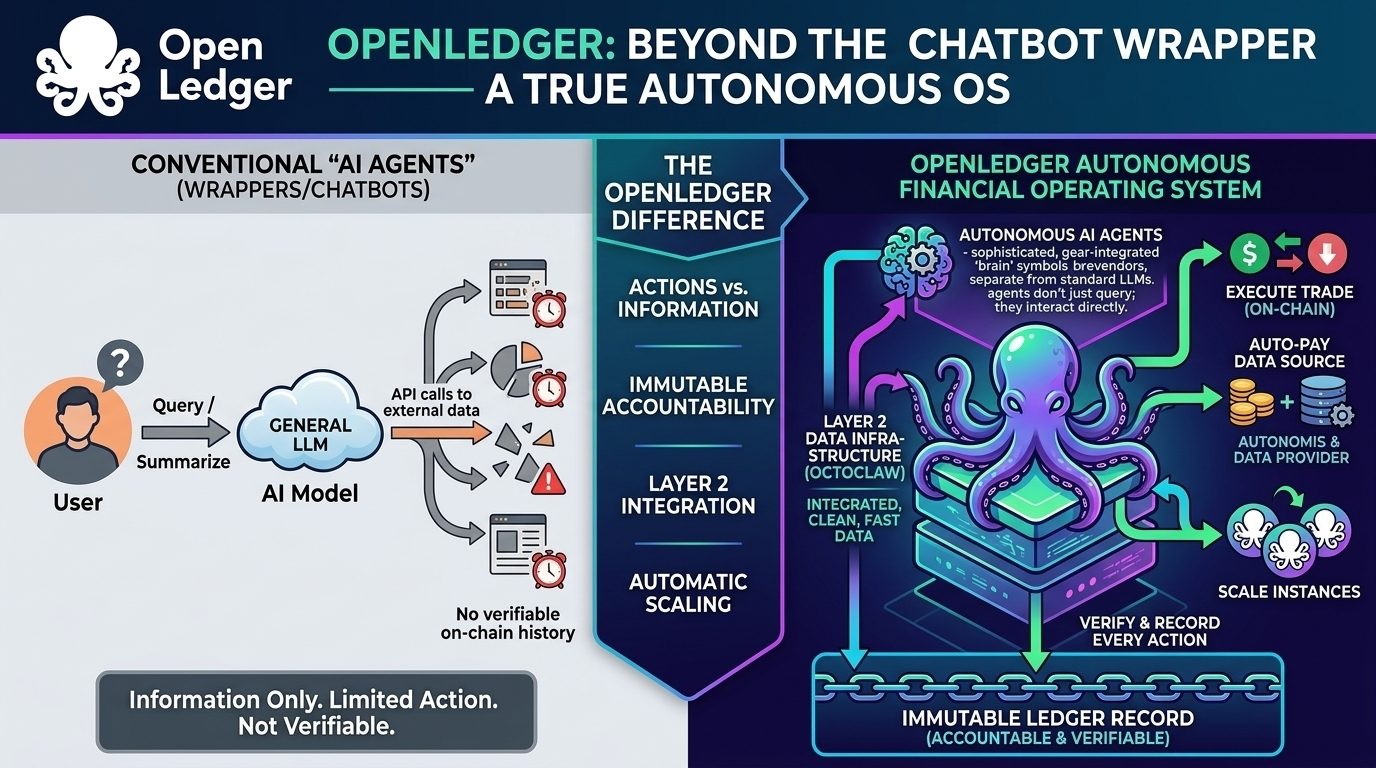
The reason this works differently from competitors is the Layer 2 data infrastructure underneath OctoClaw.
Agents are not calling external APIs and hoping the data is clean and fast. They run directly on the protocol's own data layer.
That changes the reliability calculation entirely. Most so-called AI agents in Web3 right now are wrappers around general purpose models with no real onchain integration and no way to verify what they did or why.
That is the gap OpenLedger has actually crossed.
What This Means Practically
If you are a developer the Cloud Config architecture lets you deploy modular nodes without one failure collapsing the whole setup.
The staking requirement means the marketplace you are entering already has a quality floor.
If you are a trader the pitch is pretty simpler.
The things you currently do manually because the market does not run on your schedule can now run on their own.
Not through a rigid bot that breaks when conditions shift but through an agent reading live data and adapting in real time.
The projects that will matter in three to five years are the ones building real systems right now while everyone else debates narratives.
OpenLedger is one of them. OctoClaw is already running. Cloud Config is live. $OPEN has real mechanics behind it. The infrastructure exists.
The only question is whether you are using it.

#OpenLedger #OctoClaw #Web3 #CryptoAutomation @OpenLedger