
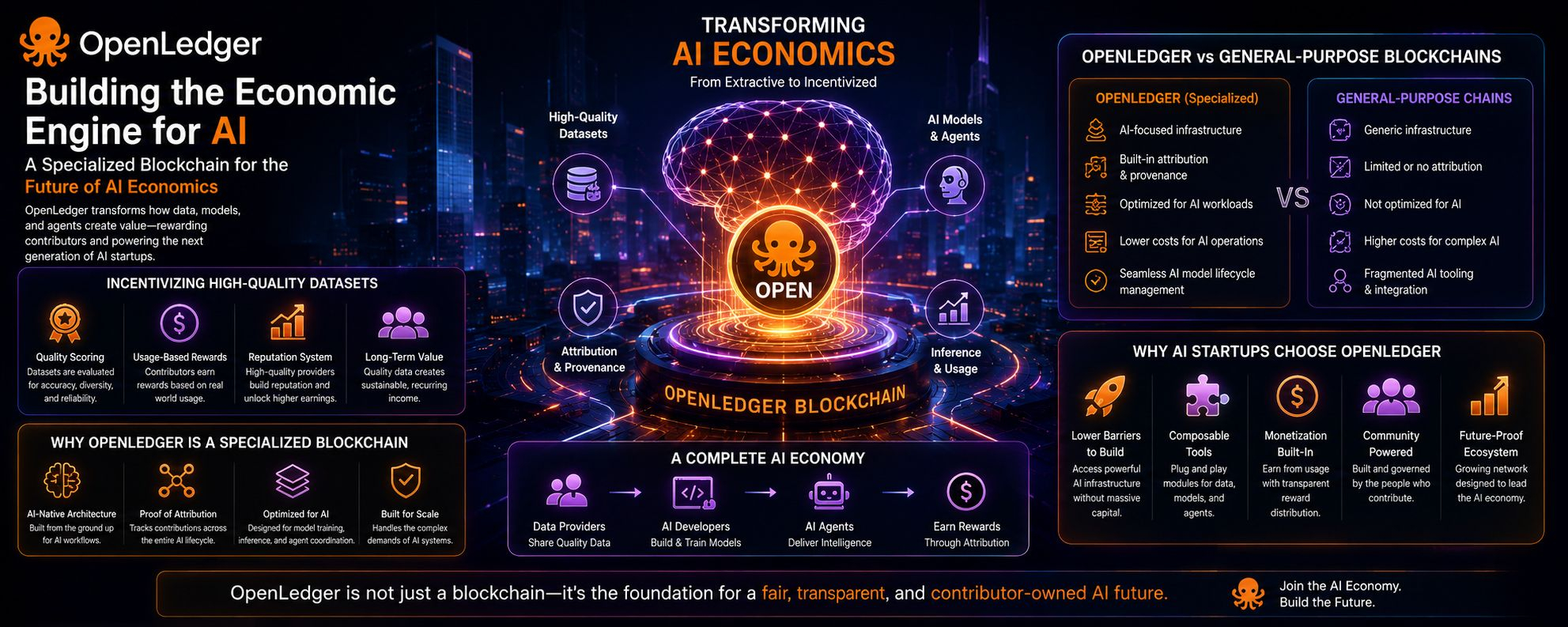


Honestly? I Been sitting with @OpenLedger for a while now, and I think most people still frame it the wrong way. 😂 They see another AI token attached to blockchain infrastructure and assume it’s just part of the usual crypto narrative cycle. But after running through the mechanics more deeply, OpenLedger feels less like a generic Layer 1 and more like a specialized economic operating system for AI itself.

That distinction matters.
General-purpose blockchains are designed to support everything at once DeFi, NFTs, gaming, payments, governance — which sounds flexible until AI workloads start demanding attribution tracking, inference accounting, data provenance, and scalable model coordination. OpenLedger is purpose-built around those exact requirements. Instead of forcing AI into infrastructure never designed for it, the chain itself becomes optimized for AI-native interactions between datasets, models, validators, and autonomous agents.
What I kept coming back to is the dataset economy. Most AI systems today rely on enormous amounts of low-visibility data scraping where contributors rarely benefit financially. OpenLedger flips that model by creating incentives tied directly to usage and attribution. If a dataset consistently improves inference quality or model performance, contributors can theoretically earn recurring rewards tied to downstream activity. That changes the psychology completely because data stops being disposable fuel and becomes a monetizable digital asset.
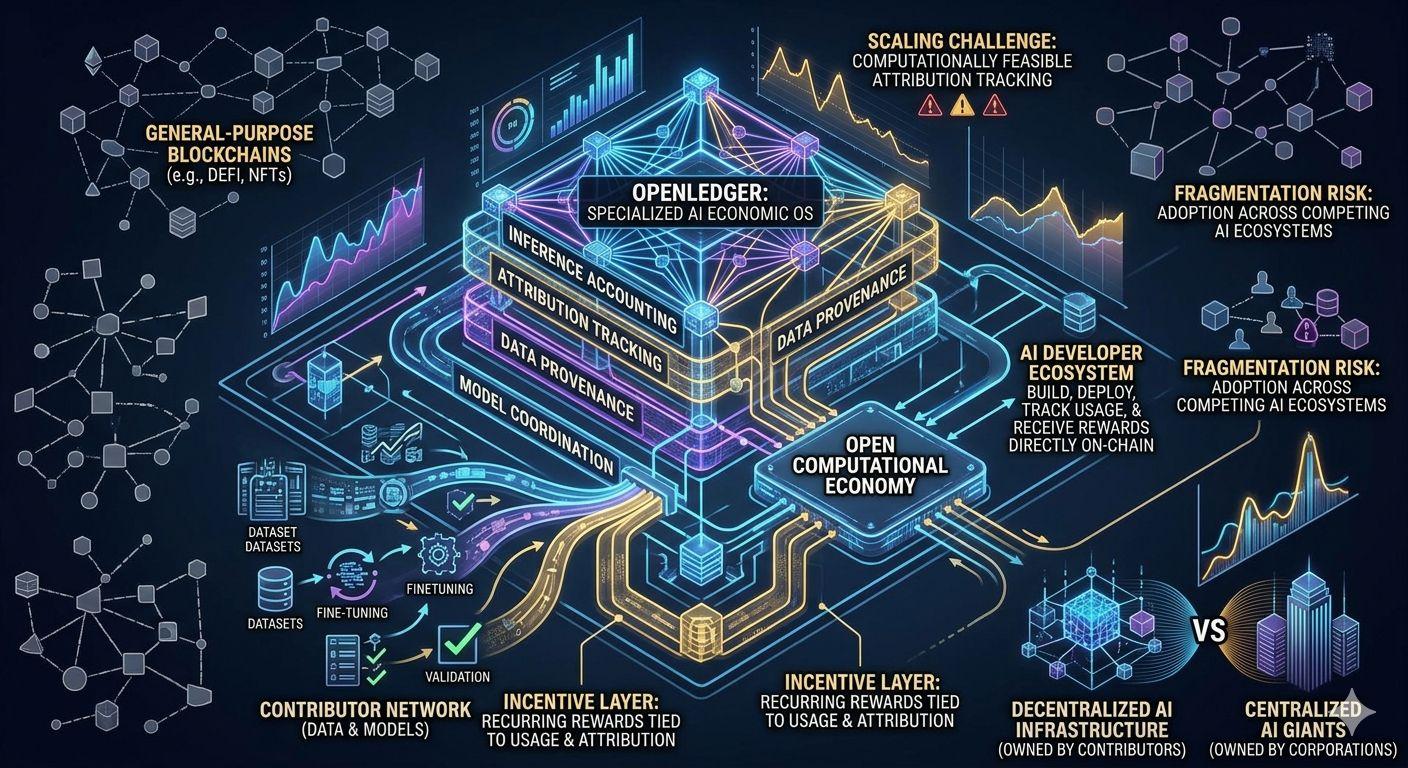
And honestly, that’s probably why AI startups may find this ecosystem attractive. Training models from scratch is brutally expensive. Infrastructure access, fine-tuning, deployment, and monetization are usually fragmented across multiple centralized providers. OpenLedger compresses those layers into one economic network where developers can build, deploy, track usage, and receive attribution-based rewards directly on-chain. The architecture creates a more composable environment for smaller AI teams that otherwise couldn’t compete with giant incumbents.
The blockchain specialization is the key here. OpenLedger isn’t trying to outperform Ethereum or Solana as a universal chain. It’s narrowing focus toward AI coordination itself. That’s a smarter strategy than most people realize because specialized infrastructure often scales better than generalized infrastructure once complexity increases.
But the tension here is obvious too. AI systems evolve incredibly fast, and building protocol-level attribution mechanisms assumes contribution tracking remains computationally feasible at scale. That’s a huge assumption. There’s also the risk that specialized chains become too niche if adoption fragments across competing AI ecosystems.

Still, I can’t ignore the direction OpenLedger is pushing toward. It treats AI not as software owned by corporations, but as an economic network owned by contributors. The real question is whether decentralized AI infrastructure can evolve fast enough before centralized AI giants permanently dominate the intelligence economy.
