
I’m watching people feed machines all day without calling it work. A woman tagging skin lesions in Manila between bus rides. A teenager in Lahore correcting subtitles for training data because it pays a little better than surveys. Someone in Buenos Aires talking to an AI companion long enough for the conversation itself to become useful inventory. None of them own the systems they’re improving. Most of them don’t even know where the value goes after they press submit.
And the strange thing is how normal this has started to feel.
The internet trained us into giving things away in fragments. Photos first. Then opinions. Then behavior. Tiny unconscious movements. We built entire markets out of invisible habits. The platforms became landlords of human attention, and everyone adapted to the rent. Even now, with all the language around artificial intelligence and agents and autonomous systems, the old pattern is still there underneath everything: extract quietly, aggregate centrally, reward selectively.
I keep noticing how often people talk about AI as if it appeared fully formed, descending from some sealed research lab. But most of it is stitched together from millions of small human acts. Corrections. Ratings. Repetitions. Edge cases. The machine becomes intelligent because crowds of ordinary people slowly transfer pieces of themselves into it. Their judgment. Their humor. Their timing. Their accents. Their mistakes.
Yet the ownership remains strangely narrow.
A hedge fund can suddenly value an AI company at billions because the model responds elegantly to prompts. Meanwhile the people whose conversations, annotations, or specialized knowledge shaped that fluency stay economically invisible. Not exploited in the dramatic old sense. Something quieter than that. More administrative. They become background infrastructure.
And maybe that’s why I keep circling back to this emerging idea that data itself is beginning to behave like labor. Not metaphorically. Economically. It has inputs, outputs, quality variance, market value. Some datasets produce better models the way skilled workers produce better products. But the systems around AI still treat data contributors like exhaust instead of participants.
That gap feels important.
Especially now, when models are multiplying faster than trust. Every company says they have AI. Every startup says agents will replace workflows. But underneath the noise there’s this growing pressure nobody fully admits: the models need fresh, reliable, incentivized intelligence to survive. Static data ages quickly. Human behavior changes. Language changes. Markets shift. The machine has to keep learning from somewhere.
I’ve been thinking about what happens when people stop giving that value away casually.
Not through protest. Just through awareness.
The moment someone realizes their dataset has weight. Their niche expertise has leverage. Their interactions are not merely consumption but production. Suddenly the architecture of AI starts looking incomplete. There’s computation, there’s capital, there’s infrastructure — but the liquidity around human contribution still feels primitive, almost pre-financial.
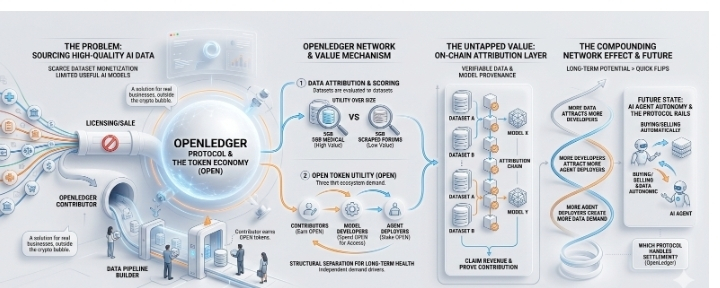
And then projects begin appearing at the edges, trying to close that gap indirectly. Systems where models, datasets, and agents stop behaving like closed corporate assets and start behaving more like tradable economic units. Places where contribution can actually circulate back toward the contributor instead of disappearing upward into a platform balance sheet.
Not utopian. Just structurally different.
Because right now, most people creating value for AI never see the market that forms around their participation. They only experience the surface layer: the chatbot, the app, the interface. The deeper economy remains hidden behind APIs, cloud contracts, and private valuations.
But I think people are starting to sense it.
You can feel it in the way freelancers talk about training models now. In the way open-source communities argue about licensing. In the sudden obsession with provenance, attribution, synthetic data, decentralized compute. These aren’t isolated conversations. They’re symptoms of a larger realization trying to become visible.
That intelligence is no longer just software.
It’s becoming an economy.
And economies eventually force society to answer uncomfortable questions about ownership. About compensation. About who gets remembered inside the systems they helped build.
I don’t think the next shift in AI will feel technological at first. It will feel financial. Quietly financial. A slow movement where people begin tracing value back to its origin and asking why the path only ever seemed to flow one direction.