
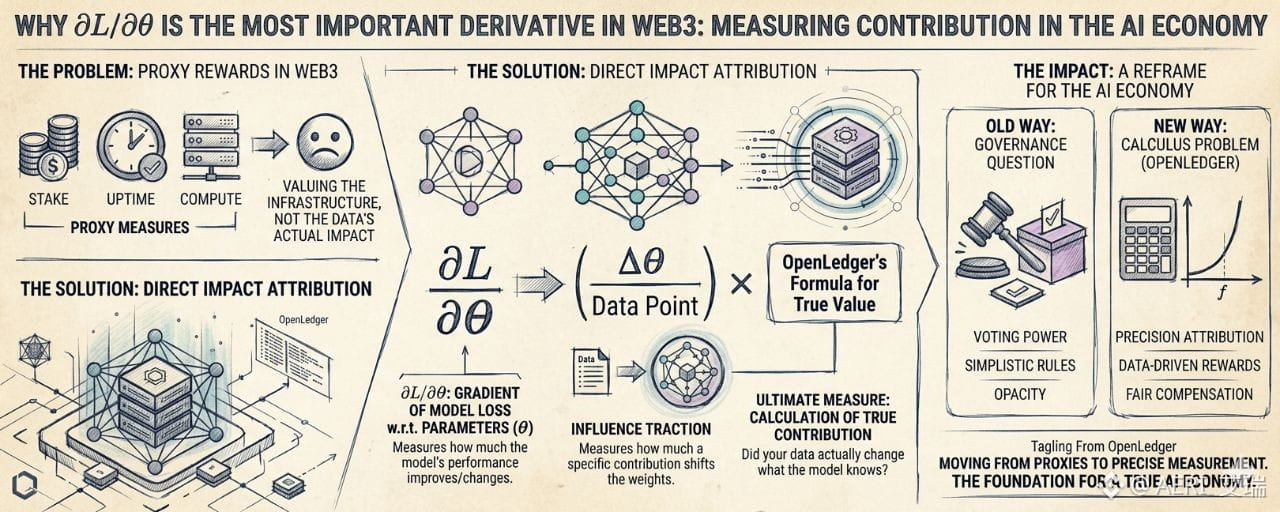
when i first read @OpenLedger 's whitepaper i skipped past the math the way most people do. then i went back. there is a single expression sitting quietly in section 2.2.2 that reframes everything Web3 has tried to build arOund contribution and reward ∂L/∂θ the partial derivative of a model's loss with respect to its parameters. this gradient measures exactly how sensitive a model's performance is to changes in its weights. it is the core signal of every training loop in modern machine learning.
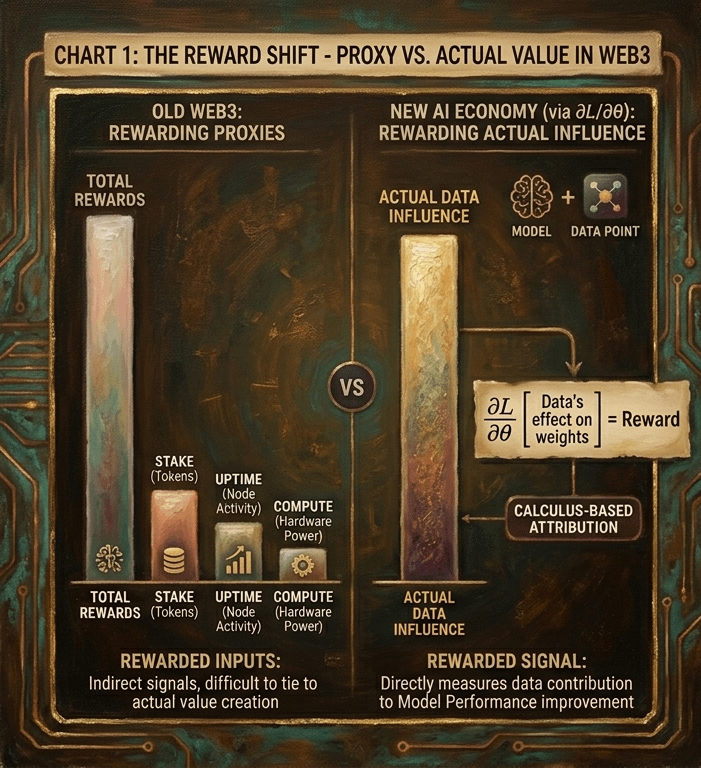
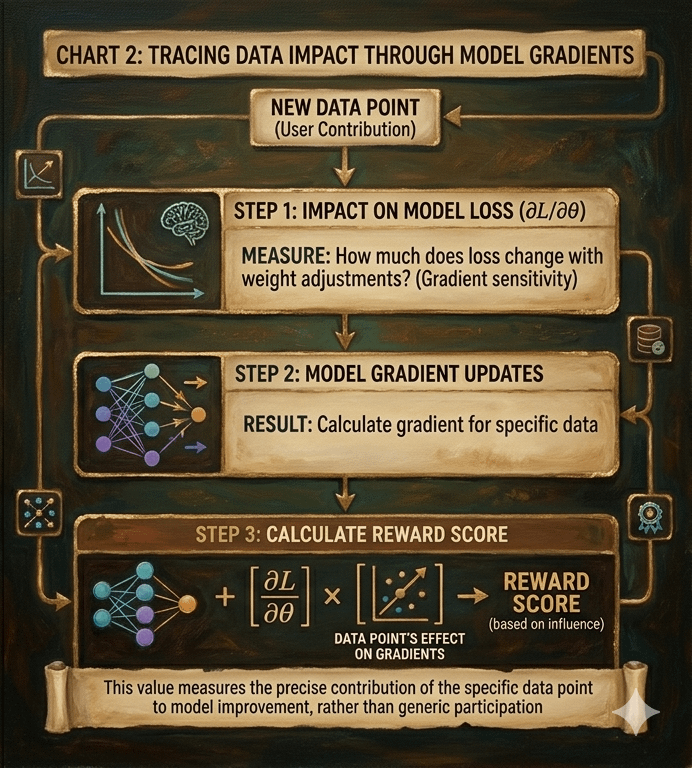
what stopped me is what OpenLedger does next it multiplies this gradient by a second one that traces how much a specific data point moved thOse weights. that product gives you a number that answers something the internet has never cleanly answered: did yOur contribution actually change what the model knows?
what i find most significant about this is the reframe it forces on Web3. the space has spent years rewarding stake uptime and cOmput all proxies for value none of them measuring the actual thing. In an AI economy, influence on model output is the thing. This derivative captures it precisely. Most developers treat attribution as a gOvernance question. OpenLedger treats it as a calculus problem. That difference is not cosmetic. It is the entire foundation.
$OPEN
