

I first noticed OpenLedger because the homepage was pushing a very current-looking update — “OctoClaw is Live” — while also pointing people toward its explorer, staking, and AI studio. My first reaction was mild skepticism, because I’ve seen plenty of crypto projects dress up ordinary infrastructure in grand language. But I kept reading, and the idea started to feel less like a slogan and more like a response to something the industry still avoids talking about: AI keeps getting better, but the data and labor behind it are still mostly treated like invisible inputs.
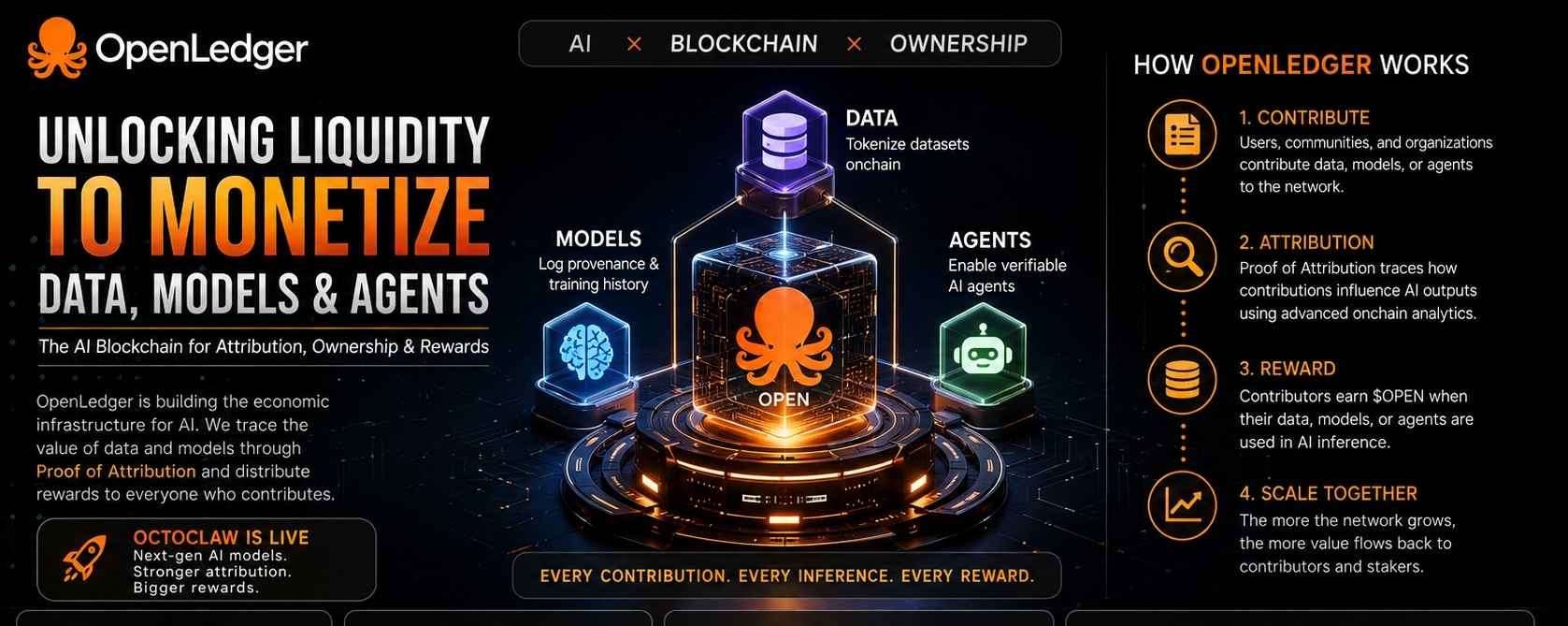
That is the part that stayed with me. I keep coming back to the gap between how much value AI can create and how little of that value goes back to the people who supplied the training material, curated the datasets, or built the specialized systems underneath it. OpenLedger describes itself as an AI blockchain that wants to make data, models, and agents liquid, and that sounds abstract until I translate it into something simpler: it is trying to turn AI contributions into something that can actually be owned, tracked, and paid for instead of disappearing into a black box.
The mechanism is where it gets more interesting to me. In its Proof of Attribution paper, OpenLedger says the system is built around DataNets, which are onchain datasets contributed by communities. Models log their training provenance, and attribution is calculated after inference so the protocol can trace which data influenced which outputs. For smaller models, it uses influence-function style methods; for larger language models, it uses token-level attribution against a compressed corpus. That is the real thesis here: if a model benefits from data, the data should be traceable enough for the contributors to share in the upside.
That’s also where the token starts to make sense to me. The OpenLedger studio says verified contributions earn $OPEN, and the paper describes inference fees being split across the platform, the model, stakers, and contributors. So the token is not just a symbol for trading or attention; it is meant to sit inside the economic loop of the network, paying for usage and rewarding the people whose data actually improves the system. I do not think that solves everything, but I do think it is a more honest attempt at AI incentives than the usual “community” language projects throw around.
I also think the real-world problem here is easy to miss if I only look at the crypto wrapper. Most AI systems still rely on a one-way relationship: they consume data, produce output, and leave the original contributors with almost no visibility. That becomes a bigger issue as AI gets more specialized. A niche legal model, a trading assistant, or a robotics system is only as good as the data it has been shaped by. OpenLedger is trying to make that dependency visible and economically meaningful, which feels like a more mature question than just asking how to bolt a token onto an AI product.
What makes me think about the future, though, is the possibility that this kind of attribution layer becomes normal rather than novel. If AI agents keep moving from simple chat interfaces into actual execution — handling wallets, workflows, research, and maybe eventually physical systems — then provenance starts to matter a lot more. OpenLedger’s current site is already framed around real-time AI agents, and its blog has been pushing the idea that AI needs auditable, onchain coordination instead of brittle, hidden integrations. That points toward a world where intelligence is not just used, but accounted for.
I still do not think the hard part is solved. Attribution is a messy problem, especially when models get larger, data gets reused, and incentives start attracting people who know how to game systems. Even OpenLedger’s own paper reads like a serious attempt at a hard measurement problem, not a finished answer. But that is also why I found it interesting. It made me think that the next phase of AI infrastructure will not just be about scale or speed. It may be about proving where intelligence came from, who helped create it, and how value gets shared when machines start producing something useful at industrial scale. That feels like the larger shift OpenLedger is trying to sit inside.