
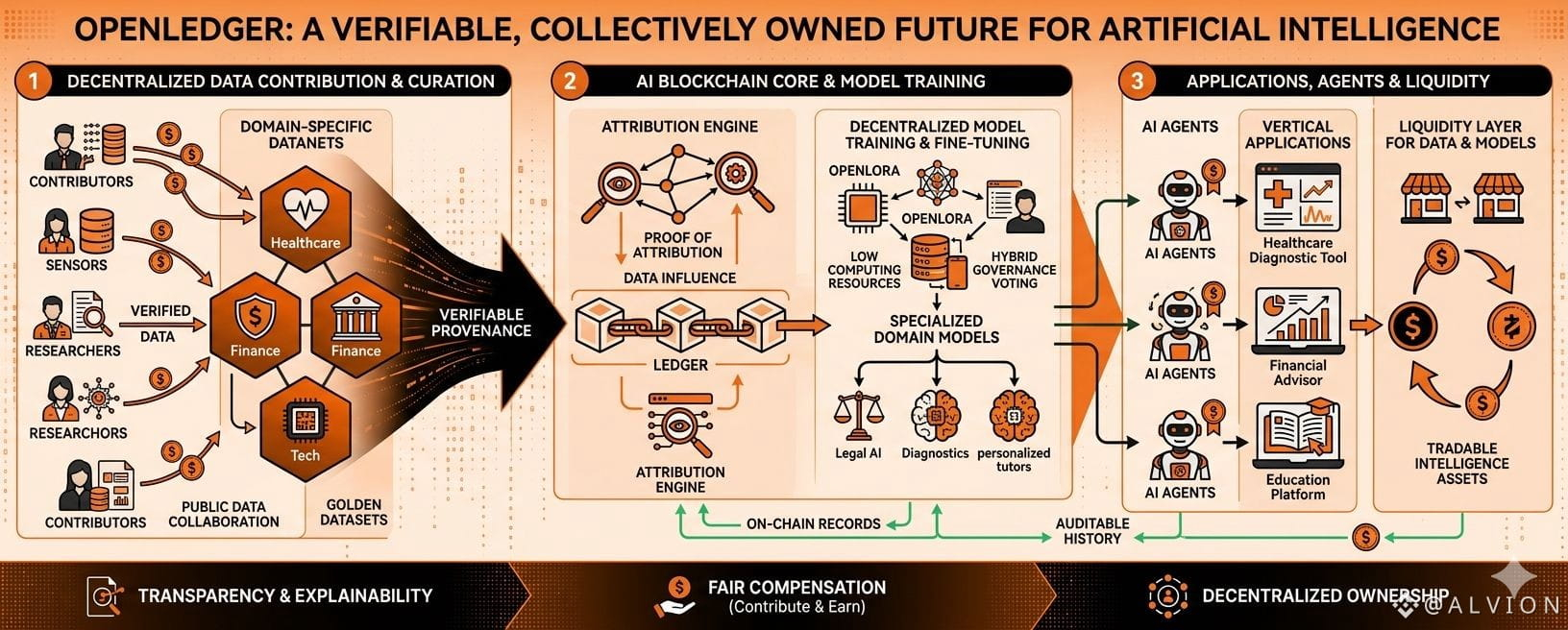

When we look at how artificial intelligence has grown over the past few years it becomes clear that something fundamental needs to change in the way we build and share these systems. OpenLedger stands as a project that aims to create a verifiable and collectively owned future for artificial intelligence by putting everything on a dedicated blockchain designed specifically for AI work.
The core idea starts with recognizing that current AI development relies heavily on centralized companies that control data models and the rewards that come from them. Most people who provide data or help improve models never see fair compensation or proper credit. OpenLedger changes that setup by recording every step of the AI lifecycle directly on its chain so that contributions become traceable and rewarded in a transparent way.
At its heart OpenLedger functions as an AI blockchain. It unlocks liquidity for data models and agents while making sure ownership stays with the community rather than a few big players. The platform records contributions like data uploads model training steps and usage events so everyone involved can prove their role and receive benefits when the AI delivers value. This approach addresses key problems in traditional AI such as lack of transparency black box decision making and unfair distribution of profits.
One of the main building blocks is called Datanets. These are on-chain collaborative networks where communities come together to create curate and contribute high quality datasets. Anyone can join a public Datanet or start their own focused on a specific domain like healthcare finance or technical skills. Each piece of data added gets verified and linked permanently to the contributor. This creates golden datasets that specialized models can use for better accuracy and relevance. Unlike random web scraped information these datasets come with clear provenance so the AI built on them carries trust and accountability.
Proof of Attribution serves as the key mechanism that makes this all work. It tracks exactly how data or model improvements influence the final outputs. When a user queries the AI and receives a response the system can trace back which Datanet contributed which pieces of knowledge. Contributors then earn rewards automatically based on real usage rather than promises or centralized decisions. This turns data from a free resource extracted by big tech into an asset that people own and monetize directly. The attribution happens on chain so it stays tamper proof and verifiable by anyone.
Model training on OpenLedger happens in a decentralized manner. The platform offers tools that let users fine tune models using their own data or community Datanets without needing massive computing resources. Techniques like OpenLoRA help run multiple specialized models efficiently on limited hardware. This lowers the barrier for individuals researchers and small teams to participate. Instead of depending on giant data centers people can contribute compute power or expertise and still get recognized for their role in improving the overall system.
The shift toward specialized models forms another important part of the vision. General purpose large language models handle broad tasks well but they often fall short in deep domain knowledge. OpenLedger supports the creation of smaller more efficient specialized models that excel in particular fields. These models can work alongside larger foundation models to deliver precise results while using far less energy and cost. For example a model trained on expert legal data through a Datanet would provide more reliable analysis than a generic AI trying to guess at statutes. This specialization makes AI more practical for real world applications in medicine education engineering and many other areas.
Transparency runs through every layer of the project. Traditional AI systems hide their training data and decision processes which makes it hard to trust outputs especially in sensitive areas. OpenLedger records the full history of each model including which datasets shaped it which contributors added value and how the model evolved over time. Users can audit the provenance before relying on results. This explainability builds confidence and reduces risks associated with hallucinations or biased information. Developers and end users both benefit from knowing exactly where the intelligence comes from.
Governance on the platform follows a hybrid on chain model. Token holders participate in decisions about protocol upgrades model quality standards and incentive rules. This collective ownership ensures that the direction stays aligned with community needs rather than profit motives of a single company. Participants vote on improvements to Datanets or adjustments to attribution algorithms based on real performance data. The system uses established frameworks to keep governance secure and effective while encouraging broad involvement.
Economic incentives play a central role in sustaining the ecosystem. Contributors earn tokens when their data influences model outputs or when their models get used in applications. This creates a flywheel effect where more high quality contributions lead to better AI which attracts more users and generates more rewards. Liquidity for data and models means people can trade or compose them in new ways similar to how decentralized finance handles assets. Agents built on the platform can also carry attribution so their actions remain traceable and their creators stay compensated.
The platform remains compatible with existing Ethereum standards which makes it easier for developers to connect wallets deploy smart contracts and integrate with other ecosystems. This EVM compatibility lowers the learning curve and allows seamless movement of value across layers. Builders can focus on AI innovation without worrying about basic infrastructure hurdles. The design prioritizes AI specific needs like handling large metadata for datasets and tracking complex model relationships that general blockchains struggle with.
Looking deeper into why this matters consider how AI currently extracts value from millions of creators without giving back fairly. Writers artists researchers and everyday users feed data into systems that then sell access or services based on that collective input. OpenLedger flips the script by making participation voluntary and rewarded. People choose what to share and under what terms while maintaining control through on chain records. This respect for contributions could encourage a surge in quality data as more individuals and communities see direct benefits.
Specialized AI also addresses environmental and cost concerns. Training and running massive general models demands enormous energy and hardware. By focusing on efficient smaller models tailored to tasks OpenLedger helps reduce the overall footprint of AI deployment. Communities can pool resources for targeted training runs instead of competing in a race for bigger parameters. This democratizes access and makes powerful intelligence available to regions or organizations that cannot afford enterprise solutions.
Applications built on OpenLedger gain built in verifiability. An AI agent handling financial advice for instance can prove which market data and models informed its recommendations. Users verify the chain of attribution before acting on suggestions. In healthcare a diagnostic tool might reference exact medical datasets and expert contributions allowing doctors to cross check sources. Education platforms could offer tutors trained on verified curricula with transparent improvement histories. These use cases show how collective ownership leads to more responsible and useful AI across sectors.
The project emphasizes collaboration at every stage. Researchers share insights model developers iterate together and data providers curate together within Datanets. This mirrors open source software development but with economic layers that keep participants motivated. Tools for no code fine tuning further open the doors so that domain experts without deep programming skills can shape models relevant to their fields. A teacher might improve an education model or a farmer could enhance agricultural prediction tools using local knowledge recorded on chain.
Challenges in current AI like bias lack of accountability and central control get tackled through these mechanisms. Since contributions stay visible communities can identify and correct problematic data. Governance votes allow collective decisions on what standards models should meet. The decentralized nature reduces single points of failure or censorship that plague centralized platforms. Over time this could foster AI systems that better reflect diverse human knowledge and values rather than the priorities of a handful of corporations.
Technical features support scalability for real world use. The blockchain handles AI specific workloads efficiently including storage of model adapters inference logging and reward distribution. OpenLoRA for example enables serving multiple models cost effectively which matters when thousands of specialized AIs operate simultaneously. Inference events trigger automatic attribution and payments without manual intervention keeping the system running smoothly at scale.
Community building forms a vital part of the approach. Developers users and contributors connect through shared goals of creating trustworthy AI. Backing from various experts in crypto and technology signals strong interest but the real strength lies in the open participation model. Anyone can start contributing small datasets or testing models and gradually build reputation and rewards within the ecosystem. This organic growth aligns incentives across different roles from data curators to application builders.
The broader economic shift from internet based models to AI native systems provides context for why projects like OpenLedger matter now. Traditional advertising and content monetization face disruption as AI handles more tasks. A new economy needs infrastructure where intelligence itself becomes a productive asset with clear ownership and flows of value. OpenLedger offers that foundation by treating data models and agents as liquid composable elements in a decentralized marketplace. This setup encourages innovation because creators know they will benefit from the success of their work.
In practice the user journey feels straightforward. Someone visits the platform connects a wallet and begins exploring Datanets. They might upload relevant documents or knowledge for a topic they care about. The system verifies the contribution records it on chain and links it to future model training. Later when models use that information the contributor receives tokens proportional to impact. Model creators fine tune using available data publish the result and earn when others query or deploy it. Everything stays visible and auditable which builds long term trust.
Security and verifiability receive careful attention. Blockchain properties ensure immutability while AI specific protocols handle the complexity of tracking influence across training and inference. Participants can challenge or validate data quality through community mechanisms adding another layer of collective oversight. This combination reduces risks of poisoned datasets or hidden manipulations that worry many AI users today.
OpenLedger represents a thoughtful attempt to align technological progress with fair participation. By pioneering verifiable collectively owned AI it points toward a future where intelligence benefits from broad contributions and distributes value accordingly. The project continues developing its tools and ecosystem with focus on practical usability and real impact across domains. As more people engage the network effect strengthens making specialized trustworthy AI more accessible to everyone involved.
This approach does not claim to solve every issue in artificial intelligence overnight but it establishes solid infrastructure for ongoing improvement through community effort. Data stays valuable models evolve transparently and ownership remains distributed. In a world increasingly shaped by AI having systems built on these principles could make a meaningful difference in how technology serves society as a whole. The emphasis on openness traceability and shared benefits offers a compelling path forward for those who want to participate actively in shaping the next generation of intelligent systems.!!!
