
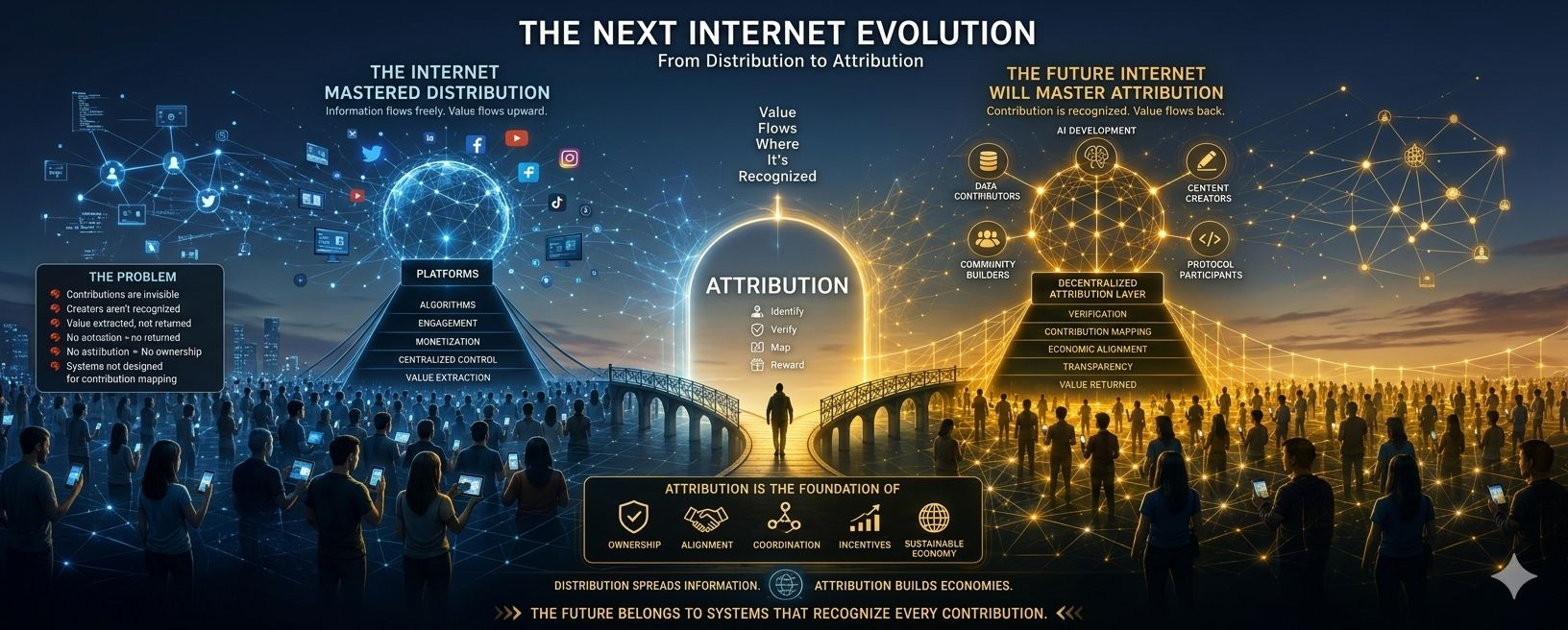

I keep coming back to one thought lately…
The internet became incredibly good at spreading value, but surprisingly bad at recognizing who actually creates it.
That imbalance quietly shaped the entire digital economy.
For years, the Internet Optimized one thing better than almost any system in history: distribution. Information could move globally in seconds. Platforms scaled to billions of users. Social networks amplified visibility faster than traditional media ever could. Algorithms mastered engagement. Infrastructure mastered scale.
But somewhere inside that explosive growth, attribution got left behind.
And I think that problem is becoming impossible to ignore.
Every single day, billions of People contribute value online without ever being properly recognized inside the systems they help grow. People create discussions, Provide feedback, generate data, coordinate communities, share insights, improve algorithms, train AI behavior indirectly, and strengthen ecosystems through participation alone.
Yet most of that value remains economically invisible.
The internet solved distribution.
It never truly solved contribution mapping.
That distinction matters far more now because digital economies are changing. Value no longer comes only from centralized companies or isolated creators. Increasingly, value emerges from networks, communities, collaborative coordination, and large groups of people interacting across decentralized systems simultaneously.
Modern digital value is deeply interconnected.
A meme becomes valuable because communities spread it.
AI models improve because millions of users interact with them.
Protocols strengthen because ecosystems participate around them.
Platforms groW because collective behavior continuously feeds them.
The challenge is that traditional internet infrastructure was never designed to track contribution across systems that complex.
And Honestly, I think that may become one of the defining infrastructure problems of the next internet era.
Because attribution is no longer just about giving credit.
It’s becoming about ownership.
Economic alignment.
Coordination.
Transparency.
Incentive Design.
Who contributed value?
How do you verify it?
How do decentralized systems reward it fairly?
How do you coordinate economies where contribution comes from thousands of interconnected actions instead of one centralized source?
Those questions are getting bigger every year.
That’s why I think projects like OpenLedger are entering a much more important conversation than many people realize.
Most people still evaluate infrastructure projects at the surface level. They look for hype cycles, narratives, token momentum, or short-term adoption metrics. But the deeper infrastructure layer is often where the real long-term shifts happen.
What makes OpenLedger strategically interesting to me is that it appears to be exploring infrastructure around attribution itself contribution verification, decentralized participation, network coordination, and systems capable of identifying value creation across distributed ecosystems.
Structurally, that direction matters.
Every major internet evolution introduced a new way to measure value.
The early web measured traffic.
Social platforms monetized attention.
Blockchain introduced programmable ownership.
The next evolution may revolve around programmable attribution.
And if that happens, it could fundamentally reshape how digital economies operate.
Because ultimately, attribution determines who captures value.
Right now, the Internet is extremely efficient at extracting value from contributors, but comparatively weak at returning value back toward them. That imbalance has existed for years, but AI and decentralized infrastructure are accelerating the problem dramatically.
Especially in AI.
Modern AI systems are increasingly built on layers of collective contribution data, behavior, interactions, feedback loops, public knowledge, and network participation. Intelligence itself is becoming more collective, while rewards remain heavily centralized.
That creates a structural tension inside the future digital economy.
And I don’t think the next Phase of the internet can scale sustainably without solving it.
The future internet may not only require systems capable of distributing information efficiently.
It may also require Systems capable of identifying, verifying, coordinating, and rewarding contribution with equal precision.
And whichever infrastructure layers solve that problem first may eventually become some of the most important foundations of the decentralized digital economy itself.