I didn’t take it seriously at first. That probably sounds unfair, but after enough years around crypto infrastructure you develop a reflex against new coordination layers promising cleaner incentives. I’ve watched too many systems begin as philosophical arguments and end as liquidity funnels with dashboards attached.
Storage, compute, indexing, governance, identity. Every cycle insists the invisible layers matter now. And they do matter, eventually. Usually right after they fail.
That’s partly why I kept circling back to OpenLedger without really wanting to. Not because I thought it solved something cleanly. More because it seemed aimed at a problem everyone quietly knows is getting worse: AI systems absorbing human contribution faster than anyone can track where value came from in the first place.
Data goes in. Outputs come out. Somewhere in between, attribution dissolves.
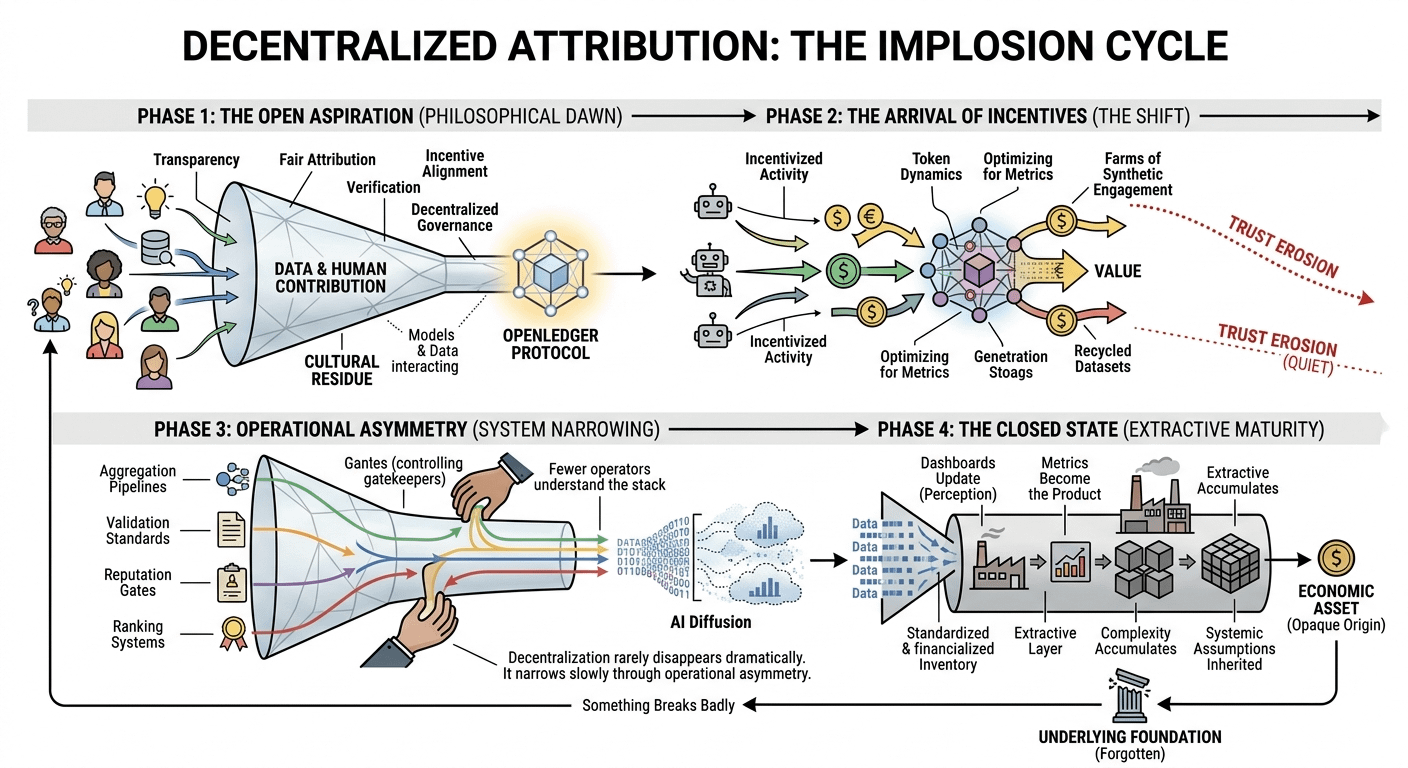
And now there’s this growing instinct across the industry to rebuild provenance after the fact. To create systems that remember who contributed what, which model interacted with which data, who deserves compensation, visibility, ownership. At least that’s the aspiration. The language around it always sounds reasonable in the early stages.
Then incentives arrive.
That’s where things start to feel uncomfortable.
Because contribution systems don’t stay philosophical for very long once money attaches itself to participation. They become environments people optimize against. You can already feel the shape of it forming across AI-data infrastructure: farms of synthetic engagement, recycled datasets, low-quality contribution loops disguised as activity.
It works in theory. Most things do.
The problem isn’t really the technology. I’ve stopped believing technical architecture is where most failures originate. Usually the breakdown happens socially, then economically, and only afterward technically. Incentives distort behavior gradually until the infrastructure starts rewarding visibility over substance. Then the metrics become the product. Then trust erodes quietly in the background while everyone keeps pretending the system is functioning because the dashboards still update.
Maybe that’s too harsh.
Still, I keep coming back to how difficult it is to verify human contribution at scale without accidentally creating a new class of gatekeepers. Someone always ends up controlling reputation layers, validation standards, ranking systems, aggregation pipelines. Decentralization rarely disappears dramatically. It narrows slowly through operational asymmetry.
The people with better tooling begin shaping reality for everyone else.
And AI infrastructure amplifies this because the underlying material — human data, behavior, creativity, language — is inherently messy. Ownership itself becomes slippery. Models don’t memorize contribution in ways humans intuitively understand. They diffuse it. Compress it. Blend it into statistical abstractions that are economically valuable precisely because they obscure origins.
So when projects like OpenLedger try to rebuild accountability around that process, I understand the instinct. I really do.
But I also wonder whether attribution systems survive contact with scale any better than governance systems did. Or reputation systems. Or decentralized marketplaces. Crypto has this recurring habit of assuming transparency can permanently stabilize incentives. Usually transparency just changes what people optimize for.
That part keeps bothering me more than it should.
Because underneath all of this is a stranger question about labor. Not digital labor exactly. Cognitive residue. Human patterns transformed into infrastructure inputs. The AI economy increasingly depends on extracting useful fragments from millions of people who may never fully understand where their contribution ended up or how it compounds downstream.
And once those fragments become financial assets, everything changes. Data stops being contextual and starts behaving like inventory.
I’m not even saying OpenLedger gets this wrong. In some ways, the fact that it’s attempting to confront these invisible coordination layers at all makes it more interesting than most AI projects floating around right now. At least it acknowledges the plumbing underneath the outputs.
But infrastructure ages strangely. Especially “open” infrastructure. Over time, complexity accumulates. Fewer people understand the full stack. Trust shifts from systems to operators, then from operators to brands, and eventually nobody can tell where decentralization actually lives anymore.
You just sort of inherit assumptions from previous cycles and keep building on top of them until something breaks badly enough that everyone suddenly remembers the foundation existed at all.
And maybe that’s what I can’t shake here. Not whether attribution works technically, but whether humans can resist turning attribution itself into another extractive layer once enough value starts flowing through it.$OPEN