
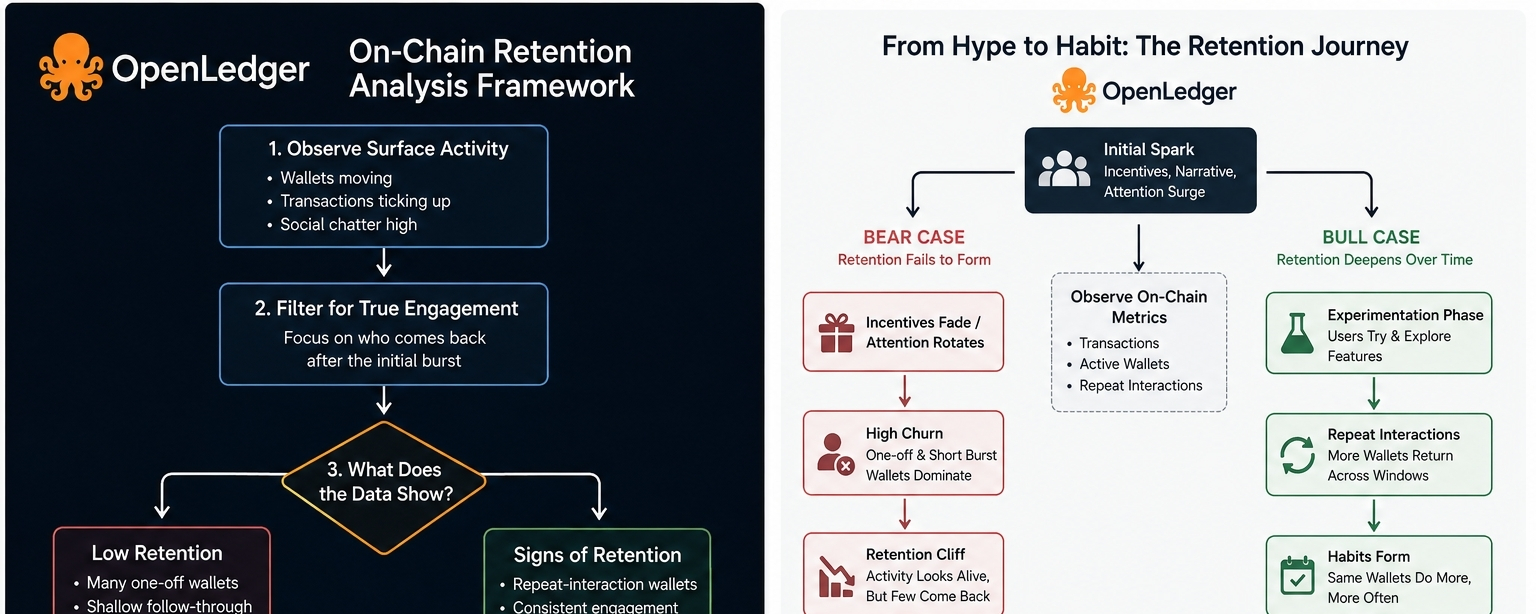
@OpenLedger I remember sitting there late, flipping between a couple of dashboards, thinking I’d finally found something worth tracking properly in AI-linked tokens. One of those days where everything looks active on the surface. Wallets moving, transactions ticking up, social chatter doing its usual thing. Then I filtered it down to something simpler: who actually came back after the initial burst?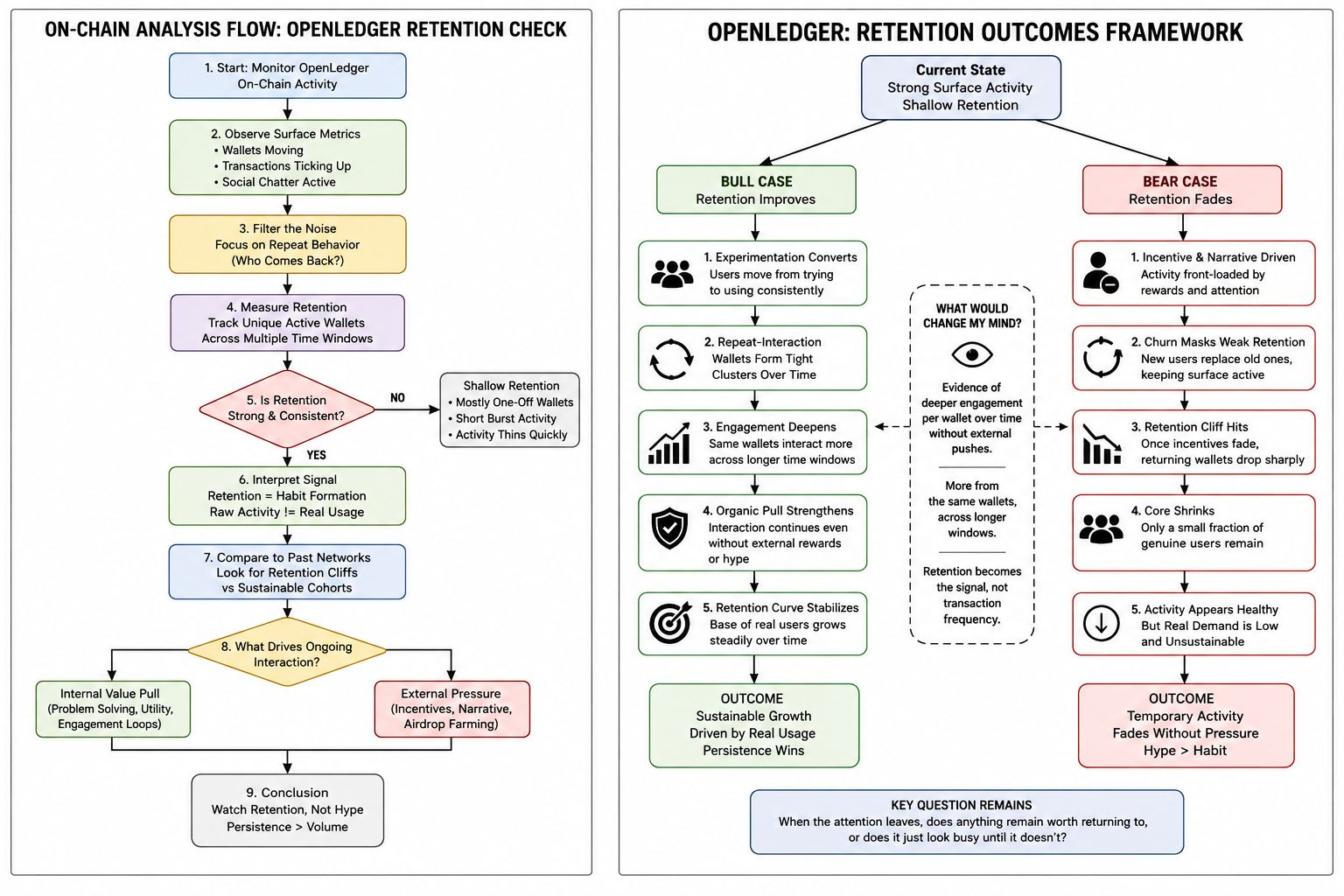
That’s when OpenLedger started to look different to me. Not in a loud way. In a quiet, slightly disappointing way that actually tells you more than hype ever does. I was watching on-chain activity tied to OpenLedger and expecting the usual pattern I’ve seen in most incentive-heavy networks. Spike, rotation, then a slow collapse in unique active wallets that stick around. What surprised me wasn’t that the early spike existed. That’s normal. It was how fast the follow-through thinned out once incentives cooled or attention rotated elsewhere.
Now here’s the thing traders often miss. Raw activity is easy to fake in these systems. Retention is not. If you strip away airdrop hunters and short-term farming behavior, what you’re left with is basically a stress test for whether people find ongoing value in interacting with the protocol. And when I looked at repeated interactions over multiple short time windows, the pattern wasn’t chaotic. It was just shallow. A lot of one-off or short burst wallets, not enough consistent return behavior.
That’s where my thinking shifted from “is this active” to “is this sticky at all without external pressure?”
Because if you’ve traded long enough, you stop trusting volume alone. You start asking how much of it is reflexive behavior versus actual usage. OpenLedger, from an on-chain perspective, feels like it’s still in that awkward phase where attention drives most of the measurable activity. The retention curve I’d expect in a system with strong end-user dependency just isn’t clearly there yet. And that matters more than people want to admit when they’re positioning early.
I’ll be honest, I like parts of what I see. The interaction patterns suggest experimentation. People are trying things, not just passively holding. But experimentation is not the same as habit formation. And retention is basically habit formation expressed in wallet behavior.
What frustrated me a bit was how easy it is to misread early metrics here. If you just look at transaction frequency, it can feel alive. But when you isolate recurring addresses, especially those that interact beyond a single cycle, the base looks thinner than the surface suggests. That gap is where traders get trapped, because they price momentum instead of persistence.
And persistence is what actually survives narrative cycles. I tried mapping it mentally against a couple of past networks I’ve followed. The ones that failed didn’t usually fail because nobody ever showed up. They failed because nobody stayed once the incentives flattened. That retention cliff is brutal, and it shows up late enough that early entrants often assume “it’ll improve with scale.” Sometimes it does. Often it doesn’t.
With OpenLedger, the question I keep coming back to is simple: if tomorrow there were no external rewards or attention, what percentage of current users would still interact with it in a meaningful way? On-chain data doesn’t fully answer that yet, but it hints at a dependency on rotation-driven activity rather than organic pull.
There is still a reasonable bull case though, and I don’t want to ignore it. The structure does support repeated interaction flows if adoption widens. If even a small fraction of current experimental users convert into consistent participants, the retention curve can stabilize faster than expected. In raw terms, I’m watching whether the repeat-interaction wallets start forming a tighter cluster over time instead of staying dispersed and episodic. That would signal that usage is shifting from curiosity to routine.
The bear case is more uncomfortable. It’s that current activity is heavily front-loaded by incentives and narrative exposure, and once that fades, the system reverts to a much smaller core of genuine users. In that scenario, on-chain metrics look deceptively healthy for a while because churn keeps refreshing the appearance of activity. Traders who don’t separate churn from retention end up overestimating real demand.
What would change my mind isn’t price action. It would be evidence of deepening engagement per wallet over time without external pushes. Not just more wallets, but the same wallets doing more, across longer windows. If that starts to show up consistently, then the retention problem starts resolving itself naturally. Until then, I treat every spike as temporary until proven otherwise.
And I’ve learned not to be polite about that conclusion. Markets punish politeness. Still, I keep watching it more than I expected to. Not because I think it’s clean or solved, but because retention is one of the few honest signals left in early-stage systems like this. Everything else can be engineered or gamed for a while. Retention usually can’t.
So I’m left in this in-between position. Not bullish enough to assume durability. Not dismissive enough to ignore the structure forming underneath the noise. Just tracking cohorts, returning wallets, and the slow question of whether this turns into something people actually come back to when nobody is pushing them to.
And that’s the only question I care about right now: when the attention leaves, does anything remain worth returning to, or does it just look busy until it doesn’t?