
There is something strangely frustrating about standing in a long line for something simple, only to realize the system itself was never designed to move efficiently. You wait, others wait, paperwork gets shuffled from one desk to another, and somehow the people who contribute the most effort often walk away with the least clarity about what they are actually receiving in return. What makes it more frustrating is not the delay itself, but the feeling that value exists somewhere in the process — time, effort, information, participation — yet it never seems to flow back fairly to the people who created it.
The more I think about systems like this, the more I notice how often modern technology quietly repeats the same pattern in different forms. Artificial intelligence, despite all its progress, increasingly feels like one of those spaces where immense value is constantly being generated, but ownership and movement of that value remain surprisingly unclear. Models improve because of user interactions. Data becomes useful because millions of people contribute signals, feedback, corrections, and behavior. Autonomous agents make decisions, interact, and create outcomes. Yet much of what is created stays trapped inside controlled environments where visibility exists, but liquidity does not.
This is where the idea behind OpenLedger becomes difficult to ignore. Not because it presents itself as another ambitious blockchain project — there are already too many of those — but because it asks a more uncomfortable question: what happens when intelligence creates value, but there is no functioning system for that value to move?
For years, conversations around blockchain have revolved around tokens, speculation, speed, scalability, and market cycles. At the same time, AI discussions became centered on model size, compute power, and breakthroughs in capability. Yet somewhere between these two worlds, an important structural issue quietly remained unresolved. If AI systems increasingly depend on data, contributors, models, and agents working together, who actually benefits from the economic activity produced?
The common assumption seems to be that innovation naturally distributes rewards over time. But history rarely works that way. Systems tend to concentrate value unless they are intentionally designed not to. In many industries, those closest to infrastructure capture disproportionate benefits, while contributors become invisible once their role feels replaceable. It is not difficult to imagine a future where billions of interactions train systems, improve outcomes, and generate intelligence, while most participants remain economically disconnected from what they helped create.
This is where OpenLedger becomes interesting — though not automatically convincing.
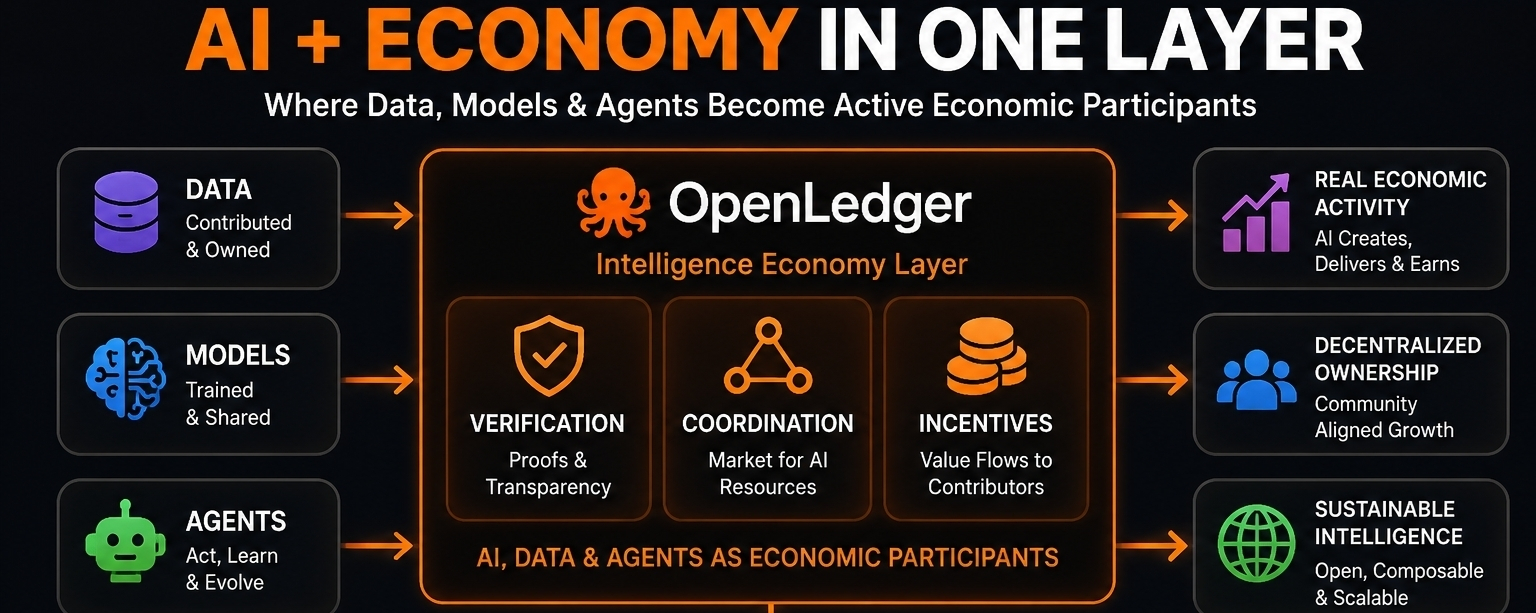
The project appears to focus on a broader interpretation of liquidity. Not simply liquidity in the traditional financial sense of trading assets, but liquidity of intelligence itself: data, models, and autonomous agents becoming economically active rather than structurally dormant. That distinction matters because it shifts attention away from speculative narratives and toward a more operational question: can intelligence become an asset class that actually circulates?
Most projects tend to approach AI with familiar patterns. Add branding around decentralization, mention ownership, introduce incentives, and assume participation will emerge naturally. But incentives without alignment often create distorted behavior. People optimize for rewards, not necessarily for quality. Data systems become vulnerable to manipulation. Models become noisy. Communities begin farming incentives instead of building meaningful contribution.
So the deeper question is not whether contributors can be rewarded. The harder question is whether a system can reward participation without damaging integrity.
Can an ecosystem monetize data without encouraging low-quality information? Can agents become economically productive without creating endless inefficiency? Can contributors remain fairly compensated while still maintaining standards? These are not technical problems alone. They are governance problems, economic problems, and perhaps even philosophical problems.
Because fairness and efficiency rarely move perfectly together.
A perfectly efficient system may centralize power because concentration creates speed. A perfectly fair system may slow down because broader participation creates friction. Somewhere in between sits the uncomfortable reality most real systems struggle to balance.
The more I look at OpenLedger, the more it feels like an attempt to sit inside that tension rather than pretending it does not exist.
If data becomes monetizable, who determines its value? If models become liquid assets, does intelligence become commoditized in ways we do not fully understand? If agents begin interacting economically with one another, what happens when optimization starts outperforming human intention? These questions matter because infrastructure decisions often shape behavior long before society notices the consequences.
There is also the risk of overestimating readiness. Many blockchain projects have historically assumed adoption happens simply because technology exists. But systems do not succeed because they are technically possible. They succeed when they solve friction that people genuinely feel. If monetizing intelligence remains too abstract, too complicated, or too disconnected from everyday incentives, even strong architecture may struggle to translate into meaningful adoption.
And yet, dismissing the problem entirely feels equally shortsighted.
Because one reality becomes harder to ignore each year: AI is already producing enormous amounts of value, while mechanisms for distribution remain surprisingly immature. We speak constantly about intelligence becoming more powerful, but far less about who participates economically in that intelligence. We discuss capability almost obsessively, while discussions around ownership, contribution, and movement of value still feel secondary.
Perhaps that imbalance explains why projects like OpenLedger are worth paying attention to — not necessarily because they have all the answers, but because they are asking questions many others seem comfortable avoiding.
Maybe the future of AI is not simply about building smarter systems. Maybe it is about building systems where value does not quietly stop at the top layer of infrastructure. Maybe liquidity itself needs to evolve beyond capital and into something broader: the ability for contribution, intelligence, and participation to actually move.
Still, skepticism remains healthy. Ambitious frameworks often sound elegant before reality exposes hidden weaknesses. Incentive structures break. Coordination becomes messy. Idealism collides with economics. The true test is rarely vision alone — it is whether structure survives pressure without abandoning its principles.
But if OpenLedger succeeds in even partially addressing this imbalance, it could force a larger conversation the industry has postponed for too long: in a world increasingly shaped by artificial intelligence, who truly owns the value intelligence creates?
And perhaps that is the most thrilling possibility here — not a sudden breakthrough, not another cycle of excitement, but the quiet emergence of a system that changes how value itself moves. Because if intelligence becomes the defining resource of the coming decade, then the systems deciding who benefits from it may matter far more than the intelligence alone.
