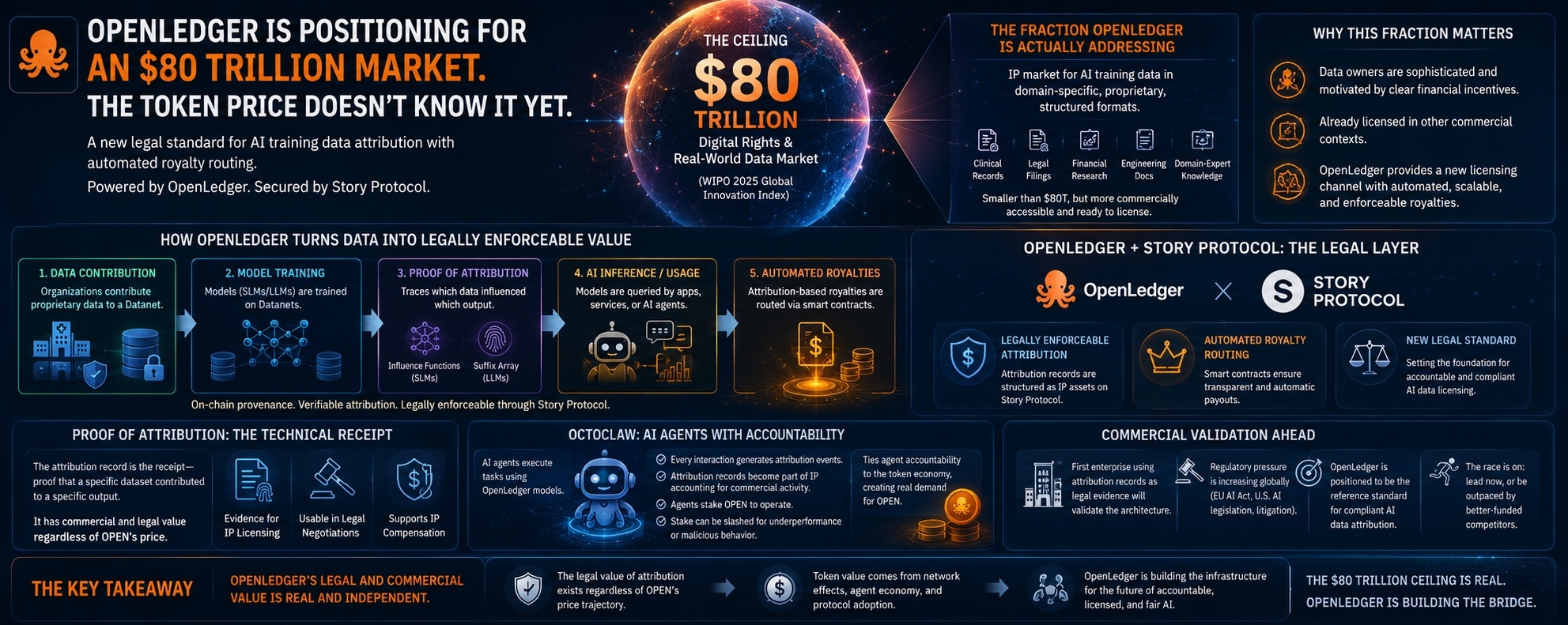
There is a number I want to start with and then complicate, because large numbers in crypto tend to be presented as validation rather than context. WIPO's 2025 Global Innovation Index estimated the digital rights and real-world data market at approximately $80 trillion. OpenLedger's January 2026 partnership with Story Protocol explicitly positions the project at the edge of that market by creating what both organizations describe as a new legal standard for AI training data attribution with automated royalty routing. The $80 trillion figure is a ceiling, not a projection. The actual addressable market for OpenLedger is a fraction of a fraction of that number. But understanding which fraction, and why it matters, is more useful than either accepting the number at face value or dismissing it.
The fraction that OpenLedger is actually addressing is the IP market specifically for AI training data in domain-specific, proprietary, structured formats. Not general web content, which is the training data at issue in the OpenAI and Google litigation. Not creative works like books and music, which are the focus of most media coverage of AI IP. The fraction OpenLedger is addressing is the clinical records, legal filings, financial research, engineering documentation, and domain-expert knowledge that organizations have spent decades and billions of dollars accumulating and that AI companies currently cannot access without either building trust with the data owners or risking litigation.
That fraction is smaller than $80 trillion. It is also more commercially accessible than the general web content market because the organizations that own this data are sophisticated, motivated by clear financial incentives, and already accustomed to licensing their proprietary information in other commercial contexts. A healthcare system that licenses its de-identified clinical records to pharmaceutical companies for drug research is already in the IP licensing business. OpenLedger's Story Protocol-integrated attribution system offers that healthcare system a new licensing channel: contribute the records to a Datanet, build or permit the building of clinical SLMs on those records, and receive attribution-based royalties through a legally enforceable framework every time those models are queried commercially.
The Proof of Attribution system is the technical layer that makes this licensing channel work. The June 2025 whitepaper describes how the system traces which training data influenced which model output using influence-function approximations for smaller specialized models and suffix-array-based token attribution for LLMs. In the IP licensing context, the attribution record is the receipt: proof that a specific dataset contributed to a specific output, legally structured through Story Protocol. That receipt has commercial value regardless of OPEN's price because it is the evidence underlying a legal claim. An organization could, in principle, use OpenLedger's attribution records to pursue IP compensation through legal channels even if they never hold a dollar of OPEN.
The uncomfortable implication of this architecture is that its legal value and its token value are somewhat independent. OPEN is the gas token for the OpenLedger L2, the mechanism for attribution rewards distribution, and the governance currency for protocol decisions. But the legal value of the attribution record exists regardless of what OPEN does. A hospital that contributes clinical data and receives legally enforceable attribution records for every AI inference that uses those records has obtained something of legal value regardless of OPEN's price trajectory. That independence is good for the hospital. It creates a partial decoupling of product utility from token value that the market does not currently appear to be pricing.
OpenLedger's OctoClaw agent platform, launched in May 2026, adds a new dimension to the IP attribution story. AI agents that execute autonomous tasks using OpenLedger's models generate attribution events for every model interaction. If those agents are operating in commercial contexts, producing outputs that have legal or financial value, the attribution records documenting which training data contributed to those outputs become part of the IP accounting for the commercial activity. The staking mechanism for agents, where AI agents must post OPEN that can be slashed for underperformance or malicious behavior, adds an accountability layer. Agents need to stake OPEN to operate, which ties agent accountability to the token economy in a way that creates a demand driver independent of the speculative narrative.
The Story Protocol partnership is still new enough that its commercial validation is ahead of us rather than behind us. The first enterprise customer that uses OpenLedger's attribution records as legal evidence in an IP licensing negotiation or legal proceeding will do more to validate the architecture than any technical announcement. That validation is coming because the underlying legal pressure on AI companies to account for their training data is not going away. The EU AI Act is adding regulatory requirements. U.S. AI legislation is developing. The litigation against frontier AI companies is establishing precedents. OpenLedger built its attribution infrastructure before those precedents are established, which means it is positioned to be the reference implementation for legally compliant AI training attribution. Whether that positioning translates into commercial leadership before better-funded competitors enter the space is the race the project is in.
@OpenLedger $OPEN #OpenLedger $ZEST